January 2013 in “Journal of Chengdu Medical College” In this study, Tolterodine Tartrate significantly improved symptoms of overactive bladder and showed fewer adverse reactions compared to the control group treatment.
 26 citations
,
October 2016 in “Case Reports in Dermatology”
26 citations
,
October 2016 in “Case Reports in Dermatology” In this study, tofacitinib treatment in a male patient with alopecia areata led to significant hair regrowth and improvement in nail dystrophy symptoms, restoring finger function within 10 months.
37 citations
,
January 1986 in “Carcinogenesis” This study found that TPA treatment transiently induces high levels of ODC in mouse epidermal cells, particularly around hair follicles, with localization reduced by retinoic acid or cycloheximide pretreatment.
2 citations
,
August 2020 in “CRC Press eBooks” This article discusses the impact of the tabby mutation on secondary vibrissae and hair follicle patterns in mice and reports no new clinical results.
March 2025 in “Journal of Investigative Dermatology” This study found that a traction alopecia prevention program for middle school students increased awareness and understanding of TA, but converting this awareness into changes in hairstyling habits proved challenging, highlighting the need for culturally sensitive strategies to influence behavior in at-risk communities.
1 citations
,
January 1987 in “Veterinary Dermatology” The study reported that topical 0.1% tacrolimus improved proliferative and necrotizing otitis externa in cats, with complete lesion resolution in some cases.
 86 citations
,
August 2011 in “Toxicological sciences”
86 citations
,
August 2011 in “Toxicological sciences” In this study, researchers found that TCDD exposure accelerated differentiation and altered gene expression in human epidermal cells, indicating the epidermal barrier as a target of TCDD-activated AHR.
 January 2025 in “International Journal of Dermatology”
 In this case report, a 14-year-old male with alopecia areata subtotalis and nail involvement showed significant improvement after 9 months of treatment with oral tofacitinib, including complete hair regrowth and nail texture improvement, though further studies are needed to confirm these findings.
This study identified the Arabidopsis cation chloride cotransporter CCC1 as essential for regulating pH and function in the trans-Golgi network/early endosome, with its absence causing significant growth and stress response defects.
 22 citations
,
January 1968 in “THE JOURNAL OF VITAMINOLOGY”
22 citations
,
January 1968 in “THE JOURNAL OF VITAMINOLOGY” This study found that α-tocopheryl acetate is well absorbed through healthy skin, with absorption occurring through specific pathways and showing high affinity for small blood vessels.
 September 2025 in “Tạp chí Da liễu học Việt Nam”
 This study found that both 2.5 mg/mL and 5 mg/mL concentrations of intralesional triamcinolone acetonide are effective for treating patchy alopecia areata, but the higher concentration promoted greater hair regrowth and density with more side effects.
 16 citations
,
January 2017 in “Acta dermatovenerologica Alpina, Pannonica et Adriatica (Tiskana izd.)”
16 citations
,
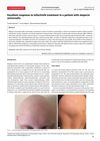
January 2017 in “Acta dermatovenerologica Alpina, Pannonica et Adriatica (Tiskana izd.)” This case study reports that a 23-year-old woman with alopecia universalis experienced complete hair regrowth after six months of treatment with tofacitinib, a JAK-3 inhibitor.
3 citations
,
March 2016 in “Practical radiation oncology” This paper reviews total skin electron therapy for mycosis fungoides and reports no new results; the authors focus on dose de-escalation's impact on toxicity and response rates.
 July 2025 in “Pakistan Journal of Intensive Care Medicine”
 In this randomized controlled trial, researchers observed that topical clobetasol propionate 0.05% was significantly more effective than topical tacrolimus 0.1% for treating alopecia areata, with a higher treatment success rate of 74.2% versus 45.2%, suggesting clobetasol as a preferred first-line topical therapy.
32 citations
,
August 2016 in “Journal of the American Academy of Dermatology” This letter discusses congenital triangular alopecia (TTA), a non-scarring hair loss condition often seen in children, without reporting new clinical findings.
December 2024 in “Journal of Pakistan Association of Dermatologists” This study found that in treating mild to moderate acne vulgaris, topical tazarotene 0.1% was more effective than topical adapalene 0.1%, with 100% of patients using tazarotene achieving the desired outcome compared to 75.3% in the adapalene group.
July 2024 in “Journal of Investigative Dermatology” ITK inhibitors may effectively treat alopecia areata.
April 2021 in “The journal of investigative dermatology/Journal of investigative dermatology” This study found that CTCF is crucial for proper skin and hair follicle development in mice, affecting keratinocyte differentiation and gene expression in keratin loci.
 61 citations
,
September 2010 in “Fitoterapia”
61 citations
,
September 2010 in “Fitoterapia” This study found that the EtOAc extract of Tridax procumbens aerial parts significantly inhibited rat paw edema and COX enzyme activity, suggesting its potential anti-inflammatory properties.
April 2012 in “Neuropediatrics” This article reviews the genetic and phenotypic characteristics of Trichothiodystrophy and discusses the associated DNA repair defects, but does not report new clinical findings.
1 citations
,
November 2016 in “Journal of dermatological treatment” In this report, two young patients with corticosteroid-refractory alopecia totalis experienced safety and efficacy from oral tacrolimus.
October 2025 in “Diagnostics” In this case study, an 18-year-old woman's triangular alopecic patch diagnosed as temporal triangular alopecia was considered non-progressive and had no impact on her quality of life, so no treatment was initiated.
April 2017 in “Leukemia research” This study reported that tofacitinib may be a promising treatment for alopecia areata in adolescents, showing significant hair regrowth with mild adverse effects in a retrospective review.
 June 2022 in “Frontiers in Immunology”
 This report describes a case of alopecia universalis successfully treated with tofacitinib, though it was associated with increased peripheral blood cytokine levels.
 24 citations
,
July 2016 in “Revue Neurologique”
24 citations
,
July 2016 in “Revue Neurologique” This review discusses treatment options for tics in Gilles de la Tourette syndrome, highlighting existing therapies and potential future advancements, but reports no new clinical findings.
November 2024 in “Actas Dermo-Sifiliográficas” This review outlines current treatment strategies for trichotillomania, noting that while cognitive-behavioral therapy is effective, N-acetylcysteine and memantine are also recommended due to their safety and efficacy, though evidence for other drugs like fluoxetine and naltrexone remains limited.
11 citations
,
May 2010 in “Pigment Cell & Melanoma Research” This study reviews the genetic mechanisms behind cat coat patterns, revealing that specific loci determine tabby variations and suggesting these patterns could unravel broader developmental and evolutionary biology insights.
2 citations
,
January 2015 6 citations
,
November 2020 in “JAAD Case Reports” This study identified overlapping genetic susceptibility loci in both alopecia areata and inflammatory bowel disease, specifically with Crohn's disease and ulcerative colitis.
September 2023 in “Journal of the American Academy of Dermatology” CTP-543 significantly improved eyebrow and eyelash regrowth and patient satisfaction in adults with alopecia areata.