January 2026 in “DR-NTU (Nanyang Technological University)” This study found that melanosomes extracted from human hair waste can effectively block UVA and UVB radiation when used as a natural UV filter in sunscreens, performing comparably to commercial UV filters and remaining stable in cosmetic formulations.
 5 citations
,
January 2010 in “International journal of trichology”
5 citations
,
January 2010 in “International journal of trichology” This report describes two cases of alopecia totalis treated with turban psoralen and sunlight exposure, but it provides no clinical outcome results.
3 citations
,
January 2010  10 citations
,
January 2014 in “Indian Dermatology Online Journal”
10 citations
,
January 2014 in “Indian Dermatology Online Journal” This study found that skin disorders, particularly cosmetic issues like acne and hair loss, are very common among medical students, with gender and place of origin significantly influencing the development of certain conditions.
 31 citations
,
January 2011 in “Dermato-endocrinology”
31 citations
,
January 2011 in “Dermato-endocrinology” This review updates the protective effects and molecular mechanisms of melatonin against ultraviolet-induced damage in human skin, reporting no new clinical findings.
1 citations
,
March 2003 in “Journal of Investigative Dermatology” Early sunburn treatment with certain inhibitors may reduce skin cancer risk.
 41 citations
,
July 2012 in “Stem Cells and Development”
41 citations
,
July 2012 in “Stem Cells and Development” This study found that low-dose UVB radiation enhances the survival, migration, and hair growth-promoting capacity of adipose-derived stem cells in mice through the generation of reactive oxygen species.
31 citations
,
February 1999 in “Dermatologic surgery” This report describes a case where solar-induced postinflammatory hyperpigmentation following laser hair removal was treated with a combination of topical treatments and serial TCA peels, resulting in only slight improvement.
20 citations
,
April 2019 in “BioMed Research International” This study found that DNA hypermethylation was present in melasma lesions, and treatments with sunscreen, niacinamide, and retinoic acid were associated with decreased methylation and clinical improvement.
 1 citations
,
January 2009 in “Elsevier eBooks”
1 citations
,
January 2009 in “Elsevier eBooks” This chapter provides an overview of skin physiology, aging effects, and how environmental factors like UV damage impact skin health, without presenting new research findings.
9 citations
,
December 2015 in “Journal of Dermatological Case Reports” A 12-year-old with ichthyosis linearis circumflexa showed significant improvement after 30 sessions of narrowband UVB phototherapy, as reported in this case study.
This review highlights recent advances in the use of light exposure for health purposes, examining its role in pathology, therapeutic strategies, and molecular changes, as well as discussing future developments in this globally supported field.
79 citations
,
December 2017 in “Cosmetics” This review study focused on various in vitro methods to evaluate skin permeation and retention of sunscreens, highlighting the importance of assessing sunscreen penetration due to widespread nanomaterial usage and advancements in cosmetic formulation.
31 citations
,
January 2014 in “The Scientific World JOURNAL” This study found that the water extract of Eclipta prostrata L. may protect skin cells against UVB-induced damage, likely due to its antioxidant properties and absorption of UVA and UVB radiation.
 9 citations
,
June 2019 in “Archives of Dermatological Research”
9 citations
,
June 2019 in “Archives of Dermatological Research” This study found that both topical calcipotriol and narrow band ultraviolet B phototherapy improved hair regrowth and vitamin D3 levels in alopecia areata patients.
October 2023 in “Cancers” In this retrospective study, patients with cutaneous squamous cell carcinoma located in highly sun-exposed areas had a higher risk of local recurrence compared to those with tumors in less sun-exposed areas, though metastasis rates did not differ between the groups.
 12 citations
,
January 2009 in “Journal of Oleo Science”
12 citations
,
January 2009 in “Journal of Oleo Science” The researchers reported that sterol surfactants with a bulky planar structure effectively solubilized ultraviolet ray absorbers, offering a stable solution more efficiently than other surfactants.
 January 2021 in “Journal of clinical and cosmetic dermatology”
 This review highlights the role of the skin's photosensory system in mediating responses to UVA radiation, contributing both to immediate protective effects and to broader circadian and seasonal adaptations, but reports no new experimental results.
 January 2024 in “Journal of tissue engineering”
 In this study, researchers used a human skin organoid model to show that solar UV exposure damages hair follicles and skin, while exosomes from mesenchymal stem cells reduced inflammation and supported hair follicle regeneration.
76 citations
,
January 2010 in “Journal of bone and mineral metabolism”  1 citations
,
December 2022 in “Exploration of Medicine”
1 citations
,
December 2022 in “Exploration of Medicine” This review discusses the antioxidant and photoprotective potential of Polypodium leucotomos for use as a natural sunscreen ingredient and reports no new experimental results; further studies are recommended to evaluate its effectiveness.
144 citations
,
December 2017 in “Pigment cell & melanoma research” This review suggests that melasma may be a photoaging skin disorder affecting genetically predisposed individuals, which could significantly influence its treatment and prevention strategies.
 437 citations
,
August 2014 in “Cell metabolism”
437 citations
,
August 2014 in “Cell metabolism” This perspective suggests that browning agents may not directly enhance UCP1 expression in white adipose tissue but instead induce browning through increased heat loss, prompting thermogenesis to compensate.
 March 2026 in “DergiPark (Istanbul University)”
 This study evaluated pregnant women's skincare and cosmetic usage habits, revealing that despite continued use during pregnancy, their awareness and practices of sun protection were insufficient. The researchers suggest that educational programs could improve knowledge on safe cosmetic choices and sun protection for expectant mothers.
In this study, the researchers reported two new cases of squamous cell carcinoma of the scalp following synthetic hair implantation, adding to existing concerns about the procedure's safety due to potential severe complications, though insufficient data exist to confirm a causal relationship.
 20 citations
,
September 2016 in “Journal der Deutschen Dermatologischen Gesellschaft”
20 citations
,
September 2016 in “Journal der Deutschen Dermatologischen Gesellschaft” This review discusses the addition of skin cancer caused by UV irradiation to the list of occupational diseases in Germany and reports no new clinical results.
 September 2019 in “Journal of Investigative Dermatology”
 This study reports that thermography and high-frequency ultrasound show promise as diagnostic tools for personalizing treatment plans in atopic dermatitis and psoriasis vulgaris by assessing skin lesion characteristics.
 26 citations
,
June 2018 in “Australasian Journal of Dermatology”
26 citations
,
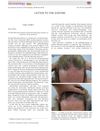
June 2018 in “Australasian Journal of Dermatology” Stopping sunscreen use on the forehead led to hair regrowth in a woman with frontal fibrosing alopecia.
 July 2024 in “Revista Científica de Estética e Cosmetologia”
 This study aimed to develop a dermocosmetic exfoliating formulation using babassu fibers for androgenetic alopecia treatment, but found that although the formulation met sensory standards, it was unstable in sunlight and heat, suggesting a need for optimization before commercialization.
 8 citations
,
March 2018 in “Cosmetics”
8 citations
,
March 2018 in “Cosmetics” In this study, researchers found that UV radiation causes hydroxy radicals to form cuticle holes specifically between the cuticle layers in wet hair, unlike random holes caused by Fenton's reaction.