 39 citations
,
January 2011 in “Archives of Dermatology”
39 citations
,
January 2011 in “Archives of Dermatology” This study found that the yellow dot pattern observed in dermoscopy of alopecia areata corresponds to inefficient follicular structures containing hair remnants, as corroborated by reflectance confocal microscopy and pathological findings.
 32 citations
,
March 2021 in “Journal of endocrinological investigation”
32 citations
,
March 2021 in “Journal of endocrinological investigation” This review covers the connection between thyroid diseases and skin conditions like alopecia, dermatitis, and vitiligo, and highlights the need for further research on the role of thyroid hormones in skin health.
 31 citations
,
July 2017 in “Clinical Science”
31 citations
,
July 2017 in “Clinical Science” This review discusses the role of microRNAs in skin function and potential therapeutic applications, emphasizing their importance in wound healing and disease management, though it reports no new experimental findings.
 31 citations
,
August 2005 in “The American Journal of Dermatopathology”
31 citations
,
August 2005 in “The American Journal of Dermatopathology” This study investigated the histopathology of ectodermal dysplasia/skin fragility syndrome, identifying specific skin and hair abnormalities associated with PKP1 gene mutations in two young female patients.
 28 citations
,
April 1996 in “Cell biology international”
28 citations
,
April 1996 in “Cell biology international” This review discusses changes in keratin structure or gene expression that result in various skin disorders and reports no new clinical findings.
 10 citations
,
November 2015 in “Experimental Dermatology”
10 citations
,
November 2015 in “Experimental Dermatology” The study observed that mRAGE expression is prevalent in keratinocytes of the healthy human epidermis and may regulate inflammation and apoptosis to maintain skin homeostasis rather than responding to aging processes.
 5 citations
,
October 2020 in “Experimental dermatology”
5 citations
,
October 2020 in “Experimental dermatology” This study reports that during late embryogenesis and early postnatal development, K79-expressing keratinocytes change and die independently of sebaceous glands to form the hair follicle opening, potentially influencing conditions like ingrown hairs or acne.
 5 citations
,
June 1994 in “Journal of Cutaneous Pathology”
5 citations
,
June 1994 in “Journal of Cutaneous Pathology” In this study, CD44 expression was absent in alopecia areata-affected scalp, with some patients regaining expression after treatment despite no significant hair regrowth, suggesting involvement in the disease's pathogenesis.
 1 citations
,
July 2016 in “Elsevier eBooks”
1 citations
,
July 2016 in “Elsevier eBooks” Understanding skin structure and development helps diagnose and treat skin disorders.
 1 citations
,
October 2012 in “Elsevier eBooks”
1 citations
,
October 2012 in “Elsevier eBooks” This article reviews advancements in understanding skin regeneration and suggests that bioengineering skin surrogates may soon enhance treatments for skin trauma, but it presents no new clinical findings.
 June 2017 in “Acta Scientiae Veterinariae”
 This case report documents a cat with necrolytic migratory erythema due to glucagonoma and diabetes mellitus, highlighting similarities to glucagonoma syndrome in humans.

This review discusses the roles and characteristics of skin stem cells, their niches, and signaling pathways in skin maintenance, aging, and cancer, highlighting their potential in therapeutic applications but presenting no new clinical findings.
 November 2025 in “International Journal for Research in Applied Science and Engineering Technology”
 This study describes the creation of a herbal hair oil using natural ingredients like curry leaves and hibiscus and found that the F1 oil formulation effectively reduces hair fall, removes dandruff, improves scalp blood flow, prevents early graying, and combats fungal infections.
 January 2018 in “Stem cell biology and regenerative medicine”
 This review discusses how the nuclear lamina integrates biochemical and mechanical signals to influence gene expression and skin homeostasis, but reports no new clinical results.
 28 citations
,
November 2013 in “The journal of investigative dermatology/Journal of investigative dermatology”
28 citations
,
November 2013 in “The journal of investigative dermatology/Journal of investigative dermatology” This study found that the selective PPARγ modulator GMG-43AC may inhibit unwanted hair growth by inducing catagen phase while preserving hair follicle epithelial progenitor cells, suggesting potential in anti-hirsutism therapy.
 March 2016 in “Institutional Repositories DataBase (IRDB)”
 This study discusses the effects of collagen hydrolysates and the dipeptide Pro-Hyp on gene expression related to hair and epidermis development in mouse skin and reports no new clinical results.
 January 1997 in “Elsevier eBooks”
 This review discusses the development and types of hair and nails as skin appendages and reports no new research findings.
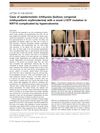 October 2011 in “Journal of dermatology”
 A man with a rare skin condition and a new gene mutation developed high calcium levels due to his treatment.
 118 citations
,
January 2016 in “Current Topics in Developmental Biology”
118 citations
,
January 2016 in “Current Topics in Developmental Biology” This essay discusses the establishment, maintenance, and role of skin stem cells in tissue homeostasis, wound repair, and their relation to skin cancer, without reporting new experimental findings.
 93 citations
,
April 2003 in “Proceedings of the National Academy of Sciences of the United States of America”
93 citations
,
April 2003 in “Proceedings of the National Academy of Sciences of the United States of America” This study identified an unexpected critical role for the FATP4 protein in skin and hair development in mice, linking it to a potential candidate gene for restrictive dermopathy in humans.
 67 citations
,
July 2016 in “Reviews in Endocrine and Metabolic Disorders”
67 citations
,
July 2016 in “Reviews in Endocrine and Metabolic Disorders” This review discusses the complex relationship between stress and various skin conditions, highlighting the role of the skin in the stress response and the brain-skin communication pathways, but reports no new research findings.
 53 citations
,
September 1999 in “The journal of cell biology/The Journal of cell biology”
53 citations
,
September 1999 in “The journal of cell biology/The Journal of cell biology” In this study, expressing human K16 in the epidermis of K14 null mice prevented early skin blistering but led to age-related anomalies, indicating K16 and K14 have distinct roles despite their sequence similarity.
 30 citations
,
November 2018 in “EMBO Reports”
30 citations
,
November 2018 in “EMBO Reports” This study found that the Ovol2-Zeb1 regulatory circuit is crucial for controlling directional migration and proliferation in epithelial cells, facilitating skin regeneration and repair in mice.
 18 citations
,
November 2020 in “Frontiers in Cell and Developmental Biology”
18 citations
,
November 2020 in “Frontiers in Cell and Developmental Biology” This review discusses how inflammation influences hair follicle stem cell activities like wound healing and follicle cycling and suggests a potential link between inflammation, stem cell activation, and programmed cell death.
 7 citations
,
December 2011 in “Annals of anatomy”
7 citations
,
December 2011 in “Annals of anatomy” This study found that involucrin likely plays a key role in forming the cornified material of the medulla and inner root sheath of human hair, contributing to its mechanical strength.
 1160 citations
,
November 2018 in “Physiological Reviews”
1160 citations
,
November 2018 in “Physiological Reviews” This review discusses the potential of single cell technologies to improve understanding and treatment of impaired wound healing and reports no new clinical results.
 218 citations
,
April 2008 in “Genes & Development”
218 citations
,
April 2008 in “Genes & Development” This research discusses how epithelial stem cells in the skin maintain normal homeostasis, contribute to wound repair, and highlights the importance of these processes, as defects can lead to skin diseases including cancers, but provides no new experimental results.
 185 citations
,
June 2011 in “Molecular and cellular endocrinology”
185 citations
,
June 2011 in “Molecular and cellular endocrinology” This review discusses the regulation and function of vitamin D and its receptor in skin cells, highlighting their roles in processes such as proliferation inhibition, differentiation, and innate immunity, but reports no new results.
 158 citations
,
August 2011 in “Reviews in endocrine and metabolic disorders”
158 citations
,
August 2011 in “Reviews in endocrine and metabolic disorders” This review examines the functions of vitamin D and its receptor in skin and explores how these are regulated, reporting no new clinical results.
 133 citations
,
September 2013 in “Nature Reviews Molecular Cell Biology”
133 citations
,
September 2013 in “Nature Reviews Molecular Cell Biology” Different types of stem cells and their environments are key to skin repair and maintenance.