12 citations
,
November 2012 in “Bulletin of experimental biology and medicine” Taxifolin-based treatments help skin heal after chemical burns.
15 citations
,
January 2013 in “Dermatologic Surgery” This study observed that white hair follicles in vitiligo patients may repigment following epithelial grafting and phototherapy, suggesting potential cosmetic improvements in vitiligo treatment.
 27 citations
,
May 2010 in “Dermatologic surgery”
27 citations
,
May 2010 in “Dermatologic surgery” This study found that photodynamic therapy with methyl 5-aminolevulinic acid was ineffective for treating alopecia totalis, even with microneedle rolling to enhance drug delivery.

This study found that an injectable hydrogel, SF-g-SDA, outperformed commercial Tegaderm™ in healing wounds, promoting collagen deposition, and enhancing neovascularization in animal models.

This case report suggests that scalp arteriovenous malformations can cause local hair loss, which may recover following ethanol embolization treatment.
5 citations
,
November 2023 in “Journal of Investigative Dermatology” This study observed that cutaneous microwounds created by fractional photothermolysis heal differently from typical wounds, displaying rapid re-epithelialization and limited inflammation, which may help reduce scar formation by delaying collagen remodeling and minimizing myofibroblast activation.
 March 2026 in “Portuguese Journal of Dermatology and Venereology”
 This study observed an unexpected case where a 44-year-old woman developed linear scalp pigmentation, resembling a tattoo, after undergoing a microneedling procedure followed by hair dyeing two days later, emphasizing the need to advise patients on avoiding hair dye application soon after such treatments.
6 citations
,
April 2023 in “Frontiers in Bioengineering and Biotechnology” In a murine burn wound model, this study found that an enhanced fractal self-pumping dressing significantly reduced wound area and tissue edema by efficiently draining excess exudates.
19 citations
,
January 2020 in “Journal of Biophotonics” This study found that using a PEG-400/oleic acid mixture as an optical clearing agent enhanced the detection depth of particles in skin without causing dehydration, based on tests in rats and further testing in vivo.
 2 citations
,
March 2023 in “Frontiers in Bioengineering and Biotechnology”
2 citations
,
March 2023 in “Frontiers in Bioengineering and Biotechnology” This study found that CuO/SiO2 nanowires enhanced with photothermal therapy exhibit significant antibacterial effects against E. coli and S. aureus and promote wound healing and vascularization, suggesting potential as an alternative treatment for infected wounds in mouse models.
 January 2023 in “Indian Dermatology Online Journal”
 This article reviews the indications for micropigmentation in dermatological conditions like stable vitiligo and alopecia, but presents no new clinical results.
19 citations
,
September 2023 in “Journal of Biomedical Science” This review explores how the interaction of AKT and β-catenin signaling pathways, alongside photobiomodulation effects on cellular signaling proteins, could potentially enhance diabetic wound healing by addressing dysregulated cellular signaling.
 March 2026 in “Research Square”
 This study developed a novel regenerative platform using nanozyme-enabled materials combined with exosomes and laser stimulation to enhance wound healing in a mouse model, which more effectively regulated reactive oxygen species and improved early angiogenesis and collagen organization compared to conventional methods.
 23 citations
,
March 1998 in “Dermatologic Surgery”
23 citations
,
March 1998 in “Dermatologic Surgery” This narrative discusses the use of radiosurgery in cosmetic procedures and reports no new clinical results.
2 citations
,
June 2023 in “Clinical Cosmetic and Investigational Dermatology” In this study, post-treatment with DCO was found to speed up epidermal wound healing after micro-needling of 3D skin models while maintaining the treatment's immunostimulatory benefits, potentially optimizing aftercare and reducing patient recovery time.
June 2026 in “Journal of Cutaneous Pathology” This study found that polarized light microscopy is more effective than diffractive microscopy in distinguishing scarring from non-scarring alopecia, providing a highly specific adjunct diagnostic tool for alopecia biopsy specimens.
 January 2022 in “Skin appendage disorders”
 This case report describes a unique occurrence of alopecia totalis resulting in pigmented hair growth over superficial scalp veins in an adult female using augmented betamethasone dipropionate ointment.
 June 2025 in “Clinical Cosmetic and Investigational Dermatology”
 In this case report, a 42-year-old man with radiation-induced alopecia following endovascular embolization for a cerebral arteriovenous fistula experienced complete hair regrowth after three months of treatment with intramuscular corticosteroids and topical 5% minoxidil, suggesting a novel therapeutic approach for faster recovery.
3 citations
,
October 2018 in “Journal of cosmetic dermatology” This study found that intralesional pentoxifylline injections were effective for localized alopecia areata, with the best results observed when combined with triamcinolone acetonide.
 April 2025 in “Journal of Biomedicine and Translational Research”
 This case report describes the successful treatment of a post-excisional biopsy dehisced wound in an 11-year-old girl using 1% framycetin sulphate tulle combined with ozonated oil as adjuvant therapy, leading to wound healing with some complications like secondary cicatricial alopecia.
53 citations
,
October 1998 in “The journal of investigative dermatology/Journal of investigative dermatology” This study found that cyclophosphamide induced significant keratinocyte apoptosis in anagen hair follicles of mice, while topical calcitriol-analogs reduced this apoptosis, suggesting a protective effect against chemotherapy-induced alopecia.
 11 citations
,
June 2005 in “Journal of Cosmetic Dermatology”
11 citations
,
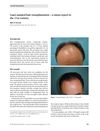
June 2005 in “Journal of Cosmetic Dermatology” Lasers in hair transplantation show promise but are not yet standard, with current methods causing some side effects and needles still being preferred for creating recipient sites.
 4 citations
,
September 2012 in “Journal of Nanoscience and Nanotechnology”
4 citations
,
September 2012 in “Journal of Nanoscience and Nanotechnology” In this experimental study, there was no impact of the surrounding ferromagnetic film on the magnetization reversal processes in submicrometric antidot arrays, though a significant increase in coercivity was observed.
 May 2022 in “Annals of Oncology”
 This study found that photobiomodulation may accelerate hair regrowth one month after chemotherapy in breast cancer patients, but no significant differences were observed at two and three months post-therapy.
5 citations
,
October 2020 in “Veterinary record case reports” In this case report, a 15-year-old golden retriever with calcinosis cutis showed accelerated improvement in FLE-treated skin infections compared to untreated areas, highlighting FLE's potential as a treatment adjunct.
1 citations
,
November 2011 in “InTech eBooks” This review discusses the challenges of anticoagulation in hemodialysis, including the limitations and risks of current methods, and emphasizes the need for better solutions, but reports no new clinical results.
 May 2025 in “Afyon Kocatepe University Journal of Sciences and Engineering”
 The researchers monitored various pollutants in real cosmetics industry wastewater and reported high removal efficiencies for parameters like Chemical Oxygen Demand and heavy metals through coagulation-flocculation, yet suggested that more effective COD treatment alternatives are necessary to better protect the environment and human health.
In this study, a novel CT@GA-gel hybrid hydrogel was developed for diabetic wound treatment, demonstrating improved mechanical properties, tissue adhesion, and chronic wound healing benefits, including immune regulation and re-epithelialization, due to enhanced crosslinking and ROS scavenging by incorporated carbon dots.
22 citations
,
November 2022 in “Materials & Design” This study found that using a combination of Alginate-TEMPO-oxidized cellulose nanofiber-α-tocopherol membranes and Pluronic-α-tocopherol hydrogels facilitated better wound healing in diabetic rats through enhanced angiogenesis and no observable toxicity compared to using each treatment individually.
August 2026 in “Materials Technology” This study developed a multifunctional TA-MoS2-SF hydrogel for diabetic ulcer treatment, demonstrating enhanced photothermal bactericidal effects, immune environment remodeling, and fibroblast proliferation, suggesting it may serve as an effective 'antibacterial-immunomodulatory-repair' strategy.