 April 2023 in “The journal of investigative dermatology/Journal of investigative dermatology”
 This study found that an E-cadherin mutant preserved normal cadherin levels and prevented inflammation and lethality in mouse skin lacking p120, highlighting p120's role in regulating cadherin-mediated cell adhesion and inflammation.
June 2003 in “Clinical orthopaedics and related research” This case study reports a rare instance of Majocchi's granuloma caused by Candida, highlighting the patient's diabetes mellitus and kidney transplant as predisposing factors for the infection.
28 citations
,
November 2012 in “Experimental dermatology” This study suggests that mTORC1 may play a role in regulating the timing of hair growth cycle phases, particularly the initiation of the anagen phase.
3 citations
,
March 2024 in “iScience” This study found that long-lived proteins in mice, identified across various tissues, may be linked to neurodegenerative and cardiovascular diseases due to their low renewal rate and increased risk of damage.
 16 citations
,
March 2016 in “The journal of investigative dermatology/Journal of investigative dermatology”
16 citations
,
March 2016 in “The journal of investigative dermatology/Journal of investigative dermatology” In this study, researchers observed that a noncanonical mechanism involving the γ-secretase-dependent, RBPj-independent Notch intracellular domain improves survival in Msx2-Cre mice by delaying hair follicle destruction and reducing disease severity.
 11 citations
,
January 2013 in “Methods in molecular biology”
11 citations
,
January 2013 in “Methods in molecular biology” This study describes a method for labeling and tracking hair follicle stem cells in mouse skin using a Cre/lox recombination system with tamoxifen, providing insights into stem cell behavior and contribution to tissue regeneration.
 71 citations
,
January 2015 in “Journal of molecular cell biology/Journal of Molecular Cell Biology”
71 citations
,
January 2015 in “Journal of molecular cell biology/Journal of Molecular Cell Biology” This study found that mTOR signaling plays a crucial role in activating hair follicle stem cells by balancing BMP-mediated repression, essential for hair regeneration.
 1 citations
,
July 2023 in “Nature communications”
1 citations
,
July 2023 in “Nature communications” This study found that deleting the Mof gene in mouse skin leads to severe defects in skin cell self-renewal, differentiation, and hair follicle growth, indicating that MOF is crucial for mitochondrial and ciliary gene expression and essential for skin development.
 20 citations
,
May 2013 in “International Journal of Molecular Medicine”
20 citations
,
May 2013 in “International Journal of Molecular Medicine” This study identified a novel missense MAFB variant in a family with some unaffected members, suggesting incomplete penetrance and the potential influence of modifier genes, epigenetic mechanisms, or environmental factors on MCTO phenotype.
 October 2025 in “JOURNAL OF CLINICAL AND DIAGNOSTIC RESEARCH”
 This case report details a 77-year-old man initially suspected of having multiple myeloma but ultimately diagnosed with Waldenstrom’s Macroglobulinaemia, highlighting the importance of accurate differential diagnosis for conditions like epistaxis and high serum IgM.
8 citations
,
March 2024 in “Regenerative Therapy” This study found that using uniform poly(lactic-co-glycolic) acid microspheres to deliver insulin-like growth factor 1 stabilizes the protein and enhances its sustained delivery, supporting stem cell functions comparably to traditional methods, and showing potential for tissue and organ regeneration.
1 citations
,
October 2024 in “Canine Medicine and Genetics” This study suggests a potential genetic component in CFA among Ridgeback dogs, but MLPH genotyping did not identify the MLPH gene as a contributing factor.
 6 citations
,
September 2023 in “Experimental physiology”
6 citations
,
September 2023 in “Experimental physiology” In this study, researchers identified the PLD-mGluR protein in primary mechanosensory terminals as the homomeric GluK2 kainate receptor, functioning purely metabotropically, which is suggested to be common to various sensory endings.
3 citations
,
December 2024 in “Journal of Animal Science” In this study, researchers identified the lncRNA MSTRG.14227.1 in cashmere goats and found it inhibits the morphogenesis of secondary hair follicles by interacting with the chi-miR-433/ADAMTS3 signaling axis, affecting cashmere yield and quality.
40 citations
,
March 1991 in “Journal of Investigative Dermatology”  11 citations
,
March 2014 in “Journal of Investigative Dermatology”
11 citations
,
March 2014 in “Journal of Investigative Dermatology” In this study, basal cell carcinoma developed in Ptch-deficient mice only after chemical treatment, not skin wounding, suggesting a second unknown event is necessary for tumor formation.
 5 citations
,
October 2019 in “The journal of investigative dermatology/Journal of investigative dermatology”
5 citations
,
October 2019 in “The journal of investigative dermatology/Journal of investigative dermatology” This study identified a high-risk allele in the PLCD1 gene associated with hereditary trichilemmal cyst formation, proposing a monoallelic two-hit mechanism as the underlying genetic pathogenesis.
 October 2011 in “Journal of dermatology”
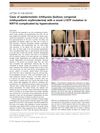
 A man with a rare skin condition and a new gene mutation developed high calcium levels due to his treatment.
27 citations
,
September 2015 in “Drug Design Development and Therapy” This study suggests that type IV collagenases, MMP-2 and MMP-9, play important roles in the hair cycle by regulating the expression of VEGF, IGF-1, and TGF-β in mice.
 June 2026 in “Strathprints: The University of Strathclyde institutional repository (University of Strathclyde)”
 In this study, researchers found that inhibiting IKKα in patient-derived CCS tumour models reduces tumour viability, supporting the potential for topical IKKα inhibitors as a treatment for CCS.
4 citations
,
January 2021 in “Current Research in Physiology” This study found that high levels of μ-crystallin in skeletal muscle are associated with greater fat metabolism and a shift in gene expression towards slower muscle function.
August 2001 in “The Journal of Cell Biology” In this study, the researchers identified a third keratin 6 gene in mice and developed a double knockout model that could aid in hair growth research.
15 citations
,
September 2018 in “Applied Biological Chemistry” This review discusses the development of Matrigel and its role in identifying thymosin beta 4 as a regenerative protein, without reporting new experimental findings.
53 citations
,
January 1953 in “The journal of nutrition/The Journal of nutrition” This study found that newborn mice deprived of colostrum developed disorders linked to zinc deficiency, and administering inorganic zinc prevented these conditions.
2 citations
,
August 2022 in “Viruses” This study found that cutaneous squamous cell carcinomas in mice infected with murine papillomavirus preferentially arise from Lgr5+ progenitor cells, while squamous cell dysplasia does not.
March 2026 in “Acta Histochemica” 1 citations
,
February 2019 in “bioRxiv (Cold Spring Harbor Laboratory)” This study identified lymphatic vessels as crucial components of the hair follicle stem cell niche, coordinating connections and contributing to hair follicle regeneration in mice.
 2 citations
,
January 2019 in “Annals of Dermatology”
2 citations
,
January 2019 in “Annals of Dermatology” This preliminary study found that Melandrium firmum extract may promote hair growth and inhibit 5α-reductase, suggesting potential as a candidate for treating androgenetic alopecia.
4 citations
,
February 2023 in “Stem Cell Research & Therapy” This study found that papillary dermal fibroblast progenitors in newborn mouse skin can be isolated and cultured to generate male germline cell precursors, demonstrating their potential through differentiation into cells with meiotic capability.
 40 citations
,
April 2014 in “Genes & Development”
40 citations
,
April 2014 in “Genes & Development” The researchers reported that in mice, prolactin signaling in the skin epithelium inhibits hair follicle stem cell activation, promoting quiescence during periods of high serum prolactin like pregnancy and lactation.