July 2025 in “Journal of Investigative Dermatology” Baricitinib stops hair loss and promotes regrowth in alopecia areata.
 66 citations
,
June 2021 in “Journal of The American Academy of Dermatology”
66 citations
,
June 2021 in “Journal of The American Academy of Dermatology” In this phase 2 study, baricitinib at 2 mg and 4 mg doses significantly improved hair regrowth in adults with alopecia areata and ≥50% scalp hair loss compared to placebo, without new safety concerns, although the small sample size limits the results' generalizability.
 1 citations
,
April 2017 in “Journal of Investigative Dermatology”
1 citations
,
April 2017 in “Journal of Investigative Dermatology” This study found that oral tofacitinib led to variable hair regrowth in patients with resistant alopecia areata, implying that longer treatment durations may be needed to fully assess its effectiveness.
 14 citations
,
August 2007 in “Bioorganic & Medicinal Chemistry Letters”
14 citations
,
August 2007 in “Bioorganic & Medicinal Chemistry Letters” This study reported that the compound (1R, 2S)-4-(2-cyano-cyclohexyl-oxy)-2-trifluoromethyl-benzonitrile effectively stimulated hair growth in mice and reduced sebum production in hamsters.
2 citations
,
November 2004 in “Hospital pharmacy” This article reviews adverse drug reactions, emphasizes methods of prevention, and encourages reporting to the FDA's medWatch program, but presents no new study findings.
July 2026 in “Journal of Investigative Dermatology” Tanshinone Capsule may help regrow hair by boosting specific cell signals.
2 citations
,
November 2019 in “Jurnal Penelitian Perawat Profesional” This literature review concludes that mulberry, with its rich anthocyanin, phenolic, and antioxidant content, may serve as an effective adjuvant therapy for preventing and managing obesity by reducing body fat levels.
 40 citations
,
September 2018 in “Journal of the American Academy of Dermatology”
40 citations
,
September 2018 in “Journal of the American Academy of Dermatology” This letter discusses the emerging use of Janus kinase inhibitors, specifically oral tofacitinib, for treating alopecia areata in children, but reports no new clinical findings.
110 citations
,
April 2009 in “Cell Motility and the Cytoskeleton” This review discusses the intracellular activity of β-thymosins and their role in modulating the actin cytoskeleton, but it reports no new experimental results.
 2 citations
,
April 2023 in “Expert Review of Clinical Immunology”
2 citations
,
April 2023 in “Expert Review of Clinical Immunology” This review details how baricitinib successfully demonstrated significant hair regrowth in clinical trials for severe alopecia areata, now leading to its approval as the first systemic therapy for the condition, while also highlighting the importance of assessing individual risk factors for adverse events.

This study analyzed Reddit discussions on JAK inhibitors and found that a small number of users contribute most of the conversational content, highlighting the need for expert oversight in interpreting health information shared online.
October 2014 in “Cancer research” This study found that targeting mTORC1 with rapamycin effectively inhibited skin tumor promotion in a mouse model, highlighting a potential target for cancer chemoprevention.
 56 citations
,
February 2006 in “American journal of physiology. Cell physiology”
56 citations
,
February 2006 in “American journal of physiology. Cell physiology” This study observed that in hormone-starved prostate cancer cells, the androgen 5alpha-dihydrotestosterone rapidly induces matriptase activation and shedding, which involves androgen receptor signaling and requires both transcription and protein synthesis.
 16 citations
,
January 2017 in “Acta dermatovenerologica Alpina, Pannonica et Adriatica (Tiskana izd.)”
16 citations
,
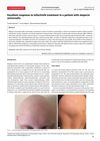
January 2017 in “Acta dermatovenerologica Alpina, Pannonica et Adriatica (Tiskana izd.)” This case study reports that a 23-year-old woman with alopecia universalis experienced complete hair regrowth after six months of treatment with tofacitinib, a JAK-3 inhibitor.
 February 2024 in “Planta”
 This study found that TRM21 acts as a positive regulator of flavonoid biosynthesis at the translational level in Arabidopsis, leading to changes in root hair growth and a decrease in flavonoid content when TRM21 is mutated.
4 citations
,
November 2015 in “Research Journal of Medicinal Plant” This study found that ethanolic, aqueous, and hydroethanolic extracts of Tridax procumbens inhibited mitosis and caused mutagenic effects on cell division in Allium cepa root meristematic cells.
 238 citations
,
November 2016 in “Journal of The American Academy of Dermatology”
238 citations
,
November 2016 in “Journal of The American Academy of Dermatology” In this study, tofacitinib was reported to improve scalp hair regrowth in patients with severe alopecia areata, alopecia totalis, and alopecia universalis, showing a higher response in alopecia areata.
 136 citations
,
April 2013 in “Clinical Cancer Research”
136 citations
,
April 2013 in “Clinical Cancer Research” The study found that IPI-926 was well tolerated up to 160 mg once daily for 28-day cycles and showed activity as a single-agent treatment in Hedgehog pathway inhibitor-naïve patients with basal cell carcinoma.
 25 citations
,
October 2019 in “JAAD Case Reports”
25 citations
,
October 2019 in “JAAD Case Reports” This article discusses the role of interleukin-15 and Janus kinase inhibitors in alopecia areata based on a murine model and reports no new experimental results.
 4 citations
,
December 2024 in “Clinical Cosmetic and Investigational Dermatology”
4 citations
,
December 2024 in “Clinical Cosmetic and Investigational Dermatology” This study suggests that combining baricitinib with narrowband UV-B therapy is an effective and well-tolerated approach for treating active nonsegmental vitiligo.
May 2025 in “OPAL (Open@LaTrobe) (La Trobe University)” The researchers reported that in a mouse model of alopecia areata, tofacitinib treatment influenced disease progression by modulating CD8+ T cell infiltration through the linoleic acid metabolism and magnesium ion pathway, offering insights into potential treatment approaches.
This study found that radiofrequency microneedling significantly enhanced the absorption of topical triamcinolone acetonide, with insertion depth being more influential than RF energy levels.
5 citations
,
May 2025 in “Journal of the American Academy of Dermatology” March 2005 in “Journal of the American Academy of Dermatology” Recognizing minor skin lesions can help identify serious cancer syndromes.
 February 2026 in “Clinical Drug Investigation”
 In this study, patients with severe alopecia areata who were treated with baricitinib 4 mg/day for 48 weeks showed significant improvements in both hair regrowth and nail abnormalities, although the correlation between hair and nail improvement was weak.
 September 2024 in “Skin Appendage Disorders”
 This case report describes a 21-year-old woman with circumscribed alopecia areata incognita, who experienced a sustained positive response to treatment with oral tofacitinib after conventional treatments frequently failed to provide lasting effects.
 January 2020 in “bioRxiv (Cold Spring Harbor Laboratory)”
 This study found that the ethyl acetate extract of Semecarpus anacardium leaves demonstrated cytotoxicity against MCF-7 cancer cells and induced apoptosis, suggesting potential as a cancer treatment with fewer side effects.
 March 2026 in “Dermatology Online Journal”
 Medicaid coverage for alopecia areata treatments is inconsistent and often limited.
 1 citations
,
May 2021 in “Annals of the rheumatic diseases”
1 citations
,
May 2021 in “Annals of the rheumatic diseases” This study found that tofacitinib may be effective for treating pediatric rheumatic diseases, with especially promising results in patients with autoinflammatory diseases, arthritis and alopecia, and juvenile dermatomyositis.
January 2008 in “中山醫學大學醫學研究所學位論文” This study found that Danthron induced apoptosis in a human malignant melanoma cell line through mitochondrial, endoplasmic reticulum, and death receptor pathways.