 1 citations
,
May 2024 in “Cureus”
1 citations
,
May 2024 in “Cureus” This case series describes five patients with rare facial lichen planopilaris, detailing the clinical presentation and treatment of their pigmentary changes and scarring alopecia.
 September 2022 in “The American Journal of Dermatopathology”
 This study found that IL-17 expression was significantly higher in perifollicular fibrosis of active Lichen planopilaris lesions, suggesting that targeting IL-17 could impact the disease's progression.
113 citations
,
May 2007 in “Journal of the American Academy of Dermatology” This study suggests that tetracycline may be more effective for treating lichen planopilaris than previously thought, alongside topical high-potency and intralesional corticosteroids.
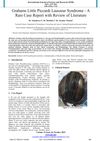 October 2023 in “International Journal of Science and Research (IJSR)”
 This paper describes Grahams Little Piccardi Lassueur Syndrome, a rare type of Lichen Planopilaris that causes different types of alopecia and distinctive skin papules, primarily affecting females aged 40 to 70, and notes the current challenges in treatment options, particularly once scarring occurs.
 1 citations
,
July 2021 in “Curēus”
1 citations
,
July 2021 in “Curēus” This case report describes a rare occurrence of lichen planopilaris in a nine-year-old child, emphasizing the need for awareness of this condition in the pediatric population.
 5 citations
,
April 2014 in “The American Journal of Dermatopathology”
5 citations
,
April 2014 in “The American Journal of Dermatopathology” This article reports on a typical case of lichen planopilaris with foreign-body granulomas around hair shaft material, suggesting these may be an additional criterion for diagnosing late-stage LPP/FFA.
158 citations
,
June 2014 in “Journal of Lipid Research” This review summarizes recent discoveries of GPCRs for lysophosphatidylserine and lysophosphatidylinositol, detailing their roles as lipid mediators, but reports no new experimental results.
 6 citations
,
January 2016 in “Skin appendage disorders”
6 citations
,
January 2016 in “Skin appendage disorders” This case report describes a 38-year-old male with scarring body hair loss as the sole manifestation of lichen planopilaris, characterized by progressive alopecia and preceding itching.
October 2024 in “Skin Appendage Disorders” This study found that lichen planopilaris is associated with several environmental factors, such as stress and hair dye use, as well as thyroid disorders and genetic components.
 4 citations
,
May 2020 in “Journal of The American Academy of Dermatology”
4 citations
,
May 2020 in “Journal of The American Academy of Dermatology” This letter argues that cicatricial pattern hair loss likely represents end-stage androgenetic alopecia and not a variant of lichen planopilaris, as previously suggested.
 March 2020 in “Clinical research in dermatology”
 This report describes two unusual cases of lichen planopilaris in Caucasian patients, detailing features suggestive of folliculotropic mycosis fungoides and an overlap with systemic lupus erythematosus.
1 citations
,
September 2020 in “Journal of dermatology” This study identified a novel mutation and confirmed a previous mutation in the LIPH gene in a woman with autosomal recessive woolly hair, expanding the mutation spectrum for this condition.
3 citations
,
December 2023 in “International Journal of Nanomedicine” Repaglinide-loaded liponiosomal hybrids improve blood sugar control and insulin release better than regular Repaglinide.
 April 2023 in “Journal of Investigative Dermatology”
 In this study, the KPAI and KP-IGA scoring systems for assessing keratosis pilaris showed excellent interrater and intrarater reliability, offering standardized measures for clinical and research use.
39 citations
,
November 2017 in “PubMed” This case series reported that low-dose naltrexone may benefit patients with lichen planopilaris by reducing scalp symptoms and slowing disease progression, with no adverse effects observed in the patients.
7 citations
,
June 2009 in “Journal of the European Academy of Dermatology and Venereology” This study found that in lichen planopilaris, the basement membrane zone of the hair follicles exhibited disrupted and discontinuous staining patterns, potentially contributing to scarring and irreversible hair loss.
 14 citations
,
May 2018 in “Journal of the American Academy of Dermatology”
14 citations
,
May 2018 in “Journal of the American Academy of Dermatology” This paper reviews treatments for lichen planopilaris, including low-level laser therapy, but reports no new clinical results and highlights the need for further research.
1 citations
,
December 2017 in “Annals of Dermatological Research” This case report highlights that dermatoscopy and histopathological analysis were crucial for accurately diagnosing Lichen Planopilaris in two patients, leading to a correct diagnosis after initial misdiagnoses.
 June 2024 in “International Journal of Dermatology”
 This article in the International Journal of Dermatology reports on a case series where the drug upadacitinib was used to treat patients with recalcitrant lichen planopilaris, but no abstract or detailed results are provided to assess its efficacy or safety fully.
 April 2026 in “American Journal of Dermatopathology”
 This study identified a new dermoscopic feature, plexiform erythema, in lichen planopilaris lesions, suggesting it may indicate active disease and the potential need for more aggressive treatment.
1 citations
,
July 2024 in “Journal of lasers in medical sciences” This case study reports that treating a female patient with facial partial unilateral lentiginosis using a 532-nm Nd:YAG fractional picosecond laser resulted in significant improvement in pigmentation without notable side effects, indicating it may be an effective and well-tolerated treatment option.
12 citations
,
November 2023 in “Skin Appendage Disorders” This study suggests that although data on JAK inhibitors for treating LPP and FFA is mainly from retrospective studies and case reports, these inhibitors may offer a new treatment option, particularly for challenging cases.
April 2021 in “The journal of investigative dermatology/Journal of investigative dermatology” This study examined clinical characteristics of lichen planopilaris and frontal fibrosing alopecia in 24 men, revealing common scalp symptoms, frequent beard involvement, and limited association with thyroid disease.
 1 citations
,
September 2013 in “The Journal of Dermatology”
1 citations
,
September 2013 in “The Journal of Dermatology” An 8-year-old girl developed a rare skin condition in a linear pattern on one side of her body after a lung infection, which improved with treatment.
 August 2016 in “Journal of Investigative Dermatology”
 This case report identifies a novel LIPH gene mutation linked to autosomal recessive woolly hair/hypotrichosis in a Japanese boy, expanding the spectrum of known mutations associated with this condition.
April 2024 in “International Journal of Women’s Dermatology” This study suggests that lichen planopilaris should be considered as a potential diagnosis in African American women with scarring alopecia, often displaying an "arrowhead" distribution pattern, which may guide treatment strategies.
 8 citations
,
July 2020 in “Journal of The American Academy of Dermatology”
8 citations
,
July 2020 in “Journal of The American Academy of Dermatology” Patients with Lichen Planopilaris are more likely to have rosacea and skin cancer but less likely to have congestive heart failure, stroke, and glaucoma.
1 citations
,
December 2024 in “Archives of Iranian Medicine” This study found that tofacitinib significantly improved disease activity in most patients with LPP, though further research is needed to refine protocols, understand response predictors, and address gender-specific adverse effects.
 16 citations
,
October 2014 in “Journal of the American Academy of Dermatology”
16 citations
,
October 2014 in “Journal of the American Academy of Dermatology” This study found that oral retinoid therapy may provide clinical improvement in a small percentage of patients with treatment-resistant lichen planopilaris, although it is not commonly used as a first-line treatment.
 May 2015 in “Journal of The American Academy of Dermatology”
 Mycophenolate mofetil may improve symptoms and stop hair loss in Lichen planopilaris, but more research is needed.