 7 citations
,
February 2004 in “Clinical and Experimental Ophthalmology”
7 citations
,
February 2004 in “Clinical and Experimental Ophthalmology” This case report details a 65-year-old woman who developed malignant melanoma in her right eye socket following previous eye trauma, treated by orbital exenteration.
 4 citations
,
April 2023 in “JURNAL FARMASI DAN ILMU KEFARMASIAN INDONESIA”
4 citations
,
April 2023 in “JURNAL FARMASI DAN ILMU KEFARMASIAN INDONESIA” This study evaluated green tea extract-loaded spanlastic formulations and found that a vesicle builder to edge activator ratio of 8:2 produced optimal characteristics, including a particle size of 419.70 nm, an entrapment efficiency of 60.85%, and a drug loading of 11.07%.
 4 citations
,
January 2015 in “Journal of analytical & bioanalytical techniques”
4 citations
,
January 2015 in “Journal of analytical & bioanalytical techniques” This study developed a rapid and sensitive method for determining finasteride concentrations in pharmaceuticals, with results comparable to those from the standard HPLC method.
 3 citations
,
May 2010 in “Victorian literature and culture”
3 citations
,
May 2010 in “Victorian literature and culture” This article discusses the substantial presence of advertising material in the original serial numbers of "The Pickwick Papers," accounting for almost one third of the content, but presents no new results.
 2 citations
,
March 2025 in “International Journal of Advanced Science and Engineering”
2 citations
,
March 2025 in “International Journal of Advanced Science and Engineering” This review highlights that nanoemulsions, especially those with droplet sizes under 200 nm, show promise in pharmaceuticals and cosmetics by improving drug stability, bioavailability, and reducing side effects, with potential applications in CNS diseases, cancer treatments, and skincare products.
 1 citations
,
December 2022 in “Middle East Journal of Science”
1 citations
,
December 2022 in “Middle East Journal of Science” This review covers hair dye formulations, their mechanisms, and potential applications, but reports no new findings; the authors highlight the process of oxidative dyeing and repairing damaged hair.
1 citations
,
July 2020 in “Reviews in separation sciences” This study developed a simple method to determine finasteride, indapamide, and tiemonium methylsulfate in pharmaceuticals by using their ability to form silver nanoparticles measurable via spectrophotometry.
 December 2025 in “Journal of Pharma Insights and Research.”
 This paper reviews the state of knowledge on injectable cryogels, highlighting their unique properties such as shape-memory and mechanical integrity, which allow for minimally invasive delivery via needles and potential applications in oncology and regenerative medicine.
 November 2025 in “Communications Materials”
 This research demonstrated that transforming pomelo peel into expanded sponges and carbonized aerogels can accelerate hemostasis and enhance healing in diabetic wounds while eradicating bacterial biofilms, offering an eco-friendly solution for wound care from agricultural waste.
 October 2024 in “International Journal of Pharmaceutical Sciences Review and Research”
 This study reviewed existing literature on Androgenetic Alopecia treatments, finding that minoxidil promotes hair growth but can cause side effects due to its traditional formulations. Novel delivery systems like film-forming sprays may reduce these side effects and enhance efficacy.
 March 2022 in “Marmara University Open Access System”
 This article critically examines the relationship between new media and digital games, emphasizing their cultural and historical contexts, but provides no new empirical findings.
 October 2020 in “Veterinary Dermatology”
 This review discusses autoimmune blistering diseases across species and highlights new treatment efficacy findings and ongoing trials, but it reports no new clinical results.

This handbook of dermatology provides a comprehensive practical manual for dermatologists, but reports no new research findings.
 July 2017 in “Contemporary Endocrinology”
 This article discusses the ongoing care needs for individuals with 21-hydroxylase deficiency due to mutations in the CYP21A2 gene but does not present new clinical findings.
 62 citations
,
February 2016 in “ACS Applied Materials & Interfaces”
62 citations
,
February 2016 in “ACS Applied Materials & Interfaces” This study found that 3D microtissue models of dermal papilla cells can enhance the ability to induce hair-follicle neogenesis in vivo, offering potential for controlled cell production in follicle regeneration.
 48 citations
,
April 2013 in “Expert Opinion on Investigational Drugs”
48 citations
,
April 2013 in “Expert Opinion on Investigational Drugs” This article reviews emerging treatments for androgenetic alopecia, including topical 5-alpha-reductase inhibitors and prostaglandin modulators, but reports no clinical results and calls for further efficacy evidence, especially for PRP.
22 citations
,
September 2024 in “Human Reproduction Update” This study found that total testosterone and free testosterone are recommended as first-line tests for diagnosing biochemical hyperandrogenism in women with PCOS; liquid chromatography with tandem mass spectrometry is preferred for its accuracy.
 16 citations
,
May 2015 in “Tissue Engineering Part C-methods”
16 citations
,
May 2015 in “Tissue Engineering Part C-methods” This study found that expanding hair follicle keratinocytes with a fibroblast feeder followed by short-term coculture with dermal papilla cells could restore their ability to form new hair follicles.
 15 citations
,
June 2015 in “Human Cell”
15 citations
,
June 2015 in “Human Cell” This study found that forming spheroids using silicone micro-wells improved the viability and neural differentiation potential of human adipose-derived stem cells after thawing.
 9 citations
,
May 2021 in “International Journal of Dermatology”
9 citations
,
May 2021 in “International Journal of Dermatology” In this study, sublingual tofacitinib achieved a longer estimated half-life than oral administration in treatment-resistant alopecia areata patients, potentially supporting daily dosing; overall treatment response was modest.
 8 citations
,
January 2020 in “Skin Pharmacology and Physiology”
8 citations
,
January 2020 in “Skin Pharmacology and Physiology” This article discusses the potential for topical caffeine as a natural alternative for treating androgenetic alopecia due to its ability to penetrate skin, but it reports no new clinical findings.
 7 citations
,
June 2020 in “Experimental dermatology”
7 citations
,
June 2020 in “Experimental dermatology” This study identified key lipid differences between black and white hair in individuals with premature greying, highlighting vitamin D3 as a potential target for further research in understanding this condition.
 2 citations
,
September 2022 in “Advances in Environmental Biology”
2 citations
,
September 2022 in “Advances in Environmental Biology” This study found that ethanolic extracts of Avicennia marina leaves showed potential antibacterial activity against Vancomycin-Resistant Enterococcus faecium but were less effective than standard antibiotics.
 2 citations
,
January 2017 in “Plant”
2 citations
,
January 2017 in “Plant” This study found that in vitro extracts of Glycyrrhiza glabra root are strong antioxidants, particularly in ethanolic form, and contain secondary metabolites, but only showed mild antibacterial activity.
 March 2026 in “Open MIND”
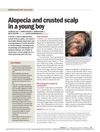
 Early treatment of scalp infections can prevent permanent hair loss.

This study introduced a rapid rehydration approach for creating customizable, multifunctional hydrogel sensors, enabling precise detection of surface deformations and easy integration of layers, highlighting its potential for standardized and adaptable manufacturing of wearable devices.
 October 2024 in “Российский физиологический журнал им И М Сеченова”
 This study explores the neurobiology and genetics of barbering (hair and whisker biting) in laboratory rodents, and its potential links to stress, aggression, grooming, and stereotypic behaviors, highlighting its significance in experimental work with these animals.
 November 2023 in “Regenerative Biomaterials”
 This study developed a degradable and bioactive citrate-based polyurethane adhesive that achieves rapid and strong tissue adhesion, exhibiting improved bonding strength in wet environments, biocompatibility, biodegradability, and hemostatic properties, with potential to enhance wound healing by promoting angiogenesis.
 September 2023 in “Journal of Cosmetic Dermatology”
 This study found that patients with alopecia areata who have low vitamin D levels and high CRP levels are more likely to develop the universalis form of the condition, indicating a need for more aggressive treatment in these cases.
 September 2021 in “Research Square (Research Square)”
 This study found that measuring specific steroid hormone levels can aid in diagnosing P450 oxidoreductase deficiency, a subtype of congenital adrenal hyperplasia, by distinguishing affected patients from healthy individuals.