45 citations
,
August 1954 in “Experimental Biology and Medicine” This study found that vitamin A dissolved in alcohol penetrates skin quickly and does not impair hair growth, even in large doses, but it does not retard keratinization unlike when dissolved in fatty acids.
44 citations
,
August 1990 in “PubMed” This study provides evidence for K1 and K10 derivatives' presence in the inner root sheath and hair cuticle, suggesting that these hair follicle parts may follow familiar keratinization principles.
 42 citations
,
October 2009 in “The journal of investigative dermatology/Journal of investigative dermatology”
42 citations
,
October 2009 in “The journal of investigative dermatology/Journal of investigative dermatology” In this study, researchers identified two distinct homozygous mutations in the KRT85 gene among consanguineous Pakistani families with pure hair and nail ectodermal dysplasia, highlighting variations in severity and potential impacts on the K85 protein function.
41 citations
,
October 2001 in “Experimental Dermatology” This review discusses the molecular and functional aspects of the nude gene in skin biology, providing insights into its role and evolutionary development, but reports no new results.
41 citations
,
July 1994 in “Journal of Dermatological Science” This review examines the differentiation potential of epithelial cells from various sources in hair follicle formation, concluding that complex interactions are required for hair-specific characteristics, which were achieved in vivo but not in vitro.
30 citations
,
November 2012 in “Proceedings of the Royal Society B Biological Sciences” This study found that the keratin matrix in mammalian hard α-keratins is crucial for maintaining stiffness in water by controlling intermediate filament hydration.
30 citations
,
April 2009 in “Mycoses” This study found that the fungus Microsporum gypseum enzymatically degrades keratin in human hair, with the sequence of degradation reflecting the keratinization and cystine content of individual hair components in vitro.
28 citations
,
August 2005 in “Journal of Investigative Dermatology” TG5 helps maintain hair follicle health, while TG3 aids in hair shaft development.
 25 citations
,
October 1996 in “Dermatologic Clinics”
25 citations
,
October 1996 in “Dermatologic Clinics” This article discusses loose anagen syndrome, highlighting its characteristics, diagnostic methods, and spontaneous improvement over time, but provides no new clinical results.
25 citations
,
October 1962 in “Journal of Ultrastructure Research” The hair follicle structure is more complex than thought, with new findings on protein formation.
 23 citations
,
March 1989 in “The Veterinary clinics of North America. Food animal practice”
23 citations
,
March 1989 in “The Veterinary clinics of North America. Food animal practice” This review discusses dermatological issues in llamas, detailing common findings, parasites, and disorders, but reports no new clinical results; it highlights the need for recognizing normal skin variations and discusses potential treatments like zinc therapy for certain conditions.
18 citations
,
October 2024 in “Medical Science Monitor” This review discusses the mechanisms of skin barrier impairment in acne vulgaris and suggests strategies for its repair but reports no new clinical results.
17 citations
,
November 1967 in “American Journal of Anatomy” This study observed that the catagen phase in hairless mice displayed a slower shortening of the mutant epithelial column, resulting in longer total follicle length and abnormalities in the connective tissue sheath and glassy membrane.
16 citations
,
August 2000 in “Il Farmaco” This study observed that tryptophan levels in human hair are higher in males than females, increase with age, and vary with hair color, being highest in grey and white hair.
 13 citations
,
January 2007 in “Epilepsia”
13 citations
,
January 2007 in “Epilepsia” This case report describes a 47-year-old woman who experienced reversible curling of her hair during treatment with valproic acid, suggesting potential side effects on hair texture.
13 citations
,
January 1953 in “Archives of Dermatology” This research article discusses unsaturated compounds causing temporary hair loss in lab animals and reports no new results; previous studies indicated similar effects in humans.
12 citations
,
January 2000 in “Biochemical and Biophysical Research Communications” This study characterized the intron-exon organization of human keratin 15 and keratin 19 genes to aid future mutation detection analyses related to potential genetic disorders of keratinization.
12 citations
,
September 1997 in “PubMed” This review explores how vitamin D3 analogs could target various skin processes and diseases, potentially offering selective and effective treatments beyond psoriasis, but reports no new clinical findings.
10 citations
,
October 2018 in “JDDG Journal der Deutschen Dermatologischen Gesellschaft” This review discusses the skin and systemic conditions associated with Down syndrome and reports no new clinical results, emphasizing the need for awareness of these manifestations in diagnosis.
9 citations
,
August 2021 in “International journal of molecular sciences” This study found that loss of epidermal PPARγ in mice altered the expression of many genes related to skin inflammation, keratinization, and sebaceous gland function, indicating its key role in maintaining skin homeostasis.
 9 citations
,
August 2007 in “Journal of animal science/Journal of animal science ... and ASAS reference compendium”
9 citations
,
August 2007 in “Journal of animal science/Journal of animal science ... and ASAS reference compendium” This study observed that amino acid uptake into wool follicles varies significantly, with cysteine showing the highest uptake rate, suggesting specialized transport systems that may influence wool growth.
9 citations
,
September 1977 in “Journal of Small Animal Practice” In this study, gamma benzene hexachloride washes successfully resolved skin disease in guinea pigs affected by Trixacarus caviae, after confirmation via skin scrapings.
7 citations
,
September 1980 in “Zoological Journal of the Linnean Society” This study observed that dermal dendritic cells migrate to the epidermis in mouse tail and back skin, correlating with changes in epidermal physiology like ortho- and parakeratosis.
6 citations
,
December 2019 in “International Journal of Cosmetic Science” This study found that tryptophan fluorescence in natural white hair is significantly weaker than in other unpigmented keratin fibers, possibly due to greater environmental UV exposure or unknown chemical interactions.
6 citations
,
July 2017 in “Clinical and Experimental Dermatology” This report presents four new cases of follicular porokeratosis, which exhibit distinct histological features where the cornoid lamella are confined to the follicular ostia.
6 citations
,
January 2015 in “Indian Dermatology Online Journal” This case report describes a unique presentation of porokeratotic eccrine ostial and dermal duct nevus with lesions on the dorsum of the hand and a focal lichenoid infiltrate, differing from typical palm and sole involvement.
6 citations
,
November 1984 in “Acta Dermato Venereologica” This study investigated the immunohistochemical characteristics of keratin proteins in epidermal appendages, finding variable staining patterns in different skin structures and tumor cells, which suggests differences in keratinization.
 5 citations
,
May 2021 in “International Journal of Cosmetic Science”
5 citations
,
May 2021 in “International Journal of Cosmetic Science” This review discusses the evidence for a cause-and-effect relationship between scalp condition and hair condition, and reports no new clinical results from trials.
 5 citations
,
January 2017 in “Anais brasileiros de dermatologia/Anais Brasileiros de Dermatologia”
5 citations
,
January 2017 in “Anais brasileiros de dermatologia/Anais Brasileiros de Dermatologia” This review reports two new cases of porokeratotic eccrine and hair follicle nevus and analyzes all known cases in the Spanish and English literature, suggesting a link to a GJB2 gene mutation.
 5 citations
,
January 2014 in “Journal of Cutaneous and Aesthetic Surgery”
5 citations
,
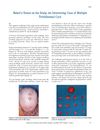
January 2014 in “Journal of Cutaneous and Aesthetic Surgery” A woman had 13 non-cancerous cysts on her scalp successfully removed in one surgery.