7 citations
,
September 1997 in “PubMed” This study found that Finasteride treatment significantly reduced dihydrotestosterone and epidermal growth factor levels in benign prostatic hyperplasia tissue, particularly in the periurethral zone, while Flutamide decreased epidermal growth factor but not dihydrotestosterone.
January 2025 in “Case Reports in Oncological Medicine” This case report emphasizes the need to consider Sertoli-Leydig cell tumors in the differential diagnosis of adnexal masses in patients with Peutz-Jeghers syndrome, noting that these tumors can present unusually with bilateral adnexal involvement.
This review summarizes the potential of single traditional Chinese medicines and extracts in preventing and treating renal fibrosis, emphasizing their capacity to inhibit transforming growth factor β and reduce extracellular matrix formation, but it reports no new clinical results.
 1 citations
,
June 2021 in “Revista de la Facultad de Ciencias Médicas de Córdoba”
1 citations
,
June 2021 in “Revista de la Facultad de Ciencias Médicas de Córdoba” This case report describes a postmenopausal woman with virilization linked to ovarian stromal hyperthecosis, highlighting the importance of detailed clinical evaluation and complementary testing for accurate diagnosis and treatment.
This review outlines diagnostic and treatment approaches for hirsutism, highlighting spironolactone or cyproterone acetate with oral contraceptives as the most effective therapy, and reports no new empirical results.
 October 2023 in “Research Review”
 This source describes the development, structure, and types of skin appendage tumors, noting both benign and malignant forms, potential associations with syndromes, and categories based on follicular differentiation.
January 2011 in “Shandong yiyao” This analysis concluded that preoperative finasteride significantly reduced blood loss during transurethral resection of the prostate by potentially decreasing the expression of VEGF and microvessel density.
1 citations
,
August 2021 in “NeoReviews” This case report describes a successful outcome for a fetus with a neck mass attributed to unnecessary maternal PTU treatment for transient hyperthyroidism, highlighting the importance of accurate diagnosis and careful management.
 75 citations
,
October 1999 in “European journal of endocrinology”
75 citations
,
October 1999 in “European journal of endocrinology” This study found that both finasteride and flutamide effectively reduce hirsutism in women with polycystic ovary syndrome or idiopathic hirsutism, but flutamide was more effective.
 39 citations
,
May 2011 in “European Journal of Clinical Investigation”
39 citations
,
May 2011 in “European Journal of Clinical Investigation” This review discusses the various causes of hirsutism other than PCOS, emphasizing the importance of distinguishing potentially life-threatening conditions like androgen-secreting tumors from more benign causes; it reports no new clinical findings.
 January 2023 in “Scholars journal of applied medical sciences”
 This study found that polycystic ovary syndrome and idiopathic hirsutism are the main causes of hirsutism in the women studied at a gynecology clinic, accounting for about 94% of cases.
June 2015 in “Obstetrics, gynaecology and reproductive medicine” This article reviews the causes, physiology, and treatment strategies for hirsutism in women, highlighting that effective management often requires addressing underlying conditions and may involve lifestyle changes and pharmacological interventions.
 April 2020 in “Journal of the Endocrine Society”
 This case report highlights Leydig cell hyperplasia as a rare cause of increased testosterone and postmenopausal hirsutism, resolved after bilateral salpingo-oophorectomy in a 64-year-old woman.
June 2026 in “Journal of Clinical Gynecology and Obstetrics” In this cross-sectional study, researchers found that routine office hysteroscopy is not recommended for infertile women with PCOS who have normal transvaginal ultrasonography, though it may be useful for detecting subtle intrauterine pathology in long-standing infertility cases.
 18 citations
,
September 2015 in “Clinical Endocrinology”
18 citations
,
September 2015 in “Clinical Endocrinology” This study found that women with polycystic ovary syndrome have higher serum VEGF-B levels, which are linked to insulin resistance and decrease after metformin treatment.
 51 citations
,
November 2011 in “Reproductive Biology and Endocrinology”
51 citations
,
November 2011 in “Reproductive Biology and Endocrinology” In this study of reproductive-aged women in Tehran, idiopathic hirsutism and polycystic ovary syndrome were reported to be prevalent, with rates influenced by the screening methods used.
 98 citations
,
July 2011 in “Fertility and Sterility”
98 citations
,
July 2011 in “Fertility and Sterility” This study determined that an mFG score of 5 or greater defines hirsutism among Southern Chinese women, with prevalence and score thresholds decreasing with age.
2 citations
,
June 2025 in “Preprints.org” This review highlights the potential of amphiregulin as a therapeutic target, noting its role in both fibrotic and malignant diseases, and discusses promising early findings but reports no new clinical results.
May 2018 in “Journal of Saidu Medical College Swat” The study observed that among Afghan women attending a gynecology outpatient department, the majority of those with hirsutism exhibited associated gynecological issues and were primarily categorized as having idiopathic causes or Polycystic Ovarian Disease.
 May 2021 in “Journal of the Endocrine Society”
 This case report describes the rare association of an ovarian Leydig cell tumor and primary hyperparathyroidism in a postmenopausal woman, highlighting the importance of considering rare causes in patients with virilizing symptoms.
 1 citations
,
June 2014 in “International Journal of Dermatology”
1 citations
,
June 2014 in “International Journal of Dermatology” This correspondence discusses follicular mucinosis in association with pregnancy but does not report new clinical results, instead calling attention to the observed connection.
September 2024 in “Dermatologica Sinica” This article describes a 10-month-old female with congenital smooth muscle hamartoma, highlighting the importance of differential diagnosis in congenital skin lesions due to potential malignancy risks.
20 citations
,
December 1994 in “Fertility and sterility” In this study, treatment with flutamide combined with a low-dose oral contraceptive significantly improved hirsutism in women with polycystic ovarian disease who did not respond to oral contraceptive treatment alone.
June 2015 in “Sonography” This case report describes a rare instance of multiple sebaceous cysts over the scrotum in a 22-year-old man, highlighting the effectiveness of ultrasound imaging for diagnosis and the need for surgical intervention in severe cases.
33 citations
,
May 2015 in “JAMA Dermatology” This study identifies comedonal or cystic fibrofolliculomas as novel diagnostic clues for earlier recognition of Birt-Hogg-Dube syndrome, potentially facilitating timely surveillance of associated systemic complications.
June 2002 in “Current obstetrics and gynaecology/Current obstetrics & gynaecology” This article discusses various causes and treatment options for hirsutism in women, highlighting the effectiveness of cyproterone acetate and the importance of weight reduction, without presenting new research findings.
 1 citations
,
February 2016 in “European Journal of Obstetrics & Gynecology and Reproductive Biology”
1 citations
,
February 2016 in “European Journal of Obstetrics & Gynecology and Reproductive Biology” This case study reports that medical imaging of the ovaries may not always conclusively identify the cause of postmenopausal hyperandrogenism, as demonstrated by a patient with a rare condition.
June 2023 in “Dermatopathology” In this case report, researchers described a unique skin lesion in a 55-year-old woman, identifying it as folliculosebaceous cystic hamartoma with an unusual combination of spindle cell lipomatous and neural components, which had not been previously documented in such cases.
 January 2019 in “Skin appendage disorders”
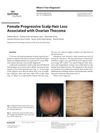
 This report presents a rare case where a bilateral ovarian thecoma in a postmenopausal woman led to an unusual pattern of female androgenetic alopecia mimicking male pattern hair loss.
1 citations
,
October 2022 in “Current Opinion in Endocrinology, Diabetes and Obesity” This review discusses the diagnosis, management, and clinical challenges of female pattern hair loss in PCOS patients but reports no new clinical findings, highlighting the need for further research and multidisciplinary care.