
This article reports a rare case of a postmenopausal woman with coexisting lichen planus pigmentosus and classic lichen planopilaris, alongside a review of related literature.
July 2025 in “Ultrasound in Medicine & Biology” This study found that nanobubble-encapsulated diclofenac with ultrasound-targeted microbubble destruction (DNBs-UTMD) can enhance the anti-tumor efficacy of Doxil® by regulating the tumor immune microenvironment, improving drug uptake, and increasing T cell responses while reducing immune-suppressive cells in the process.
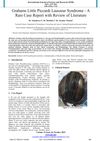 October 2023 in “International Journal of Science and Research (IJSR)”
 This paper describes Grahams Little Piccardi Lassueur Syndrome, a rare type of Lichen Planopilaris that causes different types of alopecia and distinctive skin papules, primarily affecting females aged 40 to 70, and notes the current challenges in treatment options, particularly once scarring occurs.
January 2025 in “International journal of research studies in biosciences” This abstract discusses the prevalence and forms of lichen planopilaris, a type of scarring hair loss, but reports no new clinical findings.
January 2012 in “RepositóriUM (Universidade do Minho)” This study reported that a modified nanoprecipitation protocol can effectively create PLA nanoparticles capable of delivering compounds into hair follicles, with promising potential for hair follicle therapy and cosmetic applications.
49 citations
,
July 2007 in “Ophthalmic Plastic and Reconstructive Surgery” This report describes a case of granulomatous reaction to injectable poly-L-lactic acid in the periorbital area and suggests surgical excision as an effective treatment for persistent nodules.
6 citations
,
June 1994 in “Journal of Animal Science” This study found that none of the depigmenting compounds tested in beef heifers produced a permanent depigmenting effect, though visible depigmentation lasted up to 3 months.
5 citations
,
January 2024 in “Fermentation” This study found that fermenting porcine and equine placentas with a specific lactic acid bacterial strain enhanced the moisturizing abilities and cell proliferation properties compared to traditional placental extracts, suggesting their potential for cosmetic applications.
 August 2018 in “Journal of Investigative Dermatology”
 This case report describes the first known instance of dermatomyositis-related panniculitis in the neck and mediastinal region, effectively treated with corticosteroids, dapsone, and colchicine.
9 citations
,
November 2021 in “PubMed” This study found that FDA-approved low-level light/laser therapy devices significantly increased hair density in individuals with pattern hair loss compared to sham devices.
 April 2018 in “Journal of Investigative Dermatology”
 This study found that the PPAR-γ modulator AGED can reverse epithelial-mesenchymal transition in hair follicles affected by lichen planopilaris ex vivo, suggesting potential for treating scarring alopecias.
 April 2020 in “Journal of The American Academy of Dermatology”
 This letter highlights concerns about transient lymphadenopathy as a potential adverse effect of platelet-rich plasma combined with microneedling for alopecia, emphasizing the need to understand its underlying cause.
 15 citations
,
May 2015 in “Photomedicine and Laser Surgery”
15 citations
,
May 2015 in “Photomedicine and Laser Surgery” This review assesses low-level laser therapy in plastic surgery and reports that it may improve flap survival and burn scars, but lacks efficacy for venous ulcers, alopecia, and skin aging.
78 citations
,
October 2007 in “Journal of Investigative Dermatology” Delta1 is crucial for controlling skin cell growth and preventing tumors in mice.
 June 2024 in “International Journal of Dermatology”
 This article in the International Journal of Dermatology reports on a case series where the drug upadacitinib was used to treat patients with recalcitrant lichen planopilaris, but no abstract or detailed results are provided to assess its efficacy or safety fully.
This study found that low-level laser therapy may enhance wound healing and reduce pain, swelling, and inflammation by increasing mitochondrial activity and oxidative stress, leading to greater protein synthesis and cell proliferation.
 19 citations
,
May 2016 in “Clinical, cosmetic and investigational dermatology”
19 citations
,
May 2016 in “Clinical, cosmetic and investigational dermatology” In this study, applying FGF-2-containing dalteparin/protamine nanoparticles to the scalp was associated with a significant increase in hair diameter over six months among participants with thin hair.
16 citations
,
December 2022 in “Expert Opinion on Drug Delivery” This study reviewed preclinical and clinical research and found that AFL-assisted topical drug delivery is considered safe and effective, enhancing drug efficacy, reducing treatment time and pain, and improving cosmetic and safety outcomes, but larger clinical trials are needed to confirm these benefits.
1 citations
,
March 2013 in “Journal of Dermatological Case Reports” This case report describes an atypical presentation of lichen planopilaris affecting only facial vellus hair, without scalp involvement, in a 46-year-old man.
13 citations
,
April 2013 in “Immunotherapy” This article discusses the potential of phospholipase A2 inhibition as a therapeutic strategy for inflammatory skin diseases and emphasizes the need for further exploration of its role and administration methods.
 3 citations
,
August 2023 in “Drug safety”
3 citations
,
August 2023 in “Drug safety” This source reports that trastuzumab deruxtecan improves outcomes in HER2-positive and HER2-low metastatic breast cancer, emphasizing the need for careful adverse event monitoring, particularly for interstitial lung disease, and managing emetic risk to maximize benefits.
July 2022 in “British Journal of Dermatology”  April 2018 in “International journal of nanotechnology and nanomedicine”
 In this double-blind, placebo-controlled study, researchers found that low-level laser therapy significantly improved the healing rate and reduced the area of pressure ulcers in patients compared to placebo, suggesting its effectiveness in managing ulcers resistant to conventional treatments.
July 2025 in “Journal of Clinical Medicine” In this review, platelet concentrates were found to show comparable efficacy to steroids and immunosuppressive drugs in treating oral lichen planus, with some studies reporting more benefits and others noting more severe adverse reactions with platelet treatments.
19 citations
,
March 2011 in “The Journal of Dermatology” This case report in a child suggests that lichen planus pemphigoides may represent a heterogeneous group of disorders, potentially triggered by conditions like varicella.
 5 citations
,
January 2017 in “Skin appendage disorders”
5 citations
,
January 2017 in “Skin appendage disorders” In this case report, the authors linked acute psoriasiform contact dermatitis of the forehead and scalp to a low-laser light cap, identifying DMDE in the fabric as a likely cause.
28 citations
,
September 2020 in “International Journal of Molecular Sciences” This study concluded that leucocyte-rich PRP has a continuous stimulatory effect on human fibroblast cells, enhancing their proliferation, migration, and impacting gene expression of the extracellular matrix and adhesion molecules.
41 citations
,
September 2010 in “British journal of dermatology/British journal of dermatology, Supplement” In this study, hirsute women with normal or medically normalized testosterone levels experienced similar, though declining, hair reduction from both intense pulsed light and long-pulsed diode laser treatments over six months.
In this study, low-level light therapy increased the proliferation and activation of dermal papilla cells, which in turn may enhance the growth of outer root sheath keratinocytes, suggesting potential mechanisms for improving hair follicle interaction.
39 citations
,
January 2006 in “Journal of Cosmetic and Laser Therapy” This study found that pneumatic skin flattening (PSF) significantly reduces pain and post-treatment erythema during high-energy IPL and laser hair removal while enhancing treatment efficacy.