 December 2024 in “Kırıkkale Üniversitesi Tıp Fakültesi Dergisi”
 This study found that chromosomal microarray analysis identified copy number variations in 12% of patients with dysmorphic features and congenital anomalies, demonstrating its potential as a diagnostic tool, especially for rare CNVs and immune deficiency linked to the deletion of CTLA4.
November 2024 in “Forensic Sciences” This review highlights the potential for using the Y chromosome in epigenetic analyses to better understand male-specific aging and disease mechanisms.
29 citations
,
March 2000 in “Journal of Investigative Dermatology” The gene for Marie Unna hereditary hypotrichosis is located on chromosome 8p21.
 7 citations
,
May 2010 in “Journal of Cutaneous Pathology”
7 citations
,
May 2010 in “Journal of Cutaneous Pathology” This study identified a novel locus for hereditary hypotrichosis simplex on chromosome 13q12.12~12.3 in a four-generation Chinese family.
4 citations
,
March 2000 in “Journal of Investigative Dermatology” The gene for Marie Unna hereditary hypotrichosis is located on chromosome 8p21, near the hairless gene.
 62 citations
,
January 2004 in “The journal of investigative dermatology/Journal of investigative dermatology”
62 citations
,
January 2004 in “The journal of investigative dermatology/Journal of investigative dermatology” This study identified 16 novel high sulfur KAP genes and two KAP pseudogenes on chromosome 21q23, showing expression in a specific region of the hair fiber cuticle.
 4 citations
,
September 2010 in “Journal of Dermatological Science”
4 citations
,
September 2010 in “Journal of Dermatological Science” This article reviews keratosis follicularis squamosa, a keratinizing disorder predominantly found in the Japanese population, but reports no new clinical results.
94 citations
,
April 2018 in “Nature Genetics” This study identified more than 100 genetic loci associated with hair color variation in Europeans, explaining a significant portion of the trait's heritability and advancing understanding of hair pigmentation.
47 citations
,
September 2004 in “Journal of Biological Chemistry” This study provides evidence supporting a regulatory relationship between the transcriptional regulator Hoxc13 and Krtap16 genes, which are crucial for proper hair growth in mice.
 6 citations
,
January 2013 in “Case reports in endocrinology”
6 citations
,
January 2013 in “Case reports in endocrinology” This article reviews acromegaloid facial appearance syndrome and presents a case in a 57-year-old woman, emphasizing the need for more cases to understand its clinical features and inheritance patterns.
 November 2022 in “Journal of the Endocrine Society”
 This case report highlights a novel NR5A1 gene variant associated with a severe 46,XY disorder of sex development, stressing the importance of genetic screening in similar cases.
 5 citations
,
January 2021 in “iScience”
5 citations
,
January 2021 in “iScience” Using a combination of specific cell cycle regulators is better for safely keeping hair root cells alive indefinitely compared to cancer-related methods.
January 2009 in “Xumu shouyi xuebao” In this study, researchers successfully established a stable transgenic sheep fibroblast cell line containing an artificially synthesized spider dragline silk protein gene.
 16 citations
,
April 2018 in “Animal Genetics”
16 citations
,
April 2018 in “Animal Genetics” This study identified two significant genomic regions potentially involved in hair development and growth in Casertana pigs, highlighting FOXN3 and ARHGEF10 as candidate genes associated with a hairless phenotype.
4 citations
,
January 2013 in “International Journal of Trichology” Monilethrix has no effective treatment, but avoiding hair trauma helps manage it.
June 2017 in “Mechanisms of development” Hox genes control hair follicle stem cell regeneration in different body regions.
6 citations
,
January 2004 in “DNA Research” This study identified a nonsense mutation in the Sgkl gene as the cause of defective hair growth in a mutant mouse strain, implicating the SGKL signaling pathway in hair development.
 January 1995 in “Adolescent and pediatric gynecology”
 This article reviews genetic and phenotypic aspects of androgen insensitivity syndromes, emphasizing the diversity of mutations that complicates molecular screening and the importance of genotype-phenotype correlations.
3 citations
,
December 2013 in “Balkan Journal of Medical Genetics” This case report highlights the use of microarray analysis to identify cryptic chromosomal rearrangements in a young woman with intellectual disability and multiple congenital anomalies.
 32 citations
,
August 1999 in “Journal of Investigative Dermatology”
32 citations
,
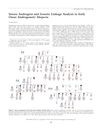
August 1999 in “Journal of Investigative Dermatology” This study found that individuals with early onset extensive androgenetic alopecia have an elevated ratio of DHT to testosterone, but no significant genetic linkage to markers on chromosomes 2 or 5 was detected.
100 citations
,
December 2002 in “Journal of biological chemistry/The Journal of biological chemistry” This study identified a domain on human chromosome 21q22.1 containing various high glycine-tyrosine and high sulfur keratin-associated protein genes, revealing their diverse expression in hair-forming cells.
 2 citations
,
October 2020 in “Annals of Oncology”
2 citations
,
October 2020 in “Annals of Oncology” This analysis discusses the role of genetic factors, particularly male hormones and specific gene variants, in influencing sex differences and potential susceptibility to severe COVID-19 outcomes, but notes that conclusive evidence is lacking, highlighting the need for larger studies.
12 citations
,
January 2000 in “Biochemical and Biophysical Research Communications” This study characterized the intron-exon organization of human keratin 15 and keratin 19 genes to aid future mutation detection analyses related to potential genetic disorders of keratinization.
 36 citations
,
October 2000 in “British Journal of Dermatology”
36 citations
,
October 2000 in “British Journal of Dermatology” This study identified a distinct gene near the hairless locus on chromosome 8p that is responsible for hereditary Marie Unna type hypotrichosis in a German family.
29 citations
,
June 2016 in “Experimental Dermatology” This study provides suggestive evidence that duplications in the MCHR2 gene may be involved in the pathogenesis of alopecia areata.
March 2026 in “Sexual Development” This study found that a young male Maine Coon cat with a tortoiseshell coat, which typically indicates unusual sex chromosomes, was fertile, carrying both XX and XY cell lines. The researchers recommend genetic testing for tri-colored male cats before breeding decisions.
 19 citations
,
November 1993 in “Mammalian Genome”
19 citations
,
November 1993 in “Mammalian Genome” This study reports that transgene insertion in homozygous transgenic mice causes irreversible hair loss and impaired immune function, linked to interruption of the hairless locus on Chromosome 14.
 51 citations
,
November 2011 in “British Journal of Dermatology”
51 citations
,
November 2011 in “British Journal of Dermatology” This study suggests that the HDAC9 gene is a third susceptibility gene for male-pattern baldness, with significant associations found in both German and Australian samples.
19 citations
,
May 2016 in “Biology Direct” This study presents iSiMPRe, a method identifying protein regions enriched in mutations, revealing potential cancer-related genes and enhancing understanding of mutation effects across a wide range of cancer types.
43 citations
,
September 2001 in “Annals of Neurology” This study found that somatic mosaic mutations in the doublecortin gene may cause subcortical band heterotopia in male patients, and molecular analysis using hair roots is a useful detection method.