 5 citations
,
September 2009 in “Journal of Complementary and Integrative Medicine”
5 citations
,
September 2009 in “Journal of Complementary and Integrative Medicine” This study found that the petroleum ether extract of Citrullus colocynthis fruit and an isolated steroidal compound may reduce prostatic hyperplasia in rats induced by testosterone, suggesting potential use in managing androgen-dependent conditions.
 3 citations
,
December 2021 in “Journal of medicinal plants”
3 citations
,
December 2021 in “Journal of medicinal plants” This review discusses the diverse bioactivities and potential applications of Halocnemum strobilaceum but reports no new experimental findings.
 3 citations
,
October 2011 in “JAT. Journal of applied toxicology/Journal of applied toxicology”
3 citations
,
October 2011 in “JAT. Journal of applied toxicology/Journal of applied toxicology” This study found that finasteride was nongenotoxic in Drosophila, while doxazosin mesylate and saw palmetto induced homologous recombination, indicating potential genotoxic actions under the test conditions.
 2 citations
,
September 2023 in “Frontiers in sustainable food systems”
2 citations
,
September 2023 in “Frontiers in sustainable food systems” This study found that Sinja Valley residents possess traditional knowledge of 13 edible oil-producing plant species, yet this knowledge is at risk due to sociocultural changes. Despite its benefits, including treating disorders like gastritis, use of indigenous oils is declining as commercial products become prevalent.
 2 citations
,
April 2023 in “Pharmacognosy Journal”
2 citations
,
April 2023 in “Pharmacognosy Journal” This study found that bio fabricated herbal silver nanoparticles from Blumea lacera extracts demonstrated significant antibacterial activity against Staphylococcus aureus and Escherichia coli, and notable anti-inflammatory effects, though their antioxidant capacity was insignificant compared to the extract.
 2 citations
,
April 2018 in “Natural Product Communications”
2 citations
,
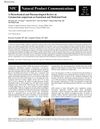
April 2018 in “Natural Product Communications” This review summarizes the bioactive compounds and pharmacological functions of Cynomorium songaricum Rupr., emphasizing its potential in developing health-related products, and notes that further research is needed.
 2 citations
,
December 2003
2 citations
,
December 2003 This article discusses Serenoa repens (Saw palmetto) for preventing and treating androgenic alopecia, highlighting its phytosterols' role and lack of side effects but reports no new clinical results.
 1 citations
,
July 2017 in “International Journal of Advanced Research”
1 citations
,
July 2017 in “International Journal of Advanced Research” This study evaluated the phytochemical properties and in-vitro anti-fungal activity of Tridax procumbens but reports no new clinical results.
 1 citations
,
May 2017 in “InTech eBooks”
1 citations
,
May 2017 in “InTech eBooks” This study suggests that while complementary and alternative treatments for hair loss are becoming more popular, their effectiveness and mechanisms remain largely unverified.
 March 2026 in “Journal of Hunan University Natural Sciences”
 This study evaluated the antimicrobial activity of Albizia saponaria stem bark against microorganisms causing dandruff and fungal alopecia. It found that the hexane fraction exhibited potent antifungal effects comparable to ketoconazole, highlighting its potential as a natural therapeutic for dandruff.
 January 2026 in “International Journal of Current Research and Review”
 This review of Adiantum capillus-veneris highlights its traditional medicinal uses, rich phytochemical profile, and broad range of pharmacological activities, but emphasizes the need for more research to validate and expand its therapeutic applications.
 June 2025 in “Jurnal Mandala Pharmacon Indonesia”
 In this study, researchers found that methanol extract from E. alba stem reduced the expression of the apoptosis marker gene Caspase-3 in T47D breast cancer cells, particularly at 100 ppm, achieving 1.859 times suppression compared to DMSO 2%.
 January 2025 in “International Journal of Pharmacognosy and Life Science”
 In this review, researchers highlighted the potential benefits of using herbal remedies, such as Aloe vera, Bhringraj, Neem, Tea tree oil, Amla, and Hibiscus, for treating various hair problems like dandruff, scalp infections, and premature greying, suggesting natural alternatives to traditional hair treatments.
 October 2024 in “International Journal of Research in Ayurveda and Pharmacy”
 This review investigates Jeemuta Bhringadi Taila, an Ayurvedic herbal oil formulation, exploring traditional claims of its benefits for hair health, skin issues, and other ailments by examining its ingredients and available scientific research, aiming to assess its relevance in modern healthcare.
 October 2024 in “Irish Journal of Medical Science (1971 -)”
 Continuous glucose monitoring and GLP-1 receptor agonists improve diabetes management, but personalized care and education are crucial.
 June 2024 in “International Journal of Advanced Research in Science Communication and Technology”
 This study highlights the growing issue of hair loss around the world and explores the potential of using certain herbs, such as Ficus religiosa and coriander seeds, as natural treatments to promote hair growth and manage hair loss, particularly in India, with minimal side effects.
 April 2024 in “Frontiers in pharmacology”
 This review of Cynoglossum amabile, a traditional Chinese and ethnomedicine, provides insights into its uses, chemical components, biological activities, and toxicity. Highlighting its market potential, the study underscores the importance of indigenous knowledge in drug development despite noted hepatotoxic risk linked to its pyrrolizidine alkaloids.
 March 2024 in “Journal of medicinal plants studies”
 This review comprehensively examines the Hibiscus rosa-sinensis plant, detailing its distribution, physical and chemical properties, bioactive compounds, ethnomedicinal uses, and potential toxicity, providing a broad understanding of its characteristics and health implications.
 February 2024 in “International Journal of Scientific Research in Science and Technology”
 This literature review outlines the traditional uses, nutritional composition, and bioactive compounds of pomegranate plants, highlighting their varied pharmacological actions such as antibacterial, antiviral, anticancer, and antioxidant effects, and discusses the peel's chemical composition and toxicology.
 November 2023 in “International journal of biology, pharmacy and allied sciences”
 This review highlights scientific information about the medicinal uses and phytochemistry of Musa paradisiaca plant parts, which are traditionally used in human medicine to treat conditions such as diabetes, diarrhoea, hypertension, and ulcers, and exhibit various pharmacological activities including antidiabetic, antioxidant, and wound healing effects.
 September 2023 in “Journal of pharmacognosy and phytochemistry”
 This review highlights the medicinal potential and pharmacological activities of the plant Plumbago zeylanica, while emphasizing the critical need for mass propagation methods to address its over-exploitation and support the development of novel herbal medicines.
 June 2023 in “International journal of research in ayurveda and pharmacy”
 This study explores how Dhatryadi rasayana, a polyherbal formulation with antioxidant properties, may help prevent and treat premature hair greying by addressing factors such as oxidative stress, nutritional deficiencies, and hormone imbalances, potentially through rasayana therapy.
 February 2023 in “Aesthetic Cosmetology and Medicine”
 This review examines the health-promoting effects of medicinal plants used in nutricosmetics, highlighting their beneficial impact on skin physiology, but offers no new clinical results.
 March 2022 in “Journal of Survey in Fisheries Sciences”
 This review discusses the diverse phytochemical constituents and medicinal applications of Asteraceae family plants, noting their significance in traditional and modern medicine, but provides no new clinical results.
 June 2021 in “Journal of emerging technologies and innovative research”
 This article reviews the potential hair-protective effects of Onion and Aloe vera against damage from hair dyes but reports no new experimental results.
 June 2020 in “International journal of medical science and clinical invention”
 This review discusses the uses of Achillea millefoilum described by Ibn Rushd, finding scientific support for its applications in treating alopecia and skin disorders.
 January 2012 in “Journal of Natural Remedies”
 This study found that the aqueous extract of Abrus precatorius leaf promoted hair growth in experimental settings, with effects comparable to 2% minoxidil.
 June 2004 in “Bulletin of Pharmaceutical Sciences. Assiut University”
 This study found that among natural hair loss treatments, formulations with Cantharidin in the saponifiable fraction showed superior efficacy compared to those with Pilocarpine.
 67 citations
,
February 2015 in “Life Sciences”
67 citations
,
February 2015 in “Life Sciences” This review discusses phytotherapy options for managing benign prostatic hyperplasia, noting some herbal agents show promise in trials for mild-moderate symptoms but more evidence is needed for others.
 41 citations
,
July 2015 in “Current Drug Discovery Technologies”
41 citations
,
July 2015 in “Current Drug Discovery Technologies” This review discusses various plants and herbal formulations traditionally used for hair growth and notes their potential as safer alternatives to synthetic hair loss treatments, but reports no new clinical results.