7 citations
,
May 1996 in “PubMed” This article outlines the clinical and histological features of milia grouped in plaques on a 59-year-old woman's face but reports no new research findings.
5 citations
,
January 2021 in “Frontiers in cell and developmental biology” This paper discusses the multipotency of cyst cells and proposes that understanding molecular circuits in cyst formation could enable engineering of desired stem cell culture phenotypes, but reports no new experimental outcomes.
This article reviews the characteristics and diagnostic criteria of tricholemmoma and tricholemmal carcinoma, detailing their clinical presentations and associations but reports no new clinical findings.
2 citations
,
May 1991 in “PubMed” This article reviews naevus comedonicus, highlighting potential treatments like retinoic acid application and surgical intervention, but reports no new clinical findings.
8 citations
,
January 2006 in “Dermatology Online Journal” This case report describes a 7-year-old girl diagnosed with multiple eccrine pilar angiomatous nevi, a rare variant of eccrine angiomatous hamartomas, characterized by slow growth and generally benign behavior.
 December 2023 in “Curēus”
 In this case study, researchers reported the first instance of keratoacanthoma on the scalp of an elderly patient in Saudi Arabia, highlighting the diagnostic challenge due to its resemblance to squamous cell carcinoma.
20 citations
,
November 2004 in “Archives of Pathology & Laboratory Medicine” This case report describes a rare instance of melanocytic matricoma, a benign pigmented papule found in sun-damaged skin of an elderly individual, highlighting its distinct clinical and pathological features.
24 citations
,
January 1998 in “Dermatology” This study found that Merkel cell hyperplasia is specific to certain skin diseases and not related to general epidermal proliferation.
39 citations
,
February 2011 in “American Journal of Dermatopathology” This study shows for the first time that onychomatricoma can recapitulate the entire nail unit with differentiation toward the nail bed and isthmus, identifying new histopathological and immunohistochemical features.
8 citations
,
July 2014 in “American Journal of Dermatopathology” This discussion reviews the classification and naming of cutaneous cysts, proposing that cysts typically named cutaneous keratocyst and steatocystoma should be unified under the term "sebaceous duct cyst," but it reports no new clinical results.
10 citations
,
July 2001 in “PubMed” This case report describes two patients with a likely new type of pachyonychia, characterized by nail thickening and severe generalized hypotrichosis, possibly linked to a mutation in a hard keratin.
4 citations
,
January 2019 in “Indian Dermatology Online Journal” This report discusses two cases of porokeratotic eccrine ostial and dermal duct nevus and porokeratotic eccrine and hair follicle nevus, suggesting they may represent a single clinical entity, but reports no therapeutic outcomes.
38 citations
,
May 1982 in “PubMed” This report describes almost complete resolution of calcinosis and healing of associated ulcers in an 83-year-old woman with localized scleroderma after repeated intralesional steroid injections.
January 1990 in “The Nishinihon Journal of Dermatology” This study suggests that keratoacanthomas may be distinguished from squamous cell carcinoma by identifying hair follicle structures, based on keratin expression and histological features observed in tumor samples.
21 citations
,
April 2000 in “Journal of Cutaneous Pathology” This case report describes a 22-year-old woman with a nevoid plaque termed localized follicular hamartoma, characterized by skin-colored papules and specific cellular and structural features.
2 citations
,
January 2007 in “Actas Dermo-Sifiliográficas” This case report describes a unilateral contact dermatitis caused by shoe dye containing 4-aminoazobenzene, which was confirmed with patch testing, highlighting its atypical presentation.
 16 citations
,
December 2006 in “International Journal of Dermatology”
16 citations
,
December 2006 in “International Journal of Dermatology” This clinical case study describes an aggressive squamous cell carcinoma developing within a giant epidermal cyst on the abdomen.
31 citations
,
January 2007 in “Journal of the American Academy of Dermatology” A rare skin growth was successfully removed without recurrence after one year.
2 citations
,
June 2001 in “Medical Electron Microscopy” This study observed that the keratinization pattern of trichilemmal cysts in two Japanese women may originate from the proliferation of the outer root sheath in the follicular isthmus of anagen hairs.
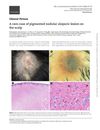
This study reported the case of a 30-year-old man with a bluish-grey scalp nodule that developed over a previously stable hairless plaque, revealing histopathological features consistent with epithelioid cell nests and spindle-shaped dermal melanocytes embedded in collagen.
January 2009 in “한국피부장벽학회지” This study reports that in mice, CaR plays a critical role in sensing the epidermal Ca2+ gradient, influencing keratinocyte differentiation, and affecting epidermal development.
40 citations
,
March 1991 in “Journal of Investigative Dermatology” 8 citations
,
January 2017 in “Journal of Oral and Maxillofacial Pathology” This report explores the potential cellular origins of keratoacanthoma lesions on the oral mucosa, noting that it reports no new results.
 March 2014 in “Journal of The American Academy of Dermatology”
 Reflectance confocal microscopy can noninvasively diagnose onychomatricoma by showing unique features different from healthy nails or nail fungus.
This study found that polycystic ovary syndrome was the most common cause of hirsutism among premenopausal Algerian women, affecting nearly 60% of participants.
2 citations
,
March 1994 in “Oncology Reports” This study suggests that keratin expression in keratoacanthomas resembles that in the upper part of hair follicles, implying a potential origin, but it is indistinguishable from squamous cell carcinomas in terms of keratin reactivity.
 81 citations
,
June 2012 in “European journal of human genetics”
81 citations
,
June 2012 in “European journal of human genetics” This review outlines a diagnostic framework for clinicians to distinguish different types of inherited ichthyoses and suggests further testing and treatment strategies, but reports no new clinical results.
August 1969 in “Archives of Dermatology” In this study, histologic analysis of rat skin with localized calciphylaxis indicated that although the skin showed potential for regeneration, the result was incomplete and resembled scar tissue with diminished hair presence.
This case report describes a six-year-old girl with hypertrichosis cubiti, characterized by excess terminal hair growth around the elbows, and notes treatment with over-the-counter depilatory creams and shaving to address aesthetic concerns.
 April 2024 in “Dermatovenerologiâ, kosmetologiâ”
 This study provides a comprehensive overview of actinic keratosis, highlighting its potential to progress to squamous cell carcinoma and noting that routine treatment poses a significant burden on healthcare providers.