
This study highlights that traumatic anserine folliculosis is a benign condition often seen in young males, which can be diagnosed without invasive biopsies using clinical examination and dermoscopy.

This case report describes a 41-year-old man with preauricular and postauricular plaques unresponsive to topical treatments, with lab results indicating low-titer antibodies for Sjögren syndrome A and B.
1 citations
,
April 2024 in “Journal of Cutaneous Pathology” This article presents a case of spontaneous, recurrent necrotizing infundibular crystalline folliculitis in the inguinal region and suggests unknown etiology possibly linked to microbiome and sebaceous gland dysfunction.
 19 citations
,
September 2014 in “JAMA Dermatology”
19 citations
,
September 2014 in “JAMA Dermatology” Eosinophilic infiltrate is not a reliable indicator for diagnosing chronic alopecia areata.
1 citations
,
October 1978 in “The Journal of Pediatrics”  17 citations
,
September 2010 in “Pediatric dermatology”
17 citations
,
September 2010 in “Pediatric dermatology” This report describes a case of widespread Porokeratotic eccrine and hair follicle nevus in a 15-year-old woman with keratitis-ichthyosis-deafness syndrome, involving both eccrine ostia and hair follicle infundibula.
August 2025 in “JEADV Clinical Practice” In this case report, researchers documented a 71-year-old woman with both alopecia areata and bullous pemphigoid who showed significant improvement using dupilumab after other treatments failed, highlighting its potential for autoimmune diseases with overlapping inflammatory mechanisms.
June 2018 in “International Journal of Dermatology” 4 citations
,
December 2014 in “Indian Journal of Dermatology” This case report documents a rare presentation of congenital milia en plaque on the scalp of a five-year-old boy, with blaschkoid extension to the nuchal area, highlighting its uncommon location and onset.
 13 citations
,
December 2010 in “Annales de Dermatologie et de Vénéréologie”
13 citations
,
December 2010 in “Annales de Dermatologie et de Vénéréologie” This retrospective study in Morocco confirms that Stevens-Johnson and Lyell syndromes lead to severe ocular and unsightly mucocutaneous sequelae, significantly affecting patients' social and professional integration.
 January 2018 in “Advances in Dermatology and Allergology”
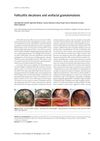
 Treatment with dapsone, topical corticosteroids, and antibiotics improved the man's skin conditions.
 July 2021 in “International Ophthalmology”
 Female hair loss patients more likely to have dry eye and gland issues.
 21 citations
,
January 2015 in “Dermatologic Therapy”
21 citations
,
January 2015 in “Dermatologic Therapy” This letter discusses a case of erosive pustular dermatosis of the scalp linked to topical latanoprost use for androgenetic alopecia, but reports no clinical results.
 14 citations
,
September 2009 in “International Journal of Dermatology”
14 citations
,
September 2009 in “International Journal of Dermatology” This study found a potential link between staphylococcal carrier status and dermatitis cruris pustulosa et atrophicans, a chronic folliculitis primarily affecting the legs.
1 citations
,
June 2019 in “Journal of Cutaneous Immunology and Allergy” This report describes two cases where topical squaric acid dibutylester application in alopecia totalis patients led to severe pustular lesions, necessitating systemic prednisolone treatment.
40 citations
,
August 2005 in “JEADV. Journal of the European Academy of Dermatology and Venereology/Journal of the European Academy of Dermatology and Venereology” In this case report, a 3-year-old male with IFAP syndrome showed moderate improvement in skin symptoms and corneal erosions but no change in alopecia or photophobia after 6 months of acitretin therapy.
 September 1998 in “Journal of The European Academy of Dermatology and Venereology”
 This review summarizes major surveys on Behcet's disease, highlighting its systemic manifestations, with primary morbidity linked to ocular involvement causing severe vision loss or blindness.
February 2023 in “Journal of the European Academy of Dermatology and Venereology”  March 2026 in “Zenodo (CERN European Organization for Nuclear Research)”
 This study explores the development and evaluation of a polyherbal gel containing Amla, Bhringraj, Tea Tree Oil, and Jojoba Oil to treat folliculitis, aiming to provide a safer, more effective natural alternative to conventional treatments while utilizing the healing properties of these herbal ingredients.
 36 citations
,
November 2005 in “Journal of The American Academy of Dermatology”
36 citations
,
November 2005 in “Journal of The American Academy of Dermatology” This article discusses the potential of latanoprost for treating alopecia areata, but notes that well-controlled studies are still needed to confirm its effectiveness.
 February 2018 in “BMJ case reports”
 This case report describes an 18-year-old woman with a pruritic rash featuring extensive confluent scaly erythema, hyperkeratotic follicular plugging, and waxy keratoderma on palms and soles.
 January 2025 in “Clinical and Experimental Optometry”
 This study found that men with androgenetic alopecia had significantly higher rates of dry eye symptoms and meibomian gland dysfunction compared to healthy controls, suggesting a potential link between the condition and these ocular issues.
November 2012 in “Annales de Dermatologie et de Vénéréologie” This report describes the first known pediatric cases of frontal fibrosing alopecia, a condition typically affecting postmenopausal women, highlighting its occurrence in children including female twins.
1 citations
,
March 2025 in “Skin Appendage Disorders” This literature review on JAK inhibitors reports that ocular side effects are rare but could be significant, with an inability to establish a causal link. Clinicians are advised to monitor such adverse events and report them to drug safety agencies.
 May 2014 in “Clinical and Experimental Dermatology”
 A 70-year-old woman with a rare skin condition improved after treatment with topical steroids and acitretin.
 7 citations
,
March 2019 in “Dermatologic surgery”
7 citations
,
March 2019 in “Dermatologic surgery” In this randomized trial, bimatoprost 0.01% significantly improved eyebrow hair density and diameter in patients with eyebrow hypotrichosis compared to a placebo, with minimal adverse effects, suggesting it is an effective and safe treatment option.
This case report describes an 11-year-old canine diagnosed with Pemphigus Foliaceus, illustrating the role of trichogram, skin scraping, cytology, and histopathology in achieving an accurate diagnosis.
9 citations
,
June 2019 in “Plastic & Reconstructive Surgery Global Open” This study reviewed the outcomes of a limited incision lateral brow lift technique, reporting that the procedure safely resolved lateral brow hooding with a low revision rate in 150 patients, and observed no permanent nerve injuries.
 3 citations
,
September 2023 in “Frontiers in immunology”
3 citations
,
September 2023 in “Frontiers in immunology” This study discusses the epithelial-immune microenvironment in chronic skin diseases, such as psoriasis and atopic dermatitis, and highlights current and future treatment strategies targeting inflammatory loops within these diseases.