This study highlights the use of dermatoscopy as a valuable tool for diagnosing and monitoring alopecia areata, noting that specific hair shaft alterations such as exclamation-mark hairs and black dots are indicators of active disease, while vellus hairs signal early regrowth.
5 citations
,
October 2021 in “Journal of the American Academy of Dermatology” PRAME helps distinguish between benign and malignant skin cells in most cases.
October 1991 in “Archives of Dermatology” This case report describes a 59-year-old woman with cicatricial alopecia and multiple skin lesions, including nodules and plaques, with biopsy results showing a lymphocytic infiltrate and collagen replacement.
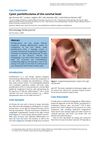 March 2026 in “Dermatology Online Journal”
 In this case report, the authors describe a rare cystic panfolliculoma in an 84-year-old man's right conchal bowl, noting its potential to mimic other tumors like basal cell carcinoma, which complicates diagnosis.
April 2022 in “The Journal of Sexual Medicine” This study reports that simultaneous cystoscopy, electroejaculation, transurethral resection of ejaculatory ducts, and seminal vesiculography were safe and effective in diagnosing and treating concurrent hematospermia and anorgasmia.
 April 2012 in “Journal of the American Academy of Dermatology”
 Clofazimine may be effective for treating ashy dermatosis.
 September 2014 in “Springer eBooks”
 This review discusses the evaluation and management of breast pain, or mastalgia, highlighting non-pharmacologic therapies and the limited role of surgical interventions, but reports no new clinical findings.
 13 citations
,
June 2013 in “Actas Dermo-Sifiliográficas”
13 citations
,
June 2013 in “Actas Dermo-Sifiliográficas” This review details five cases of syphilitic alopecia, an uncommon symptom in syphilis affecting mainly men, emphasizing that dermatologists should be vigilant as it can appear as the sole symptom.
 June 2023 in “International Journal of Research in Medical Sciences”
 This case report describes the first confirmed instances of X-linked adrenomyeloneuropathy/adrenoleukodystrophy in two brothers from Bangladesh, noting their progressive neurological symptoms, MRI findings, and differing disease outcomes over several years of observation.
January 2019 in “University of Liverpool” This study found that equine eosinophilic granuloma and mast cell tumors exhibit distinct histological and molecular features, with eosinophilic granulomas showing more mineralization and mast cell tumors having unique macrophage activity.
 April 2012 in “Journal of the American Academy of Dermatology”
 Clofazimine successfully treated a man's ashy dermatosis, clearing his skin lesions.
 January 2011 in “Journal of The American Academy of Dermatology”
 Treating generalized granuloma annulare is difficult, with PUVA being the most effective option, but relapses are common.
 January 2024 in “JEADV clinical practice”
 This study reported high patient satisfaction with multidisciplinary shared medical appointments for alopecia areata and frontal fibrosing alopecia, with participants appreciating the educational and supportive group environment.
12 citations
,
March 2022 in “Dermatologic Therapy” This report presents a case of a patient developing new multiple sclerosis while using tofacitinib for alopecia areata, noting no new comprehensive research findings.
April 2026 in “Case Reports in Dermatology” In this case report, a woman with Graham-Little-Piccardi-Lassueur Syndrome and hidradenitis suppurativa showed significant improvements in both conditions after six months of treatment with tofacitinib, a Janus Kinase inhibitor, with no recurrence or adverse events noted during a two-year follow-up.
August 2024 in “Clinical Case Reports” This case study reports on a rare benign skin tumor known as Pilomatricoma in the lower left orbital region of a 32-year-old male, highlighting its characteristic histopathological features and emphasizing the importance of surgical excision for successful treatment and minimal recurrence risk.

In this case report, a 54-year-old woman with hirsutism was found to have a benign ovarian cystadenofibroma, which resolved after surgery, highlighting the importance of evaluating postmenopausal women for ovarian causes of androgen excess.
 1 citations
,
October 2023 in “BMC oral health”
1 citations
,
October 2023 in “BMC oral health” This study reported that while Intralesional Triamcinolone Acetonide injections effectively improved mouth opening in patients with Oral Submucous Fibrosis, it also led to symptoms of Cushing's Syndrome, highlighting the need for careful monitoring of adverse effects.
 2 citations
,
April 2022 in “PLoS ONE”
2 citations
,
April 2022 in “PLoS ONE” This study reports that short exposure to vibration causes epithelial cells to retract filopodia, concentrate actin at their edges, and increase expression of the protease calpain, suggesting a mechanism for vibration-induced pain relief.
1 citations
,
August 2023 in “Clinical Cosmetic and Investigational Dermatology” This study found that exclamation mark hairs are the only trichoscopic feature that can differentiate clinically suspicious SA from AA.
 September 2022 in “Dermato”
 This review discusses acne tarda, emphasizing its commonality in women and potential links to endocrinological disorders, but reports no new clinical findings and suggests collaboration with specialists for management.
 2 citations
,
October 2023 in “The American journal of case reports”
2 citations
,
October 2023 in “The American journal of case reports” This report observed a case of pilomatrixoma appearing at the COVID-19 vaccination site of a 65-year-old man, aligning with previous findings that suggest a potential association between vaccination sites and this benign tumor.
1 citations
,
February 1938 in “Archives of Dermatology” This piece presents a case study of a woman with diffuse alopecia, suggesting a potential link to a chronic focus of infection rather than acute fever.
 July 2018 in “Elsevier eBooks”
 This review discusses primary neutrophilic cicatricial alopecias, their clinical and histological characteristics, and the importance of early therapeutic intervention to prevent scarring alopecia, reporting no new clinical results.
 January 2013 in “Journal of dermatology”
 This letter to the editor raises the possibility of a new medical entity characterized by symptoms such as poikiloderma, hyperpigmentation, alopecia, malformed bones, lymphedema, and decreased cortisol, but provides no clinical results.
 28 citations
,
April 2009 in “Annals of laboratory medicine”
28 citations
,
April 2009 in “Annals of laboratory medicine” This study found that the DFS pattern occurs in about 28% of ANA-positive cases and is relatively frequent in autoimmune diseases, contrary to previous observations suggesting no link with these diseases.
36 citations
,
October 2009 in “Journal of biological chemistry/The Journal of biological chemistry” This study reports that TFM-4AS-1, a selective androgen receptor modulator, promoted bone and muscle growth with reduced effects on reproductive organs in ovariectomized rats.
10 citations
,
November 2016 in “Clinical and experimental dermatology” This case report describes a 52-year-old woman with multiple autoimmune conditions suggesting a diagnosis of PAS IIIC, characterized by prominent skin-related symptoms.
1 citations
,
November 2024 in “Expert Opinion on Drug Safety” In this retrospective pharmacovigilance study, researchers analyzed over 7,900 adverse event reports related to aromatase inhibitors, identifying common side effects and toxicological mechanisms to highlight potential safety concerns in treating postmenopausal hormone receptor-positive breast cancer.
 August 2023 in “International Medical Case Reports Journal”
 In this case report, two patients with acne necrotica, one in early and one in late stages, showed improvement after treatment with topical mometasone furoate cream and doxycycline tablets, highlighting the under-recognition of this skin condition.