
This study validated an HPLC-UV method to detect minoxidil in cosmetic products and found that 2 out of 9 analyzed products contained minoxidil, despite international regulations banning its inclusion due to potential systemic absorption.
 April 2018 in “Journal of Chromatographic Science”
 In this study, researchers found that finasteride undergoes second-order alkaline degradation kinetics and that its degraded form negatively impacts cell proliferation, highlighting the need for careful handling in pharmaceutical manufacturing and storage.
 1 citations
,
May 2025 in “Discover Chemistry.”
1 citations
,
May 2025 in “Discover Chemistry.” This review highlights that although mangiferin, a polyphenol from the mango tree, faces challenges like low solubility and bioavailability, delivery vehicles such as nanoparticles and complexes have the potential to enhance its therapeutic effectiveness in treating various diseases.
November 2004 in “Qucosa (Saxon State and University Library Dresden)” This study developed analytical methods to better understand hair treatment with cosmetic formulations, revealing that active agents primarily adsorb on the hair surface during short washes.

This study developed a new analytical method to identify a wide range of endocrine disrupting compounds in full-term amniotic fluid, revealing diverse substances with potential endocrine activity.
 March 2026 in “Pharmaceuticals”
 This study establishes a robust analytical method using mass spectrometry to comprehensively identify 170 chemical compounds in Xiaoban Kangfu capsules for enhanced quality control.
 January 2025 in “International Journal of Scientific Research in Science and Technology”
 This study validated an HPLC analytical method for evaluating fenasteride in commercial products, finding it to be sensitive, selective, and within acceptance criteria for specificity, precision, and stability, making it suitable for quality control testing.
 94 citations
,
July 2020 in “European Journal of Human Genetics”
94 citations
,
July 2020 in “European Journal of Human Genetics” This article provides guidelines for molecular genetic testing of congenital adrenal hyperplasia due to 21-hydroxylase deficiency, focusing on quality requirements, methodologies, and variant classification; it reports no new clinical results.
1 citations
,
May 2018 in “Research & Reviews: Journal of Herbal Science” This paper presents diagnostic characteristics obtained from various analytical methods to support the pharmacognostic standardization of Lawsonia inermis L. leaf, commonly known as henna.
November 2025 in “Molecules” This review examines recent advancements in green and emerging microextraction techniques, such as SPME and DLLME, for more sustainable hormone detection in biological samples, emphasizing environmentally friendly solvents and bioanalytical applications.
 May 2026 in “Zenodo (CERN European Organization for Nuclear Research)”
 This review highlights the diverse pharmacological properties and applications of guava leaves, attributing their effectiveness to a rich phytochemical composition and modern extraction techniques, suggesting their potential as natural therapeutic agents across pharmaceutical, nutraceutical, and cosmeceutical fields.
 May 2026 in “Zenodo (CERN European Organization for Nuclear Research)”
 This review explores the significant potential of guava leaves as a source of natural therapeutic agents, noting their rich phytochemical content and diverse pharmacological properties, such as antioxidant and anti-inflammatory effects, which may support their application in pharmaceutical, nutraceutical, and cosmeceutical industries.
11 citations
,
January 2014 in “Mass spectrometry” In this study, silver oxide-based nanoparticles were used to ionize analytes and detect specific target molecules through adduct formation with silver isotopes, facilitating signal correlation with these molecules.
 15 citations
,
October 2010 in “Archives of Toxicology”
15 citations
,
October 2010 in “Archives of Toxicology” This study found that the yeast androgen screen (YAS) could detect the activity of methyltestosterone in urine for a longer period than classical GC/MS, potentially identifying long-lasting metabolites.
January 2021 in “Korean Journal of Chemical Engineering” This study found that preparing Finasteride micro and nanoparticles using a gas-antisolvent method reduced the particle size significantly.
 11 citations
,
June 2013 in “Journal of Chemical Education”
11 citations
,
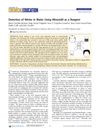
June 2013 in “Journal of Chemical Education” This study reports an easy colorimetric method for detecting nitrite in water using minoxidil, which may be suitable for various analytical applications due to its effective detection range.
July 2023 in “LA Referencia (Red Federada de Repositorios Institucionales de Publicaciones Científicas)” This study evaluated the resin oil of Copaifera officinalis L., identifying 64 compounds and developing validated analytical methods for quality control, and formulated a stable pharmaceutical foam, laying groundwork for potential clinical applications of copaiba oil.
74 citations
,
March 2006 in “Journal of Chromatography B” This review discusses the use of hair analysis for detecting misuse of drugs in livestock, covering hair biology, drug incorporation, sampling methods, and analytical techniques, but reports no new findings.
55 citations
,
January 2013 in “International Journal of Cosmetic Science” In this study, researchers found that higher concentrations of internal lipids in African hair may influence its keratin structure, as observed through various analytical methods.
December 2025 in “Drug Testing and Analysis” This meeting underscored that hair testing is a crucial and evolving area in forensic and toxicological science, emphasizing advancements in analytical methods and its importance in public health and legal medicine.
 6 citations
,
March 2018 in “Journal of Chromatography A”
6 citations
,
March 2018 in “Journal of Chromatography A” This study describes an analytical technique combining field-enhanced sample stacking with dispersive liquid-liquid microextraction, offering improved sensitivity for detecting finasteride and its metabolite in urine samples from patients treated for androgenetic alopecia.
 12 citations
,
March 2018 in “Analytical chemistry”
12 citations
,
March 2018 in “Analytical chemistry” This study found that a new analytical approach revealed an increased brain pregnenolone level following finasteride treatment in a mouse model, suggesting potential for improved understanding of neurosteroid roles in brain excitability.
September 2010 in “대한화장품학회지(J. Soc. Cosmet. Scientists Korea)” This study developed and validated a method to analyze active ingredients in hair nourisher products, which was successfully applied to products from the market.
11 citations
,
July 2014 in “Journal of The Royal Society Interface” This study demonstrates that modeling clone size independently of time offers analytical advantages for understanding cell distribution and mutation frequency in epithelial progenitors, extending applications beyond neutral models.
18 citations
,
March 2010 in “Therapeutic Drug Monitoring” This study developed a faster method to analyze fatty acid ethyl esters in human hair, potentially distinguishing alcohol consumption levels more efficiently.
January 1990 in “Medical Entomology and Zoology” This study developed a faster method for analyzing fatty acid ethyl esters in hair to help detect alcohol consumption levels, showing potential for applications in forensic and clinical settings.

Researchers developed a method to identify and measure different animal hair fibers in textiles, successfully distinguishing materials like cashmere from cheaper fibers.
 13 citations
,
January 1995 in “Journal of the American Institute for Conservation”
13 citations
,
January 1995 in “Journal of the American Institute for Conservation” This study introduced a new method for extracting red mordant dyes from wool fibers that preserved the fibers for further analysis and allowed for spectrophotometric examination of the dyes' absorption curves.
8 citations
,
January 2020 in “PeerJ” This study found significant structural and compositional differences in hair affected by alopecia areata compared to healthy hair, using a range of physico-chemical investigation methods.

This study found that a combination of betulin and cytostatic Namitecan had a statistically significant synergistic effect on solid Ehrlich adenocarcinoma tumors in NMRI mice, and suggests a promising method for administering betulin in in vivo experiments despite its water insolubility.