36 citations
,
July 2007 in “Journal of Investigative Dermatology” This study observed a strong negative association between the HLA-DQB1*0201 allele and the alopecia totalis/alopecia universalis phenotype in Caucasian individuals, indicating a potential protective role.
24 citations
,
December 2010 in “Dermatologic surgery” In this study, BTXA injections did not effectively treat recalcitrant alopecia areata or improve hair regrowth in most patients, suggesting its limitations as an alternative therapy.
43 citations
,
May 2011 in “Dermatologic therapy” This study identified at least eight genetic regions associated with alopecia areata, which may lead to the development of new targeted therapies based on these findings.
 1 citations
,
December 2024 in “Dermatology and Therapy”
1 citations
,
December 2024 in “Dermatology and Therapy” This study found that the STRIAA scoring tool provides a rapid and highly reliable assessment of alopecia areata severity, showing a significant correlation with the traditional SALT score, thus enhancing clinical evaluation in patients with this condition.
January 2022 in “Clinical Cases in Dermatology” This case report describes the successful remission of alopecia universalis in an 11-year-old girl using combined oral Baricitinib and sublingual minoxidil, suggesting potential for similar treatments in pediatric patients.
 April 2024 in “International Journal of Research Publication and Reviews”
 This source highlights that alopecia areata is a complex autoimmune disorder leading to patchy, nonscarring hair loss with variable treatment responses, reflecting unmet clinical needs. Advances in genetic research are improving understanding, yet current treatments often lead to persistent relapses.
June 2025 in “British Journal of Dermatology” This study reported significant challenges in the UK care system for alopecia areata patients, including inconsistent care pathways, long waiting times, inadequate access to specialists, and insufficient resources, particularly affecting referral processes and treatment access.
2 citations
,
January 2018 This article discusses diffuse alopecia areata, highlighting its autoimmune characteristics, more intense inflammation, and challenges in diagnosis, but presents no new clinical findings.
October 1993 in “The Journal of Clinical Pharmacology”  April 2012 in “The Journal of Urology”
 This case-control study found that men with earlier onset androgenetic alopecia, particularly frontal balding, may have an increased risk of prostate cancer in a multiethnic veterans cohort.
244 citations
,
January 2010 in “Journal of the American Academy of Dermatology” This review discusses treatment options for alopecia areata and suggests tailored treatment plans, noting the challenges posed by spontaneous remission and limited high-quality clinical trials.
 April 2024 in “Research Square”
 This study observed that children with alopecia areata had higher anxiety and depression scores, and their families showed more neglectful parenting styles compared to healthy controls.
January 2026 in “Annals of Dermatology” This source suggests that alitretinoin may be a safe and potentially effective treatment for patients with mild to moderate alopecia areata not responding to conventional therapies, though further research is needed to confirm its role, either alone or as an adjunct.
28 citations
,
October 2017 in “Journal of the American Academy of Dermatology” Pediatric alopecia areata is rare, affecting more girls than boys, and peaks at ages 9-12.
 290 citations
,
December 2017 in “Journal of The American Academy of Dermatology”
290 citations
,
December 2017 in “Journal of The American Academy of Dermatology” This article reviews the epidemiology, clinical evaluation, and pathogenesis of alopecia areata and highlights recent advancements, but it does not report new clinical findings.
5 citations
,
May 1994 in “Facial plastic surgery clinics of North America” This article reviews the clinical characterization and potential treatments for androgenetic alopecia, highlighting minoxidil's efficacy in hair regrowth and noting the need for further genetic research; it reports no new clinical results.
 46 citations
,
November 1995 in “The Journal of Dermatology”
46 citations
,
November 1995 in “The Journal of Dermatology” This study found that immunotherapy with DNCB or DPCP showed better therapeutic effects than intralesional triamcinolone acetonide for patients with bald areas greater than 50 cm², including alopecia totalis and universalis.
 September 2021 in “CRC Press eBooks”
 This article discusses alopecia areata incognito, highlighting its diffuse hair loss pattern and favorable response to steroid treatment, but it reports no new clinical data.
This study found that dermatologists in the southeastern United States are inconsistent in treating alopecia areata, often recommending no treatment, especially for children and more advanced hair loss stages.
July 2026 in “Hippocratic Journal of Unani Medicine” In this case study, a 34-year-old male with alopecia areata was treated successfully using Unani medicine, including cupping therapy, over three months, but the authors indicated the need for further research to confirm the safety and efficacy of these treatments.
 17 citations
,
September 2003 in “Journal of Investigative Dermatology Symposium Proceedings”
17 citations
,
September 2003 in “Journal of Investigative Dermatology Symposium Proceedings” This study found that anthralin and mechlorethamine were the most effective therapies among those tested in AA-affected rodent models, providing a basis for further analysis of their mechanisms in Alopecia Areata.
 25 citations
,
June 2015 in “Scientific Reports”
25 citations
,
June 2015 in “Scientific Reports” In this study, patients with alopecia areata were found to have a higher risk of stroke over a 3-year follow-up period compared to those without the condition.
January 2026 in “Pattern Recognition” This study found that their newly developed ADRL framework significantly improved the accuracy of scalp tissue layer segmentation in HR-MR images compared to existing methods.
5 citations
,
June 2024 in “Value in Health Regional Issues” The study reported that from 2016 to 2020, the number of patients with alopecia areata in Taiwan increased, with severe cases utilizing more systemic therapies and having higher outpatient visits than mild/moderate cases.
2 citations
,
February 2024 in “JAAD International” Sebaceous gland maturity and size differ between psoriatic alopecia and alopecia areata.
 December 2024 in “Dermatological Reviews”
 This review highlights significant advances in understanding and treating Alopecia Areata, emphasizing the effectiveness of JAK inhibitors like baricitinib, ritlecitinib, and deuruxolitinib for systemic treatment, while also noting ongoing research into new therapeutic approaches such as stem cell therapy and energy-assisted drug delivery.
 48 citations
,
May 1999 in “International Journal of Dermatology”
48 citations
,
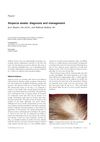
May 1999 in “International Journal of Dermatology” This article reviews the diagnosis and management of alopecia areata but reports no new research findings.
33 citations
,
October 2006 in “European Journal of Immunology” This study found that CD44 and CD49d together enhance signaling pathways in lymphocytes in mice with alopecia areata, influencing their activation and function.
1 citations
,
July 2025 in “Journal of Investigative Dermatology” IL-27 may help prevent hair loss by creating immune-suppressing cells.
 May 2023 in “Indian journal of science and technology”
 This study found that an Attention-based Balanced Multi-Task Deep learning system achieved a 95.11% accuracy in classifying Alopecia Areata conditions using hair and scalp images, outperforming classical methods.