 11 citations
,
January 2018 in “Royal Society Open Science”
11 citations
,
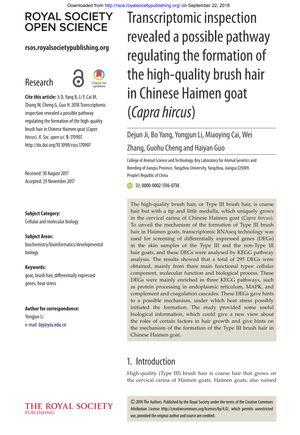
January 2018 in “Royal Society Open Science” This study investigated the formation of Type III brush hair in Chinese Haimen goats and identified genetic factors that may involve heat stress in the process.
18 citations
,
January 2017 in “PloS one” This study identified 295 genes with differential expression in Yangtze River Delta White Goats that produce high-quality brush hair, suggesting these genes and the MAPK signaling pathway may influence hair quality traits.
 42 citations
,
September 2015 in “Gene”
42 citations
,
September 2015 in “Gene” This study demonstrated that FGF5s acts as an inhibitor of FGF5 in regulating hair growth cycles in cashmere goat dermal papilla cells.
 19 citations
,
April 2015 in “International Journal of Molecular Sciences”
19 citations
,
April 2015 in “International Journal of Molecular Sciences” This study identified distinct gene expression patterns in wool follicle bulbs that may play important roles in wool follicle cycling and regeneration in sheep.
 14 citations
,
January 2015 in “Genetics and molecular research”
14 citations
,
January 2015 in “Genetics and molecular research” This study found that numerous genes involved in hair growth, including 73 co-up-regulated ones, were differentially expressed in goat hair follicles during the hair growth cycle.
 8 citations
,
January 2015 in “Genetics and molecular research”
8 citations
,
January 2015 in “Genetics and molecular research” This study identified four proteins that differ between Type III and non-Type III hair in Yangtze River Delta white goats, contributing to understanding the development of high-quality brush hair.
12 citations
,
June 2013 in “Gene” This study identified seven gene sequences related to Type III Brush Hair formation in Yangtze River Delta white goats, contributing to our understanding of hair growth and follicle cycles.
83 citations
,
May 2011 in “Experimental Dermatology” In this study, researchers identified nine new sheep keratin genes, highlighting species-specific differences in the expression and compartmentalization of wool-related keratin genes compared to humans.
 12 citations
,
May 2003 in “Journal of dermatological science”
12 citations
,
May 2003 in “Journal of dermatological science” This study found that the heat shock cognate protein Hsc70 was differentially expressed by dihydrotestosterone treatment in SV40-transformed dermal papilla cells, suggesting its involvement in androgen action on these cells.
 72 citations
,
June 2001 in “Journal of Investigative Dermatology”
72 citations
,
June 2001 in “Journal of Investigative Dermatology” This study suggests that S100A4 and S100A6 proteins may play key roles in activating stem cells for hair follicle regeneration in mice.
26 citations
,
December 1999 in “Journal of Investigative Dermatology” This study found that manipulating prolactin levels in New Zealand Wiltshire sheep induces wool follicle growth cycles, revealing gene expression changes that suggest roles for specific genes in follicle function.