 2 citations
,
January 2023 in “Journal of Education, Health and Sport”
2 citations
,
January 2023 in “Journal of Education, Health and Sport” In this study, researchers reviewed current treatments for trichotillomania and found that psychotherapy, particularly cognitive-behavioral therapy like habit reversal training, is most effective, with some medications helping to alleviate symptoms, though further study is needed on their use.
August 2024 in “American Journal of Medical Genetics Part A” In this case study, researchers detailed two Saudi cases of the ultra-rare Trichohepatoneurodevelopmental syndrome, identifying pathogenic variants in the CCDC47 gene and reinforcing a strong gene-disease association, which helps clarify the disorder's clinical features and genetic mutations.
 1 citations
,
January 2018 in “Methods in molecular biology”
1 citations
,
January 2018 in “Methods in molecular biology” This research describes methods to activate melanocyte stem cells during hair follicle regeneration and to isolate melanocytes from neonatal mouse skin, with the aim of studying melanogenesis for potential clinical applications.
December 2025 in “Molecular Pain” This study identified that the MC-5-HT-HTR2A axis plays a role in chronic pruritus in a mouse model of SADBE-induced allergic contact dermatitis, suggesting potential for therapeutic targeting.
 35 citations
,
August 2001 in “Journal of Cutaneous Medicine and Surgery”
35 citations
,
August 2001 in “Journal of Cutaneous Medicine and Surgery” This paper reviews the use of tacrolimus for various conditions, noting its effectiveness in treating certain skin disorders but highlighting that some findings remain anecdotal due to limited case numbers.
September 2021 in “The journal of investigative dermatology/Journal of investigative dermatology” This study identified a germline variant in PLCD1 as a major risk allele for familial trichilemmal cysts, requiring a subsequent somatic mutation in the same allele for cyst formation.
November 2025 in “Journal of Investigative Dermatology” TEDAR is crucial for skin cell differentiation and barrier formation.
 32 citations
,
July 2017 in “Wiley Interdisciplinary Reviews-Developmental Biology”
32 citations
,
July 2017 in “Wiley Interdisciplinary Reviews-Developmental Biology” This review discusses the emerging roles of transit-amplifying cells in tissue regeneration and cancer formation, highlighting their significance beyond a mere transitional state in hair follicles and the hematopoietic system.
 December 2015 in “Dermatologic Surgery”
 Double trichophytic closure effectively repairs thin scalp scars, reducing financial burden.
April 2024 in “Molecules/Molecules online/Molecules annual” The researchers reported that sulfated chitosan-containing sponges can modulate macrophage activity in diabetic wounds, reducing inflammation and promoting angiogenesis and tissue regeneration, which may enhance wound healing outcomes.
 January 2026 in “Immune Network”
 This review discusses the heterogeneity of Tregs in normal and tumor environments, emphasizing the complexity of targeting tumor-resident Tregs while maintaining systemic immune tolerance, but reports no new findings.
69 citations
,
August 2006 in “Behavior Therapy” This study found that group behavior therapy for trichotillomania led to greater short-term symptom improvement compared to supportive therapy, but did not achieve clinically significant changes or prevent relapse over six months.
October 2022 in “Hair Transplantation” This article discusses the temporary scalp trichopigmentation procedure, detailing its unique approach compared to traditional scalp micropigmentation, and reports no new clinical findings.
 37 citations
,
March 1990 in “The Journal of Pediatrics”
37 citations
,
March 1990 in “The Journal of Pediatrics” Toxic shock syndrome is caused by a complex interaction of bacterial toxins and the immune system, and understanding this can help improve diagnosis and treatment.
 November 2023 in “Journal of Dermatological Science”
 This study found that ITGA6-positive dermal sheath cup cells, identified by their superior migratory activity, may enhance cell-based therapy for male and female pattern hair loss by promoting cell migration into hair follicles.
3 citations
,
January 2018 in “Frontiers in bioscience” This retrospective analysis reported significant increases in testosterone levels in men with testosterone deficiency using the Daily Subcutaneous Testosterone method combined with hCG and anastrozole, indicating its potential as a treatment option.
 116 citations
,
August 2010 in “Nature”
116 citations
,
August 2010 in “Nature” Scientists turned rat thymus cells into stem cells that can help repair skin and hair.
 January 2016 in “Hair transplant forum international”
 This article is an abstract header with author credentials and reports no study findings.
July 2021 in “British Journal of Dermatology” This report describes a boy with ectodermal dysplasias who was genetically diagnosed due to newly discovered TSPEAR gene variants, which have now been associated with this condition.
 14 citations
,
January 2021 in “Scientific Reports”
14 citations
,
January 2021 in “Scientific Reports” This study found that "micro skin tissue columns" improved wound healing by enhancing re-epithelialization, collagen deposition, dermal remodeling, and reducing inflammation without causing long-term donor site morbidity.
This study found that scalp care using micro-needle therapy was effective in improving hair density and thickness in middle-aged women with menopausal symptoms compared to a control group.
16 citations
,
August 2021 in “Tumor Biology” This review discusses the dual role of the TMPRSS2 gene in coronaviral lung infection and prostate cancer, cautioning against TMPRSS2 inhibitors for early prostate cancer due to potential pro-inflammatory effects.
171 citations
,
June 2004 in “Journal of Investigative Dermatology” GLI2 activates GLI1, promoting skin tumor growth and hair development.
 1 citations
,
January 2003 in “Expert Opinion on Therapeutic Patents”
1 citations
,
January 2003 in “Expert Opinion on Therapeutic Patents” This review discusses the development and potential therapeutic applications of steroid sulfatase inhibitors for hormone-dependent disorders and cognitive dysfunction, reporting no new clinical results.
 5 citations
,
June 2012 in “The journal of investigative dermatology/Journal of investigative dermatology”
5 citations
,
June 2012 in “The journal of investigative dermatology/Journal of investigative dermatology” This study found that applying topical thymidine dinucleotide (pTT) to newborn mice before UV exposure delayed and reduced melanoma development compared to untreated controls.
 December 2023 in “Journal of ethnopharmacology”
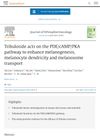
 This study found that tribuloside, a flavonoid from Tribulus terrestris L., enhances melanin production in human melanocytes, zebrafish, and human skin samples without causing toxicity, potentially through inhibiting PDE to increase cAMP levels and promote the melanin biosynthesis pathway.
 14 citations
,
May 2013 in “Experimental Dermatology”
14 citations
,
May 2013 in “Experimental Dermatology” This study found that the modified wash test was generally more effective than TrichoScan® for diagnosing hair loss, particularly telogen effluvium, though both methods showed only fair concordance with clinical diagnosis.
 January 1999 in “American Journal of Medical Genetics Part A”
 This case report describes a rare occurrence of ectodermal dysplasia features in a 14-year-old with MBTPS1 gene variants, expanding the known spectrum of related disorders.
 January 2022 in “International review of movement disorders”
 In this review, the authors found that cannabinoids and steroid-related drugs show potential for treating Tourette syndrome, but existing evidence is limited and further research is needed to confirm their efficacy and safety.
 December 2020 in “TURKDERM”
 This case report describes a 3-year-old boy diagnosed with temporal triangular alopecia, emphasizing the importance of clinical and dermoscopic examination for correct diagnosis due to the condition's rarity and risk of misdiagnosis.