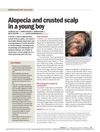
 March 2026 in “Open MIND”
 Early treatment of scalp infections can prevent permanent hair loss.
 20 citations
,
March 2005 in “Current Medicinal Chemistry”
20 citations
,
March 2005 in “Current Medicinal Chemistry” This study reports that newly synthesized steroidal trienones exhibit higher 5α-reductase inhibitory activity than dienones in various biological models, suggesting potential use in treating androgen-dependent diseases.
 December 2019 in “International journal of engineering applied science and technology”
 This review discusses the traditional uses of Tridax procumbens for wound healing, antifungal, and antibacterial purposes, but reports no clinical findings.
 June 2026 in “Drugs in Context”
 This review highlights that deucravacitinib, a selective TYK2 inhibitor, shows promise as an effective treatment for psoriasis and other inflammatory skin diseases, though real-world evidence beyond psoriasis is still emerging.
12 citations
,
January 2021 in “Dermatology Research and Practice” This study found that using a nonablative 1927 nm wavelength laser followed by hydroquinone cream is safe and effective for treating postinflammatory hyperpigmentation in patients with dark skin types.

In this case study, treatment with terbinafine effectively resolved symptoms of tinea capitis in an eight-year-old male, highlighting trichoscopy as a valuable diagnostic tool for this common fungal scalp infection and proposing its integration with clinical data for quicker diagnosis in settings lacking mycological facilities.
 156 citations
,
September 2014 in “British journal of dermatology/British journal of dermatology, Supplement”
156 citations
,
September 2014 in “British journal of dermatology/British journal of dermatology, Supplement” This guideline review discusses updated evidence-based recommendations for managing tinea capitis, with a focus on accurate diagnosis, effective treatment, and prevention strategies, but reports no new clinical results.
22 citations
,
November 2002 in “Clinical journal of oncology nursing” This article discusses arsenic trioxide as a treatment for refractory or relapsed acute promyelocytic leukemia, noting its effectiveness and manageable side effects.
15 citations
,
January 2009 in “Indian journal of dermatology, venereology, and leprology” This case report describes two instances of white piedra, a fungal hair infection, and notes successful treatment with oral itraconazole and topical ketoconazole in one patient.
2 citations
,
April 2023 in “Journal of Psoriasis and Psoriatic Arthritis” This study found that TNFα inhibitors can induce psoriatic alopecia, highlighting that early diagnosis and discontinuation of the drugs in some cases may prevent irreversible scalp damage.
 37 citations
,
January 2016 in “Drug design, development and therapy”
37 citations
,
January 2016 in “Drug design, development and therapy” This review discusses the use of tofacitinib as a treatment for plaque psoriasis, highlighting its efficacy and safety in clinical trials, but notes unresolved questions regarding long-term safety.
15 citations
,
June 2021 in “International Journal of Molecular Sciences” This study demonstrated that novel curcumin analogs CMC2.24, CMC2.23, and CMC2.5 were more effective and less toxic than parent curcumin in inhibiting melanin production in normally pigmented human melanocytes, suggesting potential for skin depigmentation therapies.
 70 citations
,
July 2020 in “Pharmacological Reports”
70 citations
,
July 2020 in “Pharmacological Reports” This review discusses the antiviral potential of cepharanthine against SARS-CoV-2, noting its effectiveness in preclinical models but presenting no new clinical results.
22 citations
,
March 2017 in “Transplant Infectious Disease” This case report describes successful treatment of generalized trichodysplasia spinulosa with leflunomide in a patient undergoing immunosuppressive therapy following solid organ transplantation.
 3 citations
,
January 2010 in “Actas Dermo-Sifiliográficas”
3 citations
,
January 2010 in “Actas Dermo-Sifiliográficas” This paper reviews the growing use of psychotropic drugs in dermatology due to the link between mental states and skin conditions but does not present new clinical findings.
 July 2023 in “GLOBAL JOURNAL FOR RESEARCH ANALYSIS”
 This study explored a new treatment approach using 20% TCA application with topical bimatoprost solution for managing alopecia areata of the eyebrows in cases where traditional treatments failed, offering a potential additional option for difficult cases.

This study explored new molecular structures as potential COVID-19 treatments, identifying a compound called Hit15 that inhibited viral infection in lab settings and reduced inflammation markers in human neutrophils, suggesting further development is warranted.
8 citations
,
January 2019 in “Journal of cosmetic dermatology” This study found that six sessions of a modified phenol peel effectively reduced hyperpigmentation in patients with Lichen Planus Pigmentosus, with 76% of treated individuals experiencing at least a 25% improvement, and no serious side effects reported.
13 citations
,
October 2001 in “British Journal of Ophthalmology” This report discusses the use of intralesional cidofovir and suggests it might be a viable option for treating SCC due to its successful outcome without observed systemic toxicity in this case.
 6 citations
,
November 1999 in “Mycoses”
6 citations
,
November 1999 in “Mycoses” This case study of a 75-year-old Japanese man with kerion Celsi found that terbinafine treatment was effective and safe, achieving a cure with minimal side effects.
 July 2015 in “Actas Dermo-Sifiliográficas”
 A young woman with a rare fungal infection showed significant improvement after treatment with antifungal medication.
August 2025 in “Anais Brasileiros de Dermatologia” This review details phenol's dermatological uses and underscores its potent skin rejuvenation effects but emphasizes the need for caution due to risks of serious complications, including cardiac arrhythmias and organ failure, particularly with improper use or large-area applications.
297 citations
,
December 2005 in “Journal of controlled release” This study found that POD-loaded solid lipid nanoparticles using 0.5% poloxamer 188 and 1.5% soybean lecithin (P-SLN) improved epidermal targeting and POD accumulation in porcine skin compared to traditional tincture.
 3 citations
,
January 2016 in “Chemical sciences journal”
3 citations
,
January 2016 in “Chemical sciences journal” This study found that ethanol and petroleum ether extracts of Tridax procumbens roots demonstrated significant antibacterial activity against various bacterial strains compared to benzene extracts.
May 2026 in “Inflammopharmacology”  16 citations
,
January 2001 in “Clinical and Experimental Dermatology”
16 citations
,
January 2001 in “Clinical and Experimental Dermatology” Photodynamic therapy was effective in treating multiple scalp basal cell carcinomas with minimal side effects and good cosmetic results.
July 2026 in “Asian Journal of Pharmaceutical Sciences” The researchers designed a Janus microneedle system for treating vitiligo, which targets the skin’s layers to regulate the immune response, promote melanocyte regeneration, and enhance pigment transfer, offering a new precise treatment approach for this condition.
 1 citations
,
April 2017 in “Journal of Investigative Dermatology”
1 citations
,
April 2017 in “Journal of Investigative Dermatology” This study found that oral tofacitinib led to variable hair regrowth in patients with resistant alopecia areata, implying that longer treatment durations may be needed to fully assess its effectiveness.
7 citations
,
January 2025 in “Journal of Medicinal Chemistry” This study identified orally available itaconate derivatives that improve cellular permeability and bioavailability, with specific POC-based prodrugs showing significant inhibition of inflammatory cytokines in human epidermal keratinocytes and favorable oral pharmacokinetics, highlighting their potential for treating systemic and skin disorders.
 5 citations
,
July 2019 in “Photodiagnosis and photodynamic therapy”
5 citations
,
July 2019 in “Photodiagnosis and photodynamic therapy” This study reports a case of a 59-year-old female with refractory follicular mucinosis and diffuse scalp alopecia who achieved complete clinical remission following treatment with a combination of topical tacalcitol and photodynamic therapy.