November 2025 in “SKIN The Journal of Cutaneous Medicine” This study observed that adolescents with alopecia areata receiving ritlecitinib 50 mg daily showed notable hair regrowth over three years, as seen in both clinician- and patient-reported outcomes. However, the decreased number of participants at later stages limits the findings.
 October 2025 in “Plastic & Reconstructive Surgery”
 This study evaluated the safety and effectiveness of MNC-QQ cell therapy in five men with androgenic alopecia, reporting no adverse effects and improvements in hair growth, hair density, and quality of life over six months.
1 citations
,
December 1995 in “Archives of Dermatology” This case report describes a patient with advanced androgenetic alopecia who underwent a 6-month trial of topical minoxidil and oral finasteride, aiming to optimize hair regrowth without surgery.
 January 2023 in “Dermatologic Therapy”
 In this randomized controlled trial, the nutritional supplement PPT5 α was associated with increased terminal hair percentages and improved self-assessed hair parameters in women with early-stage androgenetic alopecia.
 April 2025 in “International Journal of Research in Dermatology”
 In this study, a holistic hair treatment regimen significantly increased hair density in men with stages 2-4 male androgenetic alopecia, showing a more effective outcome than minoxidil over six months, and offering an alternative to traditional treatments.
 July 1997 in “The Lancet”
 This abstract reports preliminary data on the antidepressant reboxetine, noted for its different mode of action, discussed at a major psychiatry conference; it provides no new research findings.
6 citations
,
December 2021 in “Journal of Cancer Research and Therapeutics” In this study, induction nab-paclitaxel plus cisplatin, combined with nimotuzumab and IMRT, followed by S-1 adjuvant chemotherapy, showed excellent survival benefits with tolerable toxicities for stage N3 nasopharyngeal carcinoma patients.
 3 citations
,
June 1995 in “International Journal of Gynecology & Obstetrics”
3 citations
,
June 1995 in “International Journal of Gynecology & Obstetrics” This paper cites a prospective, randomized, double-blind, controlled trial investigating laser laparoscopy for pelvic pain associated with minimal to moderate endometriosis but reports no new results.
 4 citations
,
October 2020 in “Research Square (Research Square)”
4 citations
,
October 2020 in “Research Square (Research Square)” This study reported that more sensitive, early diagnosis and treatment of COVID-19 with drug combinations significantly improved clinical outcomes in males with or without androgenetic alopecia, preventing severe progression.
3 citations
,
July 2022 in “European Journal of Dermatology” In this study, researchers using multistate modeling reported that patients with psoriasis treated with brodalumab had a higher probability of achieving and maintaining a therapeutic response compared to those treated with ustekinumab over 52 weeks, based on absolute PASI measurements.
 April 2026 in “Journal of Aesthetic Medicine”
 This study found that the MIRA technique, using ultrasound-guided needle adjustments, improved cellulite treatment outcomes compared to standard methods in women with stage 3 cellulite, evidenced by greater reductions in adipose thickness and other skin irregularities, along with higher patient satisfaction.

JAK inhibitors, like baricitinib and ritlecitinib, show promise in treating alopecia areata effectively and safely.
 1 citations
,
October 2020 in “Research Square (Research Square)”
1 citations
,
October 2020 in “Research Square (Research Square)” This study observed that males with androgenetic alopecia using dutasteride showed significantly improved COVID-19 outcomes, including shorter duration of symptoms and viral shedding, compared to those not using it and non-AGA males.
4 citations
,
September 2024 in “Cell Reports” This study found that mice lacking the CXCR2 receptor regenerated tissue scarlessly in various injury models and that administering plasma or G-CSF from these mice to wild-type mice also reduced scarring, suggesting potential therapeutic strategies to improve human skin wound healing.
 February 2012 in “Australasian Journal of Dermatology”
 Some moles can disappear naturally, maintenance therapy for Stage 1 mycosis fungoides may not be necessary, allergic skin reactions in children are rising, weekly methotrexate for psoriasis is more effective than daily, long-term finasteride use improves hair growth with few side effects, and petrolatum improves UV therapy for psoriasis.
20 citations
,
April 2022 in “Frontiers in Bioengineering and Biotechnology” This review highlights the potential of regenerative medicine therapies, particularly stem cells, in treating a range of chronic diseases and injuries, while also discussing advancements and limitations in their application in Malaysia compared to other Asian countries.
 January 2022 in “Stem cell biology and regenerative medicine”
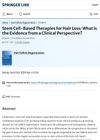
 This review explores the use of stem cell-based therapies for hair regeneration, highlighting the potential benefits of stem cell-derived conditioned medium, but stresses the need for more rigorous clinical trials to substantiate its efficacy.
 55 citations
,
April 2010 in “Cancer and Metastasis Reviews”
55 citations
,
April 2010 in “Cancer and Metastasis Reviews” This article discusses the complex role of TGFβ in cancer progression, highlighting its dual function as both a tumor suppressor in early stages and a promoter in later stages, without reporting new results.
39 citations
,
June 2009 in “Oncology” This study observed that high-dose retinol palmitate was well-tolerated in resected stage I lung cancer patients, though it raised concerns about potential impacts on lipid metabolism due to elevated gamma-GT levels and triglycerides.
4 citations
,
January 2018 in “Journal of dermatology & dermatologic surgery” This review compares European and U.S. treatment guidelines for hidradenitis suppurativa and reports no definitive standard, highlighting the need for more randomized controlled trials.
 March 2026 in “Preprints.org”
 This study found that the MIRA technique, which customizes needle length and injection angle guided by ultrasound, improved structural and esthetic outcomes for cellulite treatment compared to standard methods.
 7 citations
,
March 2011 in “Expert Opinion on Drug Safety”
7 citations
,
March 2011 in “Expert Opinion on Drug Safety” This review discusses the efficacy and safety of exemestane as a treatment for estrogen-receptor-positive breast cancer and reports no new clinical results.
 3 citations
,
February 2005 in “Lung Cancer”
3 citations
,
February 2005 in “Lung Cancer” The new chemotherapy combination for advanced lung cancer showed a 35.7% response rate but caused significant side effects.
58 citations
,
January 2015 in “Journal of the American Academy of Dermatology” Pioglitazone may help treat lichen planopilaris, but more research is needed.
 May 2017 in “InTech eBooks”
 This review discusses trichotillomania and traction alopecia, focusing on their clinical features, diagnostic criteria, and treatment options, but it reports no new research findings.
 October 2010 in “International journal of radiation oncology, biology, physics”
 In this randomized study, patients with early favorable Hodgkin lymphoma showed similar complete remission and survival rates whether receiving 2 or 4 cycles of ABVD and 20 Gy or 30 Gy IFRT, though reduced toxicity was associated with fewer cycles and lower radiation doses.
 March 2026 in “Pharmaceutics”
 This review discusses the potential of plant-derived nanovesicles as natural therapeutics and drug delivery platforms in cancer therapy, highlighting their versatility and promising applications, but reports no new clinical results.
 December 2013 in “Nursing2023”
 The FDA approved a new breast cancer treatment, found flu shots may reduce heart risks, questioned the safety of fast-tracked drug approvals, showed statins don't help with certain pneumonia, and approved a new dementia imaging agent.
 January 2019 in “Springer eBooks”
 PRP may help with hair loss and improve hair quality with few side effects, but more research is needed.
 April 2016 in “Journal of The American Academy of Dermatology”
 Ixekizumab is effective and safe for patients who did not improve with etanercept treatment for psoriasis.