 1 citations
,
October 2022 in “Molecular therapy”
1 citations
,
October 2022 in “Molecular therapy” This study found that betibeglogene autotemcel significantly improved transfusion independence in 89% of patients with transfusion-dependent beta-thalassemia, although the high cost and manufacturing challenges may limit widespread adoption.
 1 citations
,
July 2025 in “SKIN The Journal of Cutaneous Medicine”
1 citations
,
July 2025 in “SKIN The Journal of Cutaneous Medicine” In this study, ritlecitinib 50-mg showed clinically meaningful efficacy, with improvements in the Severity of Alopecia Tool score observed in patients with alopecia areata over a 3-year period, demonstrating long-term benefit in both clinician- and patient-reported outcomes.
 September 2024 in “Drugs & Therapy Perspectives”
 In this study, ritlecitinib, an oral medication approved for adolescents and adults, significantly reduced scalp hair loss and promoted eyebrow and eyelash regrowth in severe alopecia areata patients, with benefits sustained over 48 weeks and generally well-tolerated minor side effects.
 2 citations
,
January 2008 in “International Journal of Neuroscience”
2 citations
,
January 2008 in “International Journal of Neuroscience” This article presents a case of delayed diagnosis of Kearns-Sayre syndrome in a 38-year-old man and reviews clinical and laboratory findings associated with the disorder, reporting no new results.
 1 citations
,
January 2013 in “International Journal of Trichology”
1 citations
,
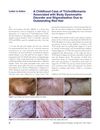
January 2013 in “International Journal of Trichology” A girl with red hair developed hair-pulling and body image disorders after being bullied for her hair color.
June 2025 in “British Journal of Dermatology” This case report details a probable severe adverse event associated with ritlecitinib for alopecia areata, highlighting risks of pulmonary emboli, infection, atrial fibrillation, and acute kidney injury despite an absence of known risk factors.
10 citations
,
January 2015 in “European journal of pharmacology” In this animal study, ginsenoside Rb1 demonstrated therapeutic effects on hypertrophic scar remodeling, with the highest efficacy observed at a dose of 0.56 mg.
January 2024 in “Ankara City Hospital Medical Journal” This case report details a 42-year-old woman with Rhupus, a rare overlap syndrome of rheumatoid arthritis and systemic lupus erythematosus, emphasizing diagnostic challenges due to non-specific clinical criteria and documenting symptoms like inflammatory arthritis, malar rash, and hematological abnormalities.
66 citations
,
August 2007 in “Applied and environmental microbiology” This study engineered a bioluminescent yeast strain responsive to androgenic chemicals, demonstrating rapid and sensitive detection suitable for high-throughput screening and environmental monitoring.
13 citations
,
July 2016 in “Indian Journal of Dermatology” This report describes two Saudi brothers with dermatopathia pigmentosa reticularis who exhibited normal hair shafts despite their condition.
 February 2026 in “Journal of Dermatology and Skin Science”
 This review highlights that obsessive-compulsive disorder and body-focused repetitive behaviors are increasingly encountered in dermatology, often going undetected, and emphasizes the role of dermatologists in early identification and interdisciplinary treatment to address both physical and psychological aspects for improved outcomes.
23 citations
,
October 2024 in “British Journal of Dermatology” In this study, ritlecitinib showed sustained effectiveness and a favorable safety profile in treating alopecia areata in patients aged 12 and older over 24 months, with improvements observed in hair and eyebrow regrowth and patient satisfaction.
 14 citations
,
April 2021 in “Biology”
14 citations
,
April 2021 in “Biology” This study found that ethanol extract of Tubtim Chumphae rice bran downregulates SRD5A gene expression, similarly to finasteride, suggesting potential use as an anti-hair loss product.
 May 2014 in “Hair transplant forum international”
 This spotlight highlights the Brazilian Association of Hair Restoration Surgery and shares the positive experiences of the International Society of Hair Restoration Surgery members with their Brazilian colleagues, reporting no new findings.
 7 citations
,
February 2019 in “Journal of pharmacological sciences”
7 citations
,
February 2019 in “Journal of pharmacological sciences” This study found that Bazhengsan significantly reduced inflammation and hyperplasia in male rats with nonbacterial prostatitis, indicating potential as a treatment for chronic prostatitis.
March 2026 in “Bioengineering & Translational Medicine” This study reported that a modified version of Thymosin beta 4, called PEG-rTβ4, demonstrated potential as a treatment for acute myocardial infarction by improving cardiac function and reducing cell death via specific biochemical pathways, suggesting its promise in drug development efforts.
 November 2002 in “Hair transplant forum international”
 This announcement from the President of the American Board of Hair Restoration Surgery reports the formation and incorporation of the International Board of Hair Restoration Surgery, but offers no new research findings.
13 citations
,
May 2010 in “Dermatologic Clinics” Recurrent furunculosis can be managed with antibiotics, decolonization, and decontamination, with potential future use of vaccines and bacteriophage therapy.
 11 citations
,
March 2014 in “Journal of Investigative Dermatology”
11 citations
,
March 2014 in “Journal of Investigative Dermatology” In this study, basal cell carcinoma developed in Ptch-deficient mice only after chemical treatment, not skin wounding, suggesting a second unknown event is necessary for tumor formation.
1 citations
,
August 2024 in “British Journal of Dermatology” This study found that after 15 months of treatment with ritlecitinib, patients with alopecia areata and less than 95% initial hair loss experienced significant hair regrowth, though those with more extensive hair loss showed more variable improvement.
3 citations
,
September 2022 in “European Journal of Dermatology” This report identifies a novel splice-site variant in the LAMB3 gene linked to junctional epidermolysis bullosa, emphasizing the need for gene sequencing in diagnosing the disease.
25 citations
,
April 2017 in “PloS one” In this study, specific SNPs in the FST gene were significantly associated with various wool quality traits in Chinese Merino sheep, suggesting potential markers for breeding programs.
 6 citations
,
January 2012 in “Journal of Biomedicine and Biotechnology”
6 citations
,
January 2012 in “Journal of Biomedicine and Biotechnology” This report reviews peer-reviewed case studies indicating potential efficacy of ustekinumab for treating challenging forms of psoriasis but notes the need for further research on cost-effectiveness and risk-benefit.
 3 citations
,
June 2020 in “Open access rheumatology”
3 citations
,
June 2020 in “Open access rheumatology” This case report reviews the management of Rowell syndrome in a patient initially diagnosed with Rhupus syndrome and highlights their development of erythema multiforme after certain medications.
107 citations
,
March 2014 in “BoneKEy Reports” This abstract reviews hereditary vitamin D-resistant rickets, a rare genetic condition causing severe early childhood rickets, and reports no new results; effective treatment typically requires high doses of calcium to address hypocalcemia and secondary hyperparathyroidism.
 January 2025 in “JCEM Case Reports”
 This report describes two cases of glucocorticoid resistance syndrome highlighting genetic diversity; one patient improved with low-dose dexamethasone despite negative genetic testing, while the other is monitored with a novel NR3C1 variant.
 March 2024 in “EMBO molecular medicine”
 This study found that the antiviral drug daclatasvir significantly improved fibrosis and quality of life in a mouse model of recessive dystrophic epidermolysis bullosa, suggesting potential for treating this and other fibrotic diseases.
 29 citations
,
January 2010 in “Methods in Enzymology”
29 citations
,
January 2010 in “Methods in Enzymology” This review discusses five genetic fate mapping methods used to study cell behaviors during development and regeneration, detailing the necessary tools and considerations without reporting new experimental results.
This study identified a 14,883 bp genomic deletion affecting the Plcd1 and Vill genes as likely responsible for the abnormal phenotype observed in snthr-1Bao mice.
14 citations
,
January 2015 in “Skin Appendage Disorders” This study examined severe skin reactions, including erythema and eczema-like lesions, associated with Brazilian keratin treatment, suggesting a drug reaction phenomenon rather than solely irritant or allergic origin.