 1 citations
,
June 2012 in “Revista Brasileira de Cirurgia Plástica”
1 citations
,
June 2012 in “Revista Brasileira de Cirurgia Plástica” In this study, the authors reported that frontal rhytidectomy with a pre-hairline incision effectively reduces a long forehead in select patients, with patients feeling the benefits outweighed the visibility of the scar.
 May 2026 in “Journal of Wildlife and Conservation Medicine”
 This study found that camera trap images revealed mange-like skin lesions in snow leopards and other species in Kyrgyz reserves, with detection rates varying widely and raising concerns about disease spread.
 January 2026 in “ITM Web of Conferences”
 This review examines the current state of automated vitiligo detection systems, noting a lack of large, diverse datasets and consistent imaging conditions, while comparing traditional and modern machine learning approaches to improve reliability and applicability.
 February 2025 in “Revista Eletrônica Acervo Saúde”
 This report emphasizes the importance of considering thyroid tuberculosis in the differential diagnosis of cervical masses, highlighting the role of biopsy and histopathological examination for accurate diagnosis and treatment.
In this study, researchers found that an injectable solution of low-molecular-weight hyaluronic acid and amino acids significantly improved skin rejuvenation and elasticity in the labia majora of post-menopausal women over 12 weeks, with a reported 25% or greater aesthetic improvement and high patient satisfaction.
 March 2024 in “Bioimpacts”
 In this study, curcumin-loaded nanoparticles with a size of 400 nm showed optimal accumulation in human hair follicles after seven days, although mouse models differed significantly in penetration and retention, indicating limitations in their suitability for follicular drug delivery studies.
 November 2023 in “Deleted Journal”
 In this study, the researchers found no superiority of combining 308-nm excimer laser with intralesional corticosteroid over corticosteroid alone for treating frontal fibrosing alopecia, and reported side effects such as erythema and postinflammatory hyperpigmentation in both treatment groups.
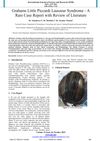 October 2023 in “International Journal of Science and Research (IJSR)”
 This paper describes Grahams Little Piccardi Lassueur Syndrome, a rare type of Lichen Planopilaris that causes different types of alopecia and distinctive skin papules, primarily affecting females aged 40 to 70, and notes the current challenges in treatment options, particularly once scarring occurs.
 April 2023 in “Acta Scientific Orthopaedics”
 This essay discusses hair loss due to head bone displacement and does not report new clinical results, building on the author's prior work regarding the natural process of growth-related changes.
 August 2021 in “Acta Haematologica Polonica”
 This paper discusses the diagnostic challenges and treatment options for folliculotropic mycosis fungoides, emphasizing the differing prognoses between its indolent and aggressive subtypes and reporting no new clinical results.
 April 2021 in “JOJ dermatology & cosmetics”
 This study found that a combination treatment of laser photobiomodulation and plasma jet therapy was effective in improving alopecia areata in a 38-year-old woman after 14 sessions over three months, as evidenced by comparative photo documentation.
 August 2018 in “Journal of The American Academy of Dermatology”
 This study found that while both conventional care and teledermatology showed similar clinical response rates for treating actinic keratosis with imiquimod 5% cream, teledermatology was associated with higher treatment failure and local reaction rates.
This source reviews advancements in microneedle-based cosmeceutical delivery, discussing new technologies and highlighting a burgeoning area of research involving microneedling combined with stem cell delivery for anti-aging, without finding measurable changes in skin barrier function or appearance during the study period.
 July 2016 in “British Journal of Dermatology”
 The book provides an overview of new trends and techniques in cosmetic dermatology.
 January 2011 in “Journal of Human Genetics”
 This study found a severe MBTPS2 gene mutation in a Japanese IFAP syndrome patient, suggesting other factors may influence the syndrome's clinical features compared to previously studied patients.

Hair properties change under electromagnetic fields and are influenced by individual characteristics and the environment.
 May 2004 in “Dermatologic Surgery”
 In this study, 32% of men continued taking finasteride for androgenetic alopecia after 1 to 3 years, but only a small percentage reported hair growth.
 May 2004 in “The Journal of Laryngology & Otology”
 The first book is highly recommended for facial surgery education, the second book is useful despite its limited focus, and the third book is not user-friendly due to dense text and poor images.
 November 2002 in “Skinmed”
 This article discusses the Columbia Manual of Dermatologic Cosmetic Surgery but provides no research results.
 May 1993 in “Current problems in dermatology”
 This review discusses diagnostic approaches for childhood skin diseases with fever through clinical observations and covers recent advances in understanding the pathogenesis and epidemiology of related infections, without reporting new clinical results.
 April 2021 in “Journal of Cosmetic Dermatology”
 Stem cell treatment improved hair density in female hair loss patient.
 January 2018 in “Sohag Medical Journal”
 Combining topical dutasteride with microneedling is more effective for hair growth than microneedling alone.
 305 citations
,
March 2018 in “International journal of molecular sciences”
305 citations
,
March 2018 in “International journal of molecular sciences” In this review, the authors summarize classical and recent insights into the biology and treatment of hypertrophic scars and keloids, concluding that while understanding and strategies have advanced, effective prevention and treatments remain unsatisfactory.
 176 citations
,
August 1981 in “JAMA”
176 citations
,
August 1981 in “JAMA” This study reported that toxic shock syndrome, originally noted in children, is now predominantly associated with menstruating women, with some experiencing recurrence and complications like vocal cord paralysis and impaired finger sensation.
 132 citations
,
October 1995 in “Journal of the American Academy of Dermatology”
132 citations
,
October 1995 in “Journal of the American Academy of Dermatology” This report concludes that the blend method is the most effective electrolysis technique for permanent hair removal, requiring proper technique and preparation such as shaving before treatment to increase efficacy.
 89 citations
,
November 2014 in “Medical Clinics of North America”
89 citations
,
November 2014 in “Medical Clinics of North America” This article reviews management strategies for PCOS and reports no new clinical results; the authors highlight oral contraceptives, lifestyle modifications, and metformin as key interventions.
 88 citations
,
May 2012 in “Human Reproduction Update”
88 citations
,
May 2012 in “Human Reproduction Update” This review discusses WHO group 2 anovulation, highlighting polycystic ovary syndrome as a common cause of infertility and noting current treatment options without presenting new clinical results.
 76 citations
,
April 2013 in “PLoS ONE”
76 citations
,
April 2013 in “PLoS ONE” The researchers reported that reactive oxygen species regulate the stress-induced SP-Mast cell pathway, which might support using antioxidants to treat stress-related hair loss.
 63 citations
,
March 1995 in “International Journal of Dermatology”
63 citations
,
March 1995 in “International Journal of Dermatology” Some drugs can cause hair loss, and stopping these drugs often leads to hair regrowth.
 58 citations
,
July 2007 in “Clinics in Dermatology”
58 citations
,
July 2007 in “Clinics in Dermatology” This article reviews the use of medical tattooing for cosmetic and therapeutic purposes across various fields, but reports no new clinical results.