 5 citations
,
April 2017 in “Dermatologic Surgery”
5 citations
,
April 2017 in “Dermatologic Surgery” PRP treatment satisfies 58% of female hair loss patients, with most noticing fuller, thicker hair and less shedding.
2 citations
,
February 2012 in “PubMed” This study found that Gp₄G increased hair length, papilla cell numbers, and versican deposition in treated animals, potentially through alterations in hair follicle phases and nucleotide concentrations.
 November 2025 in “International Journal of Advanced Research”
 In this case report, PRP therapy led to almost complete clearance of hypopigmentation in a 28-year-old Caucasian female after laser hair removal, suggesting PRP could be a promising treatment option for various hypopigmentation conditions.
 May 2022 in “Journal of Immunology”
 In this study, a TGF-β mimic molecule from Heligmosomoides polygyrus was observed to enhance wound healing in mice, with improved tissue regeneration and specific immune cell recruitment without increased scarring.
 April 2023 in “Journal of Investigative Dermatology”
 This study found that sebaceous glands can regenerate after PPARg deletion in adult skin, relying on the hair cycle and FGFR signaling.
2 citations
,
April 2022 in “Der Hautarzt” This review discusses the current literature on platelet rich plasma injections for androgenetic alopecia, noting that while some studies report positive outcomes, they often suffer from methodological weaknesses and inconsistent results.
 54 citations
,
December 2014 in “Wound Repair and Regeneration”
54 citations
,
December 2014 in “Wound Repair and Regeneration” This study observed that autologous PRP and PDRN injections improved hair thickness and density in women with pattern hair loss, with combined therapy showing greater improvement in thickness than PDRN alone.

This review outlines platelet-rich plasma practices for androgenetic alopecia at a large academic center and highlights the importance of standardizing PRP protocols to improve treatment outcomes, but it reports no new clinical results.
 2 citations
,
January 2014 in “Hair transplant forum international”
2 citations
,
January 2014 in “Hair transplant forum international” This article discusses the mixed perceptions and potential profitability of PRP therapy in hair treatment, but does not report new clinical results.
17 citations
,
May 2005 in “Hair transplant forum international” This study evaluated the effectiveness of follicular units and growth factors derived from autologous platelet-rich plasma in improving hair growth and density in 23 male patients with pattern hair loss.
 May 2024 in “Journal of the Egyptian Women's Dermatologic Society /Journal of the Egyptian Women's Dermatologic Society”
 In this split-scalp study, researchers observed that combining fractional CO2 laser and PRP treatment was significantly more effective in improving hair parameters in women with female pattern hair loss than using each intervention alone or placebo.
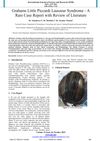 October 2023 in “International Journal of Science and Research (IJSR)”
 This paper describes Grahams Little Piccardi Lassueur Syndrome, a rare type of Lichen Planopilaris that causes different types of alopecia and distinctive skin papules, primarily affecting females aged 40 to 70, and notes the current challenges in treatment options, particularly once scarring occurs.
14 citations
,
January 2019 in “Annals of plastic surgery” This case report details a face and scalp transplant in a patient with granulomatosis with polyangiitis and trauma, showing an encouraging 3-year outcome without disease relapse or severe complications.
September 2023 in “Journal of the American Academy of Dermatology” Recognizing IPPP is crucial to prevent misdiagnosis and unnecessary treatments.
 9 citations
,
August 2002 in “Current Opinion in Pediatrics”
9 citations
,
August 2002 in “Current Opinion in Pediatrics” This article discusses the roles of pediatrics and dermatology departments at Yale University School of Medicine, but reports no specific clinical results.
19 citations
,
January 2019 in “Animals” This study suggests that PDGFA and BMP2 play a role in the hair follicle cycle in cashmere goats, with PDGFA particularly involved in activating the growth phase.
 136 citations
,
April 2016 in “Dermatologic Surgery”
136 citations
,
April 2016 in “Dermatologic Surgery” This study found that platelet-rich plasma significantly increased hair density and anagen hair proportions in androgenetic alopecia patients, suggesting potential as an adjuvant therapy.
August 2026 in “Journal of Cosmetic Dermatology” This study found that Plinest injections improved skin hydration and elasticity in the face, neck, and décolleté and were well-tolerated, with high patient satisfaction over a 4-month follow-up.
 January 2024 in “Biological & pharmaceutical bulletin”
 In this study, Panax ginseng extract and its ginsenosides were found to stimulate the proliferation of hair-related cells and promote the transition from the telogen to the anagen phase, enhancing hair-shaft growth by suppressing BMP4 expression in human dermal papilla cells.
 57 citations
,
October 2018 in “Journal of The American Academy of Dermatology”
57 citations
,
October 2018 in “Journal of The American Academy of Dermatology” This study found that platelet-rich plasma significantly increased hair count, density, and the percentage of anagen hairs in patients with androgenetic alopecia, but these improvements did not correlate with platelet or growth factor levels.
 May 2013 in “Hair transplant forum international”
 This abstract provides summaries of two conferences on hair treatments, covering growth factors and female pattern hair loss, but reports no new research findings.
2 citations
,
February 2000 in “International Journal of Dermatology” This article presents four case reports of men with porphyria cutanea tarda and hepatitis C, highlighting associations with polysubstance abuse, primarily alcohol.
 March 2024 in “Journal of Cosmetic Dermatology”
 This study found that pretreating concentrated growth factor with a 640 nm laser increased CD34+ stem cell activation and improved hair growth outcomes in androgenetic alopecia patients compared to non-pretreated CGF.
 19 citations
,
January 2017 in “International Journal of Trichology”
19 citations
,
January 2017 in “International Journal of Trichology” This study found that a standardized PRP application protocol was effective as a coadjuvant therapy in most patients with androgenetic alopecia who did not respond to minoxidil or finasteride, based on improvements in Ebling's scale.
July 2024 in “Journal of Investigative Dermatology” This study found that inhibiting the enzyme PDE8A can promote adipocyte differentiation and enhance hair growth in an animal model of androgenetic alopecia, suggesting PDE8A as a potential therapeutic target for restoring dermal adipogenesis and hair cycling.
 April 2024 in “Biomedicine & pharmacotherapy”
 This study observed that pilose antler extract promoted hair growth in mice with androgenetic alopecia by stimulating the hair follicle growth cycle via the SHH/GLI pathway activation and BMP/Smad pathway suppression.
3 citations
,
September 2025 in “Neural Regeneration Research” This review discusses the roles of prostaglandins in the nervous system and their therapeutic potential for neurological diseases, noting their complex interactions with immune cells and signaling pathways.
 3 citations
,
September 2017 in “Stem cell investigation”
3 citations
,
September 2017 in “Stem cell investigation” This review discusses the various roles of skin-resident dermal white adipose tissue in hair growth inhibition, antibacterial responses, and wound healing, reporting no new empirical findings.
The researchers reported that PEG-FGF2 conjugates, particularly Compound 6, significantly enhanced stability, proliferation, migration, and wound healing activity compared to native FGF2, despite some reduction in bioactivity near crucial binding domains.
 13 citations
,
January 2020 in “Experimental Dermatology”
13 citations
,
January 2020 in “Experimental Dermatology” This pilot clinical trial suggests that platelet-rich plasma (PRP) treatment may increase hair density in patients with androgenetic alopecia, though outcomes varied between patients.