 October 2023 in “International Journal of Science and Research (IJSR)”
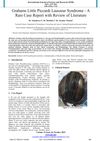
 This paper describes Grahams Little Piccardi Lassueur Syndrome, a rare type of Lichen Planopilaris that causes different types of alopecia and distinctive skin papules, primarily affecting females aged 40 to 70, and notes the current challenges in treatment options, particularly once scarring occurs.
 September 2022 in “TURKDERM”
 This article reports an unprecedented case of trichofolliculoma in the gluteal area, previously unreported in English literature.
July 2021 in “Authorea (Authorea)” This article discusses Graham-Little Piccardi Lassueur Syndrome, a rare variant of Lichen planopilaris, but reports no clinical findings or results.
April 2021 in “Aktuelle Dermatologie” This review discusses frontal fibrosing alopecia, noting its clinical characteristics, possible environmental factors, and lack of evidence-based therapies, but reports no new research findings.
December 2020 in “Forum Dermatologicum” In this case report, a combination treatment of intralesional triamcinolone acetonide, oral acitretin, and topical clobetasol propionate showed effectiveness in reducing symptoms of Graham-Little-Piccardi-Lasseur syndrome in one patient over two months, with no new areas of hair loss observed.
 January 2019 in “Medicine Science | International Medical Journal”
 This study found that specific skin lesions are common indicators of pediatric rheumatologic diseases, potentially aiding dermatologists and rheumatologists in diagnosis when biopsies are challenging.
September 2018 in “Obsgyne Review Journal of Obstetric and Gynecology of Siddharth Health Research and Social Welfare Society” This study found that pregnant women experience a broad array of skin changes, with pigmentary alterations and striae being the most common physiological changes observed.
This study reported that prompt diagnosis and treatment with 5-alpha-reductase inhibitors and topical immunomodulators are key to mitigating the effects of frontal fibrosing alopecia and preventing permanent hair loss.
May 2017 in “Journal of the American Academy of Dermatology” Monilethrix is a rare, inherited condition causing fragile hair and hair loss, with no cure but some treatments may help.
 September 2016 in “Journal of The American Academy of Dermatology”
 This case study identified the condition as Monilethrix in a 17-year-old female, characterized by a beaded hair appearance and linked to a genetic cause.
 January 2011 in “Journal of The American Academy of Dermatology”
 Two patients had a rare combination of red skin spots and white scaly skin lesions not on the genitals.
May 2007 in “Bioline International (Bioline International)” This study reports that 91.4% of pregnant women in south India experienced pigmentary alterations, highlighting various skin changes occurring during pregnancy.
January 1982 in “Clinical Cosmetic and Investigational Dermatology” This case report describes a 54-year-old woman with familial dyskeratotic comedones who experienced slight improvement in her skin lesions after three months of treatment with topical retinoids and urea cream.
January 1962 in “Archives of Dermatology” This case report describes a 5-year-old girl with lipoid proteinosis, characterized by a raspy voice, thinning scalp hair, and recurrent crusted lesions leading to pock-like scars.
139 citations
,
September 2001 in “The journal of investigative dermatology/Journal of investigative dermatology” This case report describes a patient with mutations in both alleles of the vitamin D receptor who exhibited hair loss clinically indistinguishable from generalized atrichia with papules, suggesting a potential genetic pathway shared with the hairless gene.

In this study, the authors emphasize the importance of accurately diagnosing congenital atrichia with papules—a condition marked by hair loss and papular skin lesions—differentiating it from other similar disorders to prevent unnecessary treatments and inform families about its benign but irreversible nature.
January 2025 in “Dermatology Online Journal” The man's hair loss and skin papules were diagnosed as atrichia with papular lesions, not alopecia areata universalis.
26 citations
,
May 1988 in “Pediatric dermatology” This report describes a 15-year-old male with widespread papules due to middermal epithelial cysts containing vellus hairs, also observed in his brother and father.
May 2025 in “Indian Dermatology Online Journal” This case report highlighted two atypical childhood alopecia cases: congenital atrichia without papules and Bjornstad syndrome with alopecia areata; emphasizing diagnostic challenges, notably the absence of keratotic papules usually associated with congenital atrichia and the presence of alopecia areata in Bjornstad syndrome.
 10 citations
,
April 2013 in “Veterinary dermatology”
10 citations
,
April 2013 in “Veterinary dermatology” In this study, four dogs with a novel skin disease showed clinical lesions involving verrucous, crusted papules and plaques, and responded variably to immunosuppressive therapy, suggesting an immune-mediated cause.
5 citations
,
September 2008 in “Hair transplant forum international” This abstract describes the clinical characteristics of folliculitis, focusing on the presence of erythematous papules or pustules surrounding hair follicles.
January 2025 in “International Journal of Applied and Basic Medical Research” In this case report, a 40-year-old woman with folliculitis decalvans exhibits symptoms like itchy papules and patchy hair loss, illustrating the importance of distinguishing this condition from similar scarring alopecias for appropriate treatment.
February 2022 in “Authorea (Authorea)” This report presents a case of a seven-year-old girl with porokeratotic adnexal ostial nevus manifesting as hyperkeratotic verrucous papules on her left foot.
21 citations
,
April 2000 in “Journal of Cutaneous Pathology” This case report describes a 22-year-old woman with a nevoid plaque termed localized follicular hamartoma, characterized by skin-colored papules and specific cellular and structural features.
 6 citations
,
January 2017 in “Annals of Dermatology”
6 citations
,
January 2017 in “Annals of Dermatology” This report describes a rare case of sarcoidosis occurring on an old blepharoplasty scar in a leukemia patient, suggesting the need for a skin biopsy when firm papules appear on a scar.
 5 citations
,
January 2018 in “Acta Dermatovenerologica Alpina Pannonica et Adriatica”
5 citations
,
January 2018 in “Acta Dermatovenerologica Alpina Pannonica et Adriatica” This case study highlights congenital atrichia with papular lesions as a cause of total body hair loss, characterized by the absence of hair follicles and the presence of skin-colored papules.

This case report describes a pediatric instance of follicular atopic dermatitis in a dark-skinned patient, highlighting its unique clinical and dermoscopic features, such as purplish to brownish scaly papules and specific dermoscopic patterns, which are crucial for enhancing diagnostic accuracy in similar cases.
January 2026 in “Acta Dermato Venereologica” This source reports that four weeks of dupilumab treatment led to notable improvement in skin lesions, including multiple erythematous patches and papules on the face, back, and limbs.
 October 2024 in “Iraqi postgraduate medical journal”
 This study conducted at Baghdad Teaching Hospital found that topical applications of Ciprofloxacin and Clindamycin effectively reduced acne severity indices in patients with mild to moderate acne vulgaris over 12 weeks, with Ciprofloxacin showing a greater reduction in papules and pustules compared to Clindamycin.
 January 2024 in “Clinical, cosmetic and investigational dermatology”
 In this case report, a four-year-old girl was diagnosed with vitamin D-dependent rickets type II, manifesting as diffuse alopecia, frontal bossing, hypoplastic teeth, and skin-colored papules, due to a genetic mutation causing resistance to 1.25-dihydroxy vitamin D.