 33 citations
,
March 2006 in “Seminars in cutaneous medicine and surgery”
33 citations
,
March 2006 in “Seminars in cutaneous medicine and surgery” This article illustrates various hair shaft defects and suggests that dermatologists can diagnose most of them using light microscopy and polarization without needing advanced imaging techniques.
11 citations
,
June 1974 in “Journal of Cutaneous Pathology” In this study, electron microscopy of follicular mucinosis showed severe cytoplasmic degeneration in hair follicles, with myelin figures and onion-like lamellar structures, but no indications of mucin release through degeneration or degradation were found.
10 citations
,
November 1993 in “Indian Journal of Dermatology Venereology and Leprology” This report observed that a male developed erythema multiforme linked to both topical and oral minoxidil use for androgenetic alopecia, supported by eruption recurrence with reapplication.
 3 citations
,
December 2013 in “Journal of Dermatology”
3 citations
,
December 2013 in “Journal of Dermatology” This study found that scanning electron microscopy can identify four specific hair morphology patterns in alopecia areata patients, offering a less invasive diagnostic option compared to punch biopsy.
3 citations
,
July 2020 in “Mechanisms of Development” 22 citations
,
September 1993 in “Archives of Dermatology” This case report details a 4-year-old girl who developed a fever and widespread papular, pruritic rash resembling a heat rash, with a progression to thick, scaly patches but had sterile blood and urine cultures.
2 citations
,
January 2006 in “Indian Journal of Veterinary Pathology” In this study of sheep across various breeds and ages, researchers found that Trichophyton mentagrophytes caused severe dermatophytosis, especially affecting young Shahbadi sheep during winter, leading to notable anemia and skin lesions.
11 citations
,
January 1977 in “Archives of dermatological research” Mouse tail skin has different keratinization near hair follicles and scales.
6 citations
,
February 2020 in “Journal of Cutaneous Pathology” This case report describes the histopathological features of nevus psiloliparus in an 11-year-old girl, noting "shadow" follicular units with loosely arranged collagen and reduced elastic fibers.
February 2026 in “Veterinary Dermatology” This study found that Pomeranians with Alopecia X had fewer follicles per group, more fragile hair, and distinct hair cycle stages compared to non-alopecic Pomeranians, highlighting coat-type differences significant for diagnosing the condition.
 18 citations
,
October 2002 in “Veterinary dermatology”
18 citations
,
October 2002 in “Veterinary dermatology” This study observed that follicular dysplasia in Weimar Pointers produces histopathological features and hair abnormalities similar to color dilution alopecia, though less severe.
April 1974 in “Pediatric Research” Monitoring nutrition and health is crucial for the well-being of institutionalized mentally retarded children.
 June 2024 in “British Journal of Dermatology”
 This case report highlights the diagnosis of folliculotropic mycosis fungoides in a 15-year-old boy with atypical skin and hair follicle changes, a rare occurrence in pediatric patients.
 6 citations
,
March 2011 in “Experimental Dermatology”
6 citations
,
March 2011 in “Experimental Dermatology” This study found that an imbalance of selenium in a C57BL/6 mouse model led to hair loss with color change and was linked with changes in hair follicle apoptosis markers.
 1 citations
,
March 2018 in “BMJ case reports”
1 citations
,
March 2018 in “BMJ case reports” This case report describes a 30-year-old bisexual African man with neurological symptoms, generalized wasting, and ophthalmological findings, but reports no new clinical research results.
 December 2024 in “Australian Journal of General Practice”
 In this case report, a 20-year-old woman exhibited progressive asymptomatic hair loss with a pattern inconsistent with alopecia areata or female pattern hair loss, showing areas of both extending and improving hair loss.
53 citations
,
July 2002 in “Journal of Investigative Dermatology” The Dfl mutation in mice causes poor sebaceous gland function and complete hair loss.
2 citations
,
January 1987 in “PubMed” This study reported three related cases of woolly hair syndrome transmitted as a dominant autosomal trait, characterized by fine, frizzy hair and general hair thinning.
 June 2024 in “Annals of Medicine and Surgery”
 This case report highlights the rare co-occurrence of Pili Annulati and Trichorrhexis Nodosa in a Syrian woman, underlining the need for further research into their relationship and treatment.
 January 2023 in “Figshare”
 This review discusses changes in hair follicle characteristics and stem cell dynamics as indicators of aging in mice, noting increased occurrences of white hairs and curved hair follicles at older ages.
17 citations
,
November 1967 in “American Journal of Anatomy” This study observed that the catagen phase in hairless mice displayed a slower shortening of the mutant epithelial column, resulting in longer total follicle length and abnormalities in the connective tissue sheath and glassy membrane.
149 citations
,
March 1981 in “American Journal of Ophthalmology” This study found that Demodex folliculorum and Demodex brevis mites can cause eyelid follicular and glandular changes, potentially contributing to ocular disease in humans.
 19 citations
,
March 2013 in “Journal of Cutaneous Pathology”
19 citations
,
March 2013 in “Journal of Cutaneous Pathology” This case report describes a 26-year-old female with linear morphea and unique alopecia characterized by atrophic follicular remnants, resembling telogen follicles but indicating permanent alopecia, unlike typical findings in morphea-related alopecia.
15 citations
,
June 2012 in “British Journal of Dermatology” This study identified a novel KRT86 mutation associated with autosomal dominant monilethrix, expanding understanding of its genetic basis beyond known motifs.
12 citations
,
January 2013 in “Indian Journal of Dermatology” This case report on a 13-year-old boy with monilethrix observed slight improvement after a two-month trial of oral N-acetyl cysteine, but overall hair density did not improve further.
 245 citations
,
January 1998 in “Genes & Development”
245 citations
,
January 1998 in “Genes & Development” This study found that Hoxc13 mutations in mice cause defects in hair, nail, and tongue structures, with the most noticeable issue being brittle hair leading to alopecia.
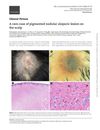
This study reported the case of a 30-year-old man with a bluish-grey scalp nodule that developed over a previously stable hairless plaque, revealing histopathological features consistent with epithelioid cell nests and spindle-shaped dermal melanocytes embedded in collagen.

This study utilized polarized light microscopy to examine hair shafts in ten children with rare genetic disorders, such as Netherton syndrome and ectodermal dysplasia, providing valuable diagnostic insights into hair thickness, composition, and structural irregularities associated with these conditions.
5 citations
,
January 2016 in “International Journal of Trichology” This case report describes two patients who experienced loose anagen hairs and pili torti, resulting in nonscarring alopecia, potentially linked to erlotinib treatment for solid tumors.
26 citations
,
April 2011 in “British Journal of Dermatology” This study identified novel mutations in the DSG4 gene in a Japanese patient with monilethrix, affecting protein interactions that may disrupt hair shaft structure.