18 citations
,
August 2019 in “Clinical breast cancer” This meta-analysis found that in postmenopausal women with a history of breast cancer, 8 weeks of vaginal estrogen therapy while on aromatase inhibitors did not result in systemic absorption of sex hormones, suggesting potential safety for treating vulvovaginal atrophy in this context.
 December 2025 in “Pakistan Journal of Health Sciences”
 This systematic review found that estrogen deficiency in postmenopausal women leads to structural and symptomatic changes in genital and cutaneous tissues, with local estrogen therapy providing short-term benefits, while evidence for device-based treatments remains limited and requires larger trials.
 30 citations
,
December 2001 in “Journal of The European Academy of Dermatology and Venereology”
30 citations
,
December 2001 in “Journal of The European Academy of Dermatology and Venereology” This paper discusses hormonal therapy options for women with severe acne, focusing on treatment for cases that do not respond to conventional methods, but it reports no new clinical findings.
January 2011 in “Padua Research Archive (University of Padua)” This study suggests that human skin locally synthesizes active sex steroid hormones, impacting inflammation, cell behavior, and wound healing, with potential implications for therapies in aging and impaired wound recovery.
 May 1993 in “Drugs & Therapy Perspectives”
 Formestane is a preferred second-line treatment for advanced breast cancer in postmenopausal women because it's effective and has fewer side effects.
 403 citations
,
November 2005 in “Journal of Endocrinology”
403 citations
,
November 2005 in “Journal of Endocrinology” This review discusses the role of DHEA in intracrinology, highlighting its impact on breast and prostate cancer treatment and potential as a menopause therapy, but reports no new research findings.
 22 citations
,
January 2002 in “Treatments in endocrinology”
22 citations
,
January 2002 in “Treatments in endocrinology” This review examines the role of androgens in cutaneous disorders and the potential therapeutic effects of different oral contraceptives, noting variations in individual responses and the influence of genetic and local factors but reports no new clinical results.
108 citations
,
April 2004 in “Medicinal Research Reviews” This review discusses the medicinal chemistry of steroid sulfatase inhibitors for estrogen- and androgen-dependent disorders but reports no new clinical results.
 25 citations
,
May 2003 in “Expert Opinion on Therapeutic Patents”
25 citations
,
May 2003 in “Expert Opinion on Therapeutic Patents” This review examines patents and publications on steroid sulfatase inhibitors since 1999 and reports no new clinical results, highlighting their potential for treating estrogen- and androgen-driven conditions.
 22 citations
,
January 2004 in “Dermatology”
22 citations
,
January 2004 in “Dermatology” This article discusses the use of topical estrogen therapy for androgenetic alopecia in menopausal females and reports no new clinical results.
 January 2026 in “Frontiers in Cellular Neuroscience”
 This study discusses the complex roles and effects of brain-synthesized sex neurosteroids, highlighting sex differences in their concentrations and their varied impacts on synaptic plasticity, cognitive behavior, and aging-related cognitive decline.
 February 2024 in “Hormones”
 This study surveyed individuals seeking estrogen-based gender-affirming hormone therapy, revealing that improving life satisfaction and femininity are top treatment goals, and highlighting the need for trials aligned with community priorities.
 4 citations
,
September 2014 in “Elsevier eBooks”
4 citations
,
September 2014 in “Elsevier eBooks” This review discusses the safety of dermatological medications used during pregnancy, highlighting that retinoids have strong teratogenic risks and should be used with caution; it reports no new clinical results.
 187 citations
,
December 2005 in “Experimental Dermatology”
187 citations
,
December 2005 in “Experimental Dermatology” This article discusses the role of estrogens in skin aging and reports no new findings; it highlights the potential of selective ER modulators to improve skin health without systemic side effects.
 120 citations
,
October 2007 in “Clinical Interventions in Aging”
120 citations
,
October 2007 in “Clinical Interventions in Aging” This review discusses the effects of estrogens on skin aging and highlights the potential benefits of estrogen replacement therapy and selective estrogen receptor modulators for improving skin health in postmenopausal women, but reports no new clinical findings.
 67 citations
,
January 2007 in “Climacteric”
67 citations
,
January 2007 in “Climacteric” This article discusses the impact of estrogens on skin aging, highlighting the potential benefits and unresolved effectiveness of alternatives like phytoestrogens and selective estrogen receptor modulators; it reports no new clinical results.
 9 citations
,
January 2014 in “Annals of Dermatology”
9 citations
,
January 2014 in “Annals of Dermatology” In this report, five female patients undergoing hormonal anticancer therapy for breast cancer prevention developed pattern alopecia, which the authors attribute to androgen-estrogen imbalance caused by antiestrogenic drugs.
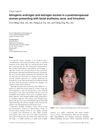 August 2009 in “International Journal of Dermatology”
 This case report describes a postmenopausal woman who experienced facial erythema, acne, and hirsutism due to excess androgen and estrogen levels.
 37 citations
,
January 1980 in “PubMed”
37 citations
,
January 1980 in “PubMed” This study found that topical hair lotions with 17 alpha-estradiol may reduce telogen hair loss in patients with androgenetic alopecia, though they did not lead to new hair regrowth.
1 citations
,
July 2024 in “Journal of Plastic Reconstructive & Aesthetic Surgery” In this study, older age was found to predict lateral hairline recession in TGNB AMAB individuals, while each year of feminizing hormone therapy in patients over 30 also predicted a decrease in lateral forehead length by 0.07 cm.
 137 citations
,
June 2005 in “Climacteric”
137 citations
,
June 2005 in “Climacteric” This review indicates that estrogen loss during menopause significantly impacts skin health, while estrogen treatment may increase skin collagen, thickness, and elasticity, though effects on other skin characteristics are inconsistent.
 51 citations
,
April 1999 in “The Journal of Steroid Biochemistry and Molecular Biology”
51 citations
,
April 1999 in “The Journal of Steroid Biochemistry and Molecular Biology” This review examines androgen replacement therapy in women for treating androgen deficiency symptoms and reports no new clinical results, while noting potential safety within a specific dose range.
 6 citations
,
September 2005 in “Expert Opinion on Pharmacotherapy”
6 citations
,
September 2005 in “Expert Opinion on Pharmacotherapy” This review discusses the role of androgens in women's sexual health and highlights the need for further research on androgen replacement therapy to optimize quality of life, but reports no new clinical results.
 228 citations
,
February 2003 in “Urology”
228 citations
,
February 2003 in “Urology” This article discusses the side effects of androgen deprivation therapy for nonmetastatic prostate cancer, highlighting the need for clinical trials to systematically study these effects.
 2 citations
,
January 2025 in “Pharmaceutical Research”
2 citations
,
January 2025 in “Pharmaceutical Research” This article reviews the possible therapeutic activities of Angelica gigas Nakai root extracts and their components, noting their potential effects on neuro-cognitive, metabolic, and other health conditions, and reports no new clinical results.
1 citations
,
July 2021 in “Frontiers in Oncology” This study found that patient-reported outcomes were similar between neoadjuvant endocrine therapy and chemotherapy in premenopausal breast cancer patients, but future perspective was significantly better with endocrine therapy.
7 citations
,
October 1974 in “PubMed” In this study, topical estrogens and corticosteroids were associated with decreased telogen rates in 52% of androgenetic alopecia patients, suggesting potential clinical improvement, though the role of corticosteroids remains unclear.
 46 citations
,
January 2008 in “Climacteric”
46 citations
,
January 2008 in “Climacteric” Randomized trials reported that testosterone therapy improved sexual function in postmenopausal women with hypoactive sexual desire disorder, particularly those who had undergone oophorectomy, with reversible and well-tolerated side effects.
 4 citations
,
October 2007 in “Dermatologic Clinics”
4 citations
,
October 2007 in “Dermatologic Clinics” This review discusses the roles of glucocorticoid and sex hormone receptors in the skin and their clinical importance, but reports no new research findings.
 58 citations
,
November 2020 in “International Journal of Molecular Sciences”
58 citations
,
November 2020 in “International Journal of Molecular Sciences” This review discusses the relationship between SHBG, NAFLD, and PCOS and reports no new clinical results; the authors highlight low hepatic SHBG production as potentially significant in PCOS pathogenesis.