February 2024 in “Pediatric Dermatology” In this case report, the researchers identified pathogenic compound heterozygous mutations in a young girl with lipoid proteinosis, noting her relatively mild symptoms and recommending genetic testing for early diagnosis and management of this rare condition.
 July 2023 in “Clinical, cosmetic and investigational dermatology”
 In this study, reflectance confocal microscopy was used to diagnose periorificial dermatitis, revealing specific skin changes such as hair follicle dilatation, increased vascular density, and inflammation, which help distinguish it from similar conditions.
 December 2022 in “Curēus”
 This case report describes a 5-year-old girl with atrichia with papular lesions, whose diagnosis was confirmed through genetic testing identifying mutations in the hairless gene.
September 2021 in “Pediatrics in review” This case study describes a 7-month-old boy diagnosed with keratitis-ichthyosis-deafness syndrome due to a de novo GJB2 gene mutation, highlighting the challenges in treatment and eventual fatal outcome due to severe complications.
 March 2021 in “CRC Press eBooks”
 This review discusses the various trichoscopic features of androgenetic alopecia and alopecia areata, noting white dots in advanced cases as indicators of poor prognosis, but reports no new clinical results.
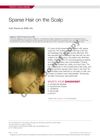
This case study describes a young girl with sparse, brittle scalp hair and multiple keratotic papules, but no systemic or familial abnormalities were found.
July 2018 in “Elsevier eBooks” This study underscores the importance of using trichoscopy and histopathology for the differential diagnosis of primary neutrophilic cicatricial alopecias to facilitate early intervention and prevent cicatricial alopecia progression.
January 2018 in “Indian Dermatology Online Journal” This case report describes a rare instance of Olmsted syndrome with hypotrichosis in a 5-year-old boy, noting mild improvement in symptoms following treatment with oral acitretin and other interventions.
May 2017 in “Journal of the American Academy of Dermatology” Monilethrix is a rare, inherited condition causing fragile hair and hair loss, with no cure but some treatments may help.
 January 2013 in “The Pan African medical journal”
 This report describes two cases of monilethrix in Afghan siblings, detailing the hair disorder's clinical presentation and potential influences on hair growth, such as hormonal changes and iron supplementation.
January 2004 in “Laboratory Animal Science and Administration” This study found that the hairless mutant gene in C 57BL/6 mice affects the hair follicle cycle and leads to early thymus degeneration and distinct skin changes.
January 1962 in “Archives of Dermatology” This case report describes a 5-year-old girl with lipoid proteinosis, characterized by a raspy voice, thinning scalp hair, and recurrent crusted lesions leading to pock-like scars.
 May 2026 in “International Journal of Drug Delivery Technology”
 This case study highlights Erythromelanosis follicularis faciei et colli as an easily overlooked pigmentary disorder characterized by a distinctive triad requiring precise diagnosis for effective patient counseling and cosmetic management.
April 2025 in “Indian Dermatology Online Journal” This study describes how avian-inspired imagery is used in dermatology to help clinicians and patients identify and communicate skin conditions, using familiar terms like "chicken skin" and "fried egg" to capture specific visual patterns and clinical features.

This study highlights that traumatic anserine folliculosis is a benign condition often seen in young males, which can be diagnosed without invasive biopsies using clinical examination and dermoscopy.
 March 2024 in “Cirugía y Cirujanos (English Edition)”
 In this study, researchers observed that all kidney transplant patients at a Mexico City hospital developed at least one type of skin condition, with infectious dermatoses being the most common. The authors recommend dermatological assessments before transplantation to manage dermatoses, potentially reducing related health risks.
 May 2017 in “InTech eBooks”
 This review discusses various types of primary cicatricial alopecias, categorized by the predominant type of inflammatory cells involved, and reports no new clinical results.
 147 citations
,
January 2003 in “American journal of clinical dermatology”
147 citations
,
January 2003 in “American journal of clinical dermatology” This review discusses various forms of ichthyosis, including genetic and acquired types, detailing their characteristics, causes, and potential management strategies, but reports no new clinical results.
79 citations
,
June 1991 in “Journal of Medical Genetics” This article discusses the classification of mental retardation based on IQ ranges and provides no new experimental findings.
 65 citations
,
November 2016 in “Journal of The American Academy of Dermatology”
65 citations
,
November 2016 in “Journal of The American Academy of Dermatology” This article reviews various types of primary cicatricial alopecias and emphasizes the importance of accurate diagnosis to improve management strategies, particularly detailing remaining lymphocytic forms and expanding on neutrophilic and mixed types.
56 citations
,
July 2020 in “Journal of Dermatological Treatment” This review found the strongest evidence supporting azelaic acid's use in treating rosacea, with somewhat less evidence for its effectiveness in melasma and acne vulgaris, and weaker support for its use in conditions like hidradenitis suppurativa and keratosis pilaris.
54 citations
,
September 2012 in “Acta ophthalmologica” This review highlights that various targeted cancer therapies are associated with specific ocular side-effects, emphasizing the importance of awareness among ophthalmologists for timely diagnosis and management.
 45 citations
,
September 2011 in “Journal of the European Academy of Dermatology and Venereology”
45 citations
,
September 2011 in “Journal of the European Academy of Dermatology and Venereology” This study found that obesity is associated with several skin conditions, such as striae and pseudoacanthosis nigricans, which may serve as markers of excessive weight.
 43 citations
,
May 1988 in “British Journal of Dermatology”
43 citations
,
May 1988 in “British Journal of Dermatology” This study reported that patients with acanthosis nigricans and insulin resistance exhibited higher insulin levels and were associated with increased insulin resistance correlating with serum testosterone levels.
42 citations
,
January 2008 in “SKINmed/Skinmed” This review article discusses the classification, epidemiology, diagnostic approach, and patient management of lymphocytic primary cicatricial alopecias, without reporting new clinical results.
31 citations
,
February 1982 in “Archives of dermatology” This study found that oral etretinate improved skin conditions like erythrodermic and pustular psoriasis, although less so for psoriasis vulgaris and lichen planus, with notable side effects including cheilitis and mucous membrane dryness.
26 citations
,
May 1991 in “Clinical and experimental dermatology” In this study, oral etretinate resulted in increased hair length and loss of beading in a childhood monilethrix case, while the scalp's keratosis pilaris persisted.
 25 citations
,
November 2013 in “Journal of the American Academy of Dermatology”
25 citations
,
November 2013 in “Journal of the American Academy of Dermatology” This study observed that 71% of chronic myeloid leukemia patients treated with second-generation tyrosine kinase inhibitors experienced adverse cutaneous reactions, which were generally less severe than those caused by imatinib.
25 citations
,
April 2008 in “Clinical and experimental dermatology” This case series describes Erythromelanosis follicularis faciei et colli in five Indian patients, suggesting it may be more common than currently reported.
25 citations
,
January 1983 in “Archives of dermatology” This article reviews the early establishment of dermatology as a specialty in the U.S. and documents the initial descriptive errors in understanding Darier's disease, offering no new clinical data.