 October 2024 in “Journal of the Endocrine Society”
 In this case study, a postmenopausal woman with symptoms of virilization was diagnosed with a rare ovarian Leydig cell tumor, and surgical removal led to a resolution of her hyperandrogenism and related symptoms, highlighting the importance of thorough differential diagnosis in postmenopausal hyperandrogenism.
 19 citations
,
January 2012 in “Dermato-endocrinology”
19 citations
,
January 2012 in “Dermato-endocrinology” This study suggests that moderate elevated prolactin levels are unlikely to cause significant hair loss in women, but still warrant further diagnostic investigation to rule out a prolactin-producing pituitary tumor.
 5 citations
,
October 2013 in “Endocrine”
5 citations
,
October 2013 in “Endocrine” This case report describes three instances where occult ovarian Leydig cell tumors were suspected based on severe hyperandrogenism symptoms, despite negative imaging findings, highlighting that elevated testosterone levels are a crucial diagnostic marker.
 60 citations
,
May 2011 in “Endocrinology and Metabolism Clinics of North America”
60 citations
,
May 2011 in “Endocrinology and Metabolism Clinics of North America” This article discusses the association between hypertension and polycystic ovary syndrome, highlighting the need for managing related risk factors, but reports no new clinical results.
January 2016 in “AACE Clinical Case Reports” In this case report, an embryonal cell carcinoma of the testicle was associated with polycythemia and markedly elevated hormone levels without secondary sexual characteristics, which were restored after treatment.
 3 citations
,
November 2020 in “Cleveland Clinic Journal of Medicine”
3 citations
,
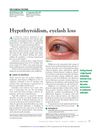
November 2020 in “Cleveland Clinic Journal of Medicine” Eyelash loss can be a sign of thyroid problems.
 April 2017 in “Medicina Clínica (english Edition)”
 This review discusses the diagnosis and management of acquired haemophilia and reports no new findings; the authors highlight the importance of early diagnosis to reduce mortality.
23 citations
,
August 1987 in “PubMed” In this study, a 7-year-old male ferret was diagnosed with hyperadrenocorticism complicated by dilatative cardiomyopathy, chronic active hepatitis, and renal disease, following symptoms including progressive hair loss and severe dehydration.
 March 1998 in “Journal of dermatological science”
 Diphencyprone initially increases mouse hair growth, then slows it, possibly due to changes in specific protein levels.
 3 citations
,
January 1988 in “PubMed”
3 citations
,
January 1988 in “PubMed” This study observed that functional hyperprolactinemia in several women was associated with skin symptoms such as seborrhea, acne, and hair-related issues, resembling androgen-induced conditions.

This study found that abnormal carbohydrate metabolism linked to increased serum fasting insulin levels is associated with 20% of women with polycystic ovary syndrome, and these women exhibit more symptoms compared to those with normal insulin levels.
 2 citations
,
January 2007 in “Acta Dermato Venereologica”
2 citations
,
January 2007 in “Acta Dermato Venereologica” In this report, a case of a bullous lesion developed at the injection site in a patient treated with PEG-IFN-α-2a for chronic hepatitis C was described.
9 citations
,
November 2013 in “Gynecological Endocrinology” This case study identified a probable pure testosterone-secreting ovarian tumor in a woman with increased facial hair and elevated testosterone levels, confirmed by histological examination as Leydig cells hyperplasia, which normalized testosterone and symptoms post-surgery.
 2 citations
,
January 2019 in “Springer eBooks”
2 citations
,
January 2019 in “Springer eBooks” The conclusion is that different blood diseases cause specific oral symptoms and require varied treatments to manage these symptoms and improve patient health.
 January 2024 in “Wiadomości Lekarskie”
 This study reports a successful combination treatment for phospho-organic compound poisoning, using standard therapy with atropine and toxogonin along with exogenous cholinesterases via blood transfusion, showing positive outcomes in patients whose endogenous cholinesterase levels dropped to 20%.
 October 2023 in “Journal of the Endocrine Society”
 This case report highlights the potential benefits of unilateral adrenalectomy in treating primary bilateral macronodular adrenal hyperplasia, noting a high rate of remission and low risk of recurrence.
October 2023 in “BMJ Case Reports” This case report describes a man diagnosed with Hoffman syndrome, characterized by muscle hypertrophy and weakness due to severe hypothyroidism, who had an excellent response to thyroid hormone replacement.
October 2024 in “Journal of the Endocrine Society” In this case report, a 70-year-old woman with a history of autoimmune hypothyroidism experienced alternating hypothyroidism and hyperthyroidism over a decade, highlighting the potential role of thyrotropin receptor autoantibodies in these fluctuations.
 January 2025 in “Cermin Dunia Kedokteran”
 This study reported that hypoglycemia is a more frequent complication in type 1 diabetes patients than in type 2, primarily due to inappropriate insulin and anti-diabetes medication dosing.
April 2026 in “BMJ Case Reports” This case study highlights the challenges of diagnosing hyperandrogenism in postmenopausal women, reporting a patient with androgenic alopecia and high testosterone due to a benign Leydig cell tumor in the ovary; surgery successfully normalized testosterone levels.
13 citations
,
August 2018 in “Clinical Chemistry” This study determined that a total testosterone concentration of ≥5.1 nmol/L identified androgen-producing tumors in women with severe hyperandrogenemia, while a lower threshold of ≥2.2 nmol/L was found for diagnosing pathologic hyperandrogenism in postmenopausal women.
 1 citations
,
April 2023 in “International Journal of Homoeopathic Sciences”
1 citations
,
April 2023 in “International Journal of Homoeopathic Sciences” This article discusses homoeopathic management of a case of alopecia areata and reports no new clinical results.
44 citations
,
September 1948 in “Radiology” This article reports that hypervitaminosis A in both experimental rats and children leads to severe symptoms such as weight loss, bone issues, and skin problems, which resolve upon stopping vitamin A intake.
 April 2026 in “International Journal of Research and Review”
 This article reviews current literature and suggests that managing gout with early urate-lowering therapy, within a 'treat-to-target' strategy, can help prevent systemic complications and address the rising prevalence of hyperuricemia-related diseases.
 March 2024 in “Cleveland Clinic journal of medicine”
 This review details contemporary medical management options for benign prostatic hyperplasia, highlighting the expanding role of phosphodiesterase-5 inhibitors and beta-3 agonists, but reports no new clinical findings.
 January 2014 in “대한피부과학회지”
 This case study in a hepatitis B patient observed that pegylated interferon alpha2a treatment may induce localized alopecia areata, which appeared to correlate with treatment administration and discontinuation.
 October 2024 in “Journal of the Endocrine Society”
 This case report highlights that in severe illnesses like sepsis, myxedema coma can occur with less elevated TSH levels than typical for primary hypothyroidism, likely due to inflammatory cytokines affecting TSH secretion, even when central lesions are absent.
137 citations
,
December 2007 in “Journal of bone and mineral research” This study suggests that 1,25-dihydroxyvitamin D(3) and fibroblast growth factor 23 form a crucial axis in regulating phosphate balance, akin to its role in calcium regulation, and explores novel VDR interactions including with curcumin.
 June 2026 in “Ginekologia Polska”
 This study found that supplementation with micronized and emulsified ferric pyrophosphate effectively improved lab test results and reduced iron deficiency symptoms in patients aged 19-70, with the majority reporting good tolerance and few side effects.
 February 2021 in “PARIPEX INDIAN JOURNAL OF RESEARCH”
 This study found that women with PCOS had a higher prevalence of hypothyroidism compared to those without PCOS, especially among the obese PCOS subgroup.