 32 citations
,
April 2014 in “The journal of investigative dermatology/Journal of investigative dermatology”
32 citations
,
April 2014 in “The journal of investigative dermatology/Journal of investigative dermatology” This study demonstrates that keratin K2 is crucial for proper keratinocyte structure and function in specific mouse skin areas, and its deficiency leads to cellular aggregates and skin abnormalities.
21 citations
,
December 2006 in “Archives of dermatology” This abstract contains no research findings and pertains only to website navigation and policies.
13 citations
,
March 1997 in “Research in Veterinary Science/Research in veterinary science” This study found that epithelial keratin K 6 is associated with hyperkeratotic and ulcerated changes in the gastric pars oesophagea of pigs, suggesting epithelial proliferation plays a role in ulcer development.
5 citations
,
May 2017 in “Journal of dermatological science” This study reviewed the genetic and phenotypic aspects of Olmsted syndrome, highlighting pathogenic mutations in TRPV3 and MBTPS2 genes and their association with specific skin manifestations like symmetrical keratoderma and hyperkeratotic plaques.
 2 citations
,
August 2013 in “British Journal of Dermatology”
2 citations
,
August 2013 in “British Journal of Dermatology” This case report observed a dramatic improvement in a 15-year-old girl's pachyonychia congenita symptoms during chemotherapy for Ewing sarcoma, suggesting chemotherapy's potential role in managing hyperkeratotic conditions.
1 citations
,
December 1997 in “Archives of dermatology” This report describes a case of trichostasis spinulosa, a condition with pruritic, black papules on the face caused by keratotic plugs with embedded vellus hairs.
July 2024 in “Indian Dermatology Online Journal” In this case study, a 45-year-old immunocompetent woman with tinea capitis exhibited an unusual presentation of the infection with a scaly plaque and hair loss, which responded well to treatment with itraconazole.
October 2025 in “Indian Journal of Paediatric Dermatology” This case study documents a boy with zinc-responsive acral hyperkeratosis improving significantly after zinc supplementation, suggesting it could result from inadequately treated acrodermatitis enteropathica.
6 citations
,
October 1998 in “PubMed” This case study reports a new variant of chronic dermatophytosis with giant cutaneous horns, suggesting a possible genetic link and highlighting successful treatment with antifungal medications.
 April 2023 in “The journal of investigative dermatology/Journal of investigative dermatology”
 This study suggests that structural changes in the TRPV3 channel are linked to severe skin conditions like Olmsted syndrome, with differences observed between heat-activated and resting states.
 2 citations
,
July 2018 in “Our Dermatology Online”
2 citations
,
July 2018 in “Our Dermatology Online” This case report documents the first known instance of nevoid hyperkeratosis of the nipple and areola with unilateral presentation in a Saudi female, diagnosed through clinical evaluation and biopsy.
January 2026 in “Animal Genetics” This study investigated a Labrador Retriever with paw pad hyperkeratosis and identified a unique de novo heterozygous missense variant in the GJB6 gene, suggesting its potential role in the condition, analogous to Clouston syndrome in humans, although differences between species may provide further insights.

In this case study, the researchers observed that a dermocosmetic formulation with encapsulated retinol led to complete regression of a chronic actinic keratosis lesion on the scalp, suggesting it may be a promising treatment approach.
 January 2025 in “ARC Journal of Clinical Case Reports”
 This case report suggests that using encapsulated retinol in polylysine may effectively treat actinic keratosis with minimal irritation, potentially providing a safer alternative for frequent use.
12 citations
,
September 2012 in “Pediatric Dermatology” This case report describes a 5-year-old boy with extensive epidermal nevus who experienced marked improvement using a topical calcipotriol/betamethasone dipropionate combination ointment.
7 citations
,
February 2002 in “Veterinary Dermatology” This study found that intracorneal vacuoles were common in various parakeratotic skin diseases in dogs, but large vacuoles were exclusively observed in congenital follicular parakeratosis.
 January 2024 in “The Indian Veterinary Journal”
 In this case study involving a two-month-old crossbred kid, severe skin conditions characterized by alopecia and pruritic lesions were linked to Malassezia yeast and bacteria, and successful treatment was observed with ketoconazole and supportive care.
 9 citations
,
July 2002 in “Journal of the European Academy of Dermatology and Venereology”
9 citations
,
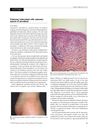
July 2002 in “Journal of the European Academy of Dermatology and Venereology” This article discusses multiple minute digitate hyperkeratosis in a dermatological context and reports no new clinical findings; the authors focus on a descriptive review.
 September 2024 in “Journal of the American Academy of Dermatology”
 In this case report, a 53-year-old woman with Little-Graham-Piccardi-Lassueur-Syndrome responded well to a treatment regimen of hydroxychloroquine, methotrexate, and other therapies, effectively halting the progression of this rare dermatosis characterized by alopecia and hyperkeratotic eruptions.
152 citations
,
April 2002 in “The journal of investigative dermatology/Journal of investigative dermatology” This study presents evidence that keratitis–ichthyosis–deafness syndrome is caused by a mutation in the connexin 26 gene, expanding the gene's known involvement in various disorders.
 87 citations
,
March 2014 in “Biochimica et Biophysica Acta (BBA) - Molecular and Cell Biology of Lipids”
87 citations
,
March 2014 in “Biochimica et Biophysica Acta (BBA) - Molecular and Cell Biology of Lipids” This paper discusses X-linked ichthyosis and its genetic causes, focusing on biochemical pathways and their role in epidermal differentiation and barrier function, but it presents no new clinical findings.
81 citations
,
February 2014 in “EMBO molecular medicine” This study found that prolonged Nrf2 activation in mouse keratinocytes led to enlarged sebaceous glands, hair loss, and cysts, suggesting a role for Nrf2 in conditions like MADISH.
 81 citations
,
June 2012 in “European journal of human genetics”
81 citations
,
June 2012 in “European journal of human genetics” This review outlines a diagnostic framework for clinicians to distinguish different types of inherited ichthyoses and suggests further testing and treatment strategies, but reports no new clinical results.
 74 citations
,
June 2018 in “Cell death and disease”
74 citations
,
June 2018 in “Cell death and disease” In this study, researchers found that depleting mtDNA in mice caused skin wrinkles and hair loss but restoring mitochondrial function reversed these effects, highlighting mtDNA's significant role in skin and hair health.
66 citations
,
October 2002 in “Human molecular genetics online/Human molecular genetics” This study found that a nonsense mutation in the Cst6 gene of mice leads to severe skin and hair abnormalities, suggesting that cystatin M/E is crucial for epidermal function and viability.
56 citations
,
January 2014 in “Journal of Investigative Dermatology” Olmsted syndrome can be inherited as an autosomal recessive trait due to a rare TRPV3 gene mutation.
49 citations
,
August 1999 in “Journal of Investigative Dermatology” In this study, transgenic mice expressing Msx-2 developed flaky skin with hyperproliferation and misalignment in epidermal cells, suggesting Msx-2 plays a role in skin and appendage growth control.
 44 citations
,
August 2008 in “Archives of Dermatology”
44 citations
,
August 2008 in “Archives of Dermatology” This abstract provides no results; it is a website notification about cookies and general access to JAMA content.
36 citations
,
September 2015 in “Orphanet Journal of Rare Diseases” This review discusses ichthyosis with confetti, highlighting its genetic basis, clinical features, diagnostic criteria, and current treatment options but reports no new clinical results.
 35 citations
,
August 2010 in “The American journal of pathology”
35 citations
,
August 2010 in “The American journal of pathology” This study reports that hypomorphic alleles of the Ass1 gene in mice resemble human CTLN1, providing a potential model for preclinical studies and indicating that standard treatments for CTLN1 can rescue phenotypes.