5 citations
,
December 1996 in “Biochemical and Biophysical Research Communications” In this study, keratin genes mHa1 and mHb4 were unable to form an extensive keratin network in one cell line, altering endogenous keratin distribution, but showed better integration in another cell line.
58 citations
,
July 2005 in “Molecular and Cellular Biology” This study showed that a 2-kilobase upstream region of the mouse keratin 17 gene enables targeted GFP expression in major epithelial appendages of transgenic mice, indicating sonic hedgehog's involvement in its regulation.
13 citations
,
September 2014 in “Birth defects research” This review discusses human epidermal neural crest stem cells (hEPI-NCSC) as candidates for cell-based therapies and drug discovery but reports no new experimental results.
 150 citations
,
June 2014 in “Biomaterials”
150 citations
,
June 2014 in “Biomaterials” This study found that 'smart' peptide hydrogels improved wound healing in a rat model of partial thickness burns, achieving greater wound closure and faster debridement compared to a standard treatment.
99 citations
,
May 1998 in “Journal of biological chemistry/The Journal of biological chemistry” This study found that small proline-rich proteins modify the biomechanical properties of cornified cell envelopes in rodent forestomachs, potentially affecting the tissue's ability to withstand mechanical stress.
3 citations
,
September 2016 in “Pediatric Dermatology” This case study reports that hypertrichosis, although not always present, may be an important diagnostic clue for superficial epidermolytic ichthyosis in a young child.
53 citations
,
June 1983 in “Journal of Investigative Dermatology” This study reports that human epidermal transglutaminase activity increases with treatment using organic solvents and chemicals without significant molecular weight changes, which may allow modulation of the enzyme in skin diseases.
May 2025 in “Biomedicine & Pharmacotherapy” This study found that HPD is a potent activator of hair follicle regeneration, surpassing the efficacy of conventional minoxidil treatment by modulating Wnt/β-catenin signaling and enhancing follicular proliferation, indicating its potential as a non-invasive hair restoration therapy.
73 citations
,
February 2023 in “Polymers” This review discusses the unique properties, design, and fabrication of peptide hydrogels for biomedical applications, focusing on advances in drug delivery, gene therapy, and regenerative medicine; it reports no new clinical results.
 30 citations
,
December 2011 in “Journal of biological chemistry/The Journal of biological chemistry”
30 citations
,
December 2011 in “Journal of biological chemistry/The Journal of biological chemistry” This study found that serine 44 in the N-terminal head domain of keratin 17 is phosphorylated in response to various stimuli affecting skin keratinocyte growth, linking K17 up-regulation with growth and stress responses in skin epithelium.
53 citations
,
June 2005 in “The journal of investigative dermatology/Journal of investigative dermatology” This article reviews extensive genetic polymorphisms in the keratin-associated proteins of human hair, indicating complexity but reporting no new clinical results and calls for further research on their potential impact on hair structure.
 38 citations
,
July 2019 in “Nature Communications”
38 citations
,
July 2019 in “Nature Communications” This study found that Par3 plays a crucial role in maintaining epidermal homeostasis by regulating Rho/actomyosin contractility and ensuring mitotic accuracy, with potential implications for other self-renewing epithelia.
July 2025 in “Journal of Investigative Dermatology” Reduced AhR signaling in HS tunnels leads to persistent inflammation and microbial imbalance.
22 citations
,
May 2007 in “Molecular Biotechnology” 201 citations
,
May 2001 in “Proceedings of the National Academy of Sciences” This study found that transgenic expression of COX-2 in mouse basal keratinocytes causes epidermal hyperplasia and certain dysplastic features at specific body sites.
July 2021 in “Zurich Open Repository and Archive (University of Zurich)” This study provided new insights into the complex and heterogeneous architecture of keratin filaments, revealing their dynamic and flexible structure through cryo-electron microscopy analysis.
18 citations
,
October 2009 in “Endocrinology” This study demonstrated that both HR isoforms are expressed in keratinocytes, but HRDelta1072-1126 lacks corepressor activity and may act as a coactivator by inhibiting HDAC recruitment to the VDR transcriptional complex.
160 citations
,
June 2008 in “American Journal Of Pathology” This review discusses the effects of the epidermal growth factor receptor system on skin biology and pathology, relying on animal models to analyze roles in cellular processes, wound healing, and tumorigenesis, but reports no new results.
 September 2014 in “International Journal of Dermatology and Venereology”
 This review explores the roles of histamine receptors H2R, H3R, and H4R in treating various dermatoses but reports no new clinical outcomes.
 February 2025 in “bioRxiv (Cold Spring Harbor Laboratory)”
 This study proposes a model suggesting that the ratio of keratin 15 to keratin 14 in epidermal keratinocytes promotes a progenitor state and opposes differentiation, based on insights from both cell culture and transgenic mouse models.
 75 citations
,
October 2010 in “Mammalian genome”
75 citations
,
October 2010 in “Mammalian genome” In this study, specific genetic polymorphisms in the KRT71 gene were associated with hairless and curly phenotypes in Sphynx and Devon Rex cats.
 October 2011 in “Journal of dermatology”
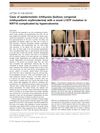
 A man with a rare skin condition and a new gene mutation developed high calcium levels due to his treatment.
46 citations
,
May 1995 in “Proceedings of the National Academy of Sciences” This study demonstrated that a specific 9-kbp fragment of the bovine keratin 6 gene effectively directs tissue-specific and inducible expression in transgenic mice, suggesting potential applications for targeted gene therapy in hyperproliferative skin conditions.
May 2020 in “International journal of dermatology and venereology” This study introduces the term "hair matrix cyst" for a cyst with both pilomatricoma and epidermal cyst characteristics, highlighting its potential for misdiagnosis among similar skin conditions.
71 citations
,
September 2013 in “Materials Science and Engineering C” Keratin-based hydrogels from human hair and wool are promising for wound dressings and are more eco-friendly.
August 1989 in “Proceedings ... annual meeting, Electron Microscopy Society of America/Proceedings, annual meeting, Electron Microscopy Society of America” This microscopy study examined the non-keratinous regions of human hair fibers, revealing detailed morphology that could help understand how external influences affect hair structure.
 June 1995 in “International Journal of Gynecology & Obstetrics”
 This article discusses immunohistochemical analysis of estrogen and progesterone receptors in endometrium and peritoneal endometriosis, introducing a new quantitative method, but reports no new experimental results.
January 2026 in “Elsevier eBooks”  1 citations
,
January 2009 in “X-ray Structure Analysis Online”
1 citations
,
January 2009 in “X-ray Structure Analysis Online” A new compound was made that might help treat diseases related to male hormones.
January 2000 in “Zhongguo yixue wulixue zazhi” This study observed that human hair keratin showed distinct morphological features depending on the dissolution speed, which could have potential applications in clinical settings for developing self-tendons.