November 2013 in “Journal of clinical & experimental dermatology research” This article describes the follicular unit extraction method for hair transplantation, discussing its application, candidate selection, technique, outcomes, and the authors' experiences in over several hundred cases, without presenting new clinical results.
13 citations
,
February 2002 in “Archives of dermatology” This abstract contains no research findings; it describes website service information and options for accessing content from JAMA Dermatology.
 June 2024 in “Journal of Dermatology & Cosmetology”
 This comparison study identified non-shaven FUT long hair (FUL) restoration as potentially offering more aesthetic benefits and fewer scars than FUE or conventional FUT for treating various types of alopecia.
 53 citations
,
May 2010 in “Dermatologic Surgery”
53 citations
,
May 2010 in “Dermatologic Surgery” This article appears to be a table of contents or navigation page for a journal, not presenting any new findings or research results.
 24 citations
,
December 2011 in “Journal of The American Academy of Dermatology”
24 citations
,
December 2011 in “Journal of The American Academy of Dermatology” This study found that Caucasian female hair is denser than Asian female hair in the occipital region regardless of treatment but thinner in diameter in both the frontal and occipital regions.
 10 citations
,
May 2008 in “Dermatologic Surgery”
10 citations
,
May 2008 in “Dermatologic Surgery” This study observed that densely packed follicular unit grafts using the lateral slit technique have high growth rates, even at 72 grafts/cm², contradicting previous findings with older methods.
1 citations
,
January 2020 in “bioRxiv (Cold Spring Harbor Laboratory)” This study found that knocking out vinculin in mouse skin disrupts bulge stem cell quiescence by impairing force generation and mechanical stability of adherens junctions.

Trichodysplasia spinulosa can occur after a heart transplant due to immunosuppressive drugs.
4 citations
,
January 2013 in “Genetics and Molecular Research” This study found that VEGF expression and microvessel density in hair follicles of Liaoning cashmere goats follow a bimodal pattern correlated with hair development throughout the year.
January 2026 in “Case Reports in Dermatological Medicine” In this case study, a young female with aseptic and alopecic nodules of the scalp achieved full resolution without recurrence using intralesional steroids.
1 citations
,
July 2004 in “The Journal of Dermatology” This case report describes a female patient with systemic lupus erythematosus who developed generalized hair-follicle hamartoma, marking the fourth documented association between the two conditions.
 4 citations
,
January 2019 in “Skin appendage disorders”
4 citations
,
January 2019 in “Skin appendage disorders” This study found that Follicular Maps, derived from trichoscopic images, remained consistent over time and unaffected by hair cycling or noncicatricial alopecia, offering a precise tool for diagnosing and monitoring hair and scalp conditions.
 April 2023 in “Rossijskij žurnal kožnyh i veneričeskih boleznej”
 This collection presents a photogallery on the follicular occlusion syndrome, uniting diseases like hidradenitis suppurativa under shared pathogenesis, but reports no new clinical results.
 January 2014 in “Journal of Cutaneous and Aesthetic Surgery”
 The document suggests that for better patient satisfaction in hair transplants, high-quality photos are needed, and using a narrow donor strip might lead to fewer grafts and dissatisfaction, but filling the scar with FUE grafts and using tranexamic acid can improve results.
 6 citations
,
January 2010 in “Actas Dermo-Sifiliográficas”
6 citations
,
January 2010 in “Actas Dermo-Sifiliográficas” This review covers the current procedure for follicular unit hair transplantation, noting that recent advancements have made the results natural and undetectable, but it presents no new experimental findings.
9 citations
,
January 1989 in “Journal of Small Animal Practice” This study reports an abnormal onion-shaped swelling on the hair shafts of some Abyssinian cats, affecting the appearance of their coat, though skin and hair structures appear normal under the microscope.
 September 2024 in “Journal of Cutaneous and Aesthetic Surgery”
 This case report detailed a successful treatment involving contracture release and expanded neck flap reconstruction for a patient with severe neck contracture and beard alopecia from past thermal burns, highlighting improved skin quality and hair regrowth following follicular unit extraction.
27 citations
,
October 2002 in “International Journal of Dermatology” This study presents a microscopic analysis of the pruritic variant of trichostasis spinulosa in two patients and reviews existing literature, reporting no new clinical results.
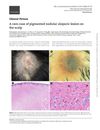
This study reported the case of a 30-year-old man with a bluish-grey scalp nodule that developed over a previously stable hairless plaque, revealing histopathological features consistent with epithelioid cell nests and spindle-shaped dermal melanocytes embedded in collagen.
2 citations
,
March 2011 in “Veterinary Dermatology” This study identified fibroblast growth factor 18 in various components of canine hair follicles and other tissues, but found no significant differences in its presence across seasons, body regions, or sexes in beagle dogs.
 10 citations
,
August 2003 in “JEADV. Journal of the European Academy of Dermatology and Venereology/Journal of the European Academy of Dermatology and Venereology”
10 citations
,
August 2003 in “JEADV. Journal of the European Academy of Dermatology and Venereology/Journal of the European Academy of Dermatology and Venereology” This case report documents a 30-year-old man's presentation with actinic superficial folliculitis and characterizes the inflammatory infiltrate, supporting the classification of this condition as a distinct disease entity.
 February 2013 in “Journal of The American Academy of Dermatology”
 A boy with a rare birthmark called verrucous hemangioma needed careful timing for surgery due to its size and depth.
 October 2023 in “Facial Plastic Surgery”
 This article reviews local anesthesia techniques for Follicular Unit Excision (FUE) hair transplantation, noting that ring blocks are preferred due to their simplicity, effectiveness, and safety, while nerve blocks are used when additional anesthesia is needed.
 September 2017 in “Plastic and reconstructive surgery. Global open”
 This study found that follicular unit transplantation is an effective and minimally invasive technique for camouflaging scarring alopecia in the head and neck area, achieving a graft survival rate of 86% and high patient satisfaction.
35 citations
,
December 2008 in “PubMed” In this study, researchers reported that specific immunoreactivity patterns observed in hair follicle stem cell markers suggest different origins for trichilemmoma, basal cell carcinoma, and squamous cell carcinoma in human skin tissues.
 May 2020 in “JOJ Dermatology & Cosmetics”
 This report describes a rare case of Trichostasis Spinulosa on the heel, an uncommon location for this type of lesion.
 March 2024 in “JEADV. Journal of the European Academy of Dermatology and Venereology/Journal of the European Academy of Dermatology and Venereology”
 Hair transplant surgery using micropunch can cause blood vessel damage similar to vasculitis in some cases.
January 2010 in “Journal of Yangzhou University” In this study, sulfated fucans promoted hair growth in mice by advancing hair follicles to anagen IV and delaying their regression to catagen, possibly through VEGF and HGF effects.
142 citations
,
June 2003 in “The journal of investigative dermatology. Symposium proceedings/The Journal of investigative dermatology symposium proceedings” This workshop overview concluded that follicular epithelial stem cells are multipotent and located in the bulge region of hair follicles, contributing to hair, epidermis, and sebaceous gland formation.
 June 2024 in “Annals of Medicine and Surgery”
 This case report highlights the rare co-occurrence of Pili Annulati and Trichorrhexis Nodosa in a Syrian woman, underlining the need for further research into their relationship and treatment.