10 citations
,
May 2007 in “British Journal of Dermatology” This case report describes the first known instance of congenital follicular mucinosis in a newborn, diagnosed through histopathological examination of a scalp lesion.
June 2026 in “British Journal of Dermatology” This study found that individuals with frontal fibrosing alopecia have increased odds of thyroid disease, lupus erythematous, vitiligo, and heart disease, supporting the consideration of FFA as a systemic disorder.
 16 citations
,
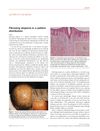
February 2010 in “Journal of the European Academy of Dermatology and Venereology”
16 citations
,
February 2010 in “Journal of the European Academy of Dermatology and Venereology” This article is a letter to the editor about fibrosing alopecia in a pattern distribution and reports no new research findings.
 16 citations
,
January 2007 in “Actas dermo-sifiliográficas/Actas dermo-sifiliográficas”
16 citations
,
January 2007 in “Actas dermo-sifiliográficas/Actas dermo-sifiliográficas” This review discusses frontal fibrosing alopecia and reports no clinical results; the authors note that no therapeutic options tested, including corticosteroids, finasteride, and minoxidil, have shown clear benefits.
2 citations
,
August 2025 in “JAAD reviews.” This review discusses frontal fibrosing alopecia in males and reports no new clinical results, indicating a broader demographic affected by this inflammatory disorder beyond postmenopausal women.
 July 2018 in “Elsevier eBooks”
 This review discusses the evolving understanding of frontal fibrosing alopecia as a generalized skin condition with diverse manifestations, and reports no new clinical results.
 33 citations
,
January 2015 in “Journal of Cosmetic Dermatology”
33 citations
,
January 2015 in “Journal of Cosmetic Dermatology” This study reports that familial frontal fibrosing alopecia was diagnosed earlier in premenopausal women compared to postmenopausal women, though long-term outcomes remain uncertain without a definitive treatment.
9 citations
,
January 2023 in “Journal of Clinical Medicine” This study presents a validated questionnaire, the FFA-QLI, which effectively assesses and differentiates the quality of life impact among patients with frontal fibrosing alopecia, showing greater sensitivity in identifying severe cases than the DLQI.
 39 citations
,
October 2015 in “Case Reports”
39 citations
,
October 2015 in “Case Reports” In this case series, four adults developed severe, disabling multisymptom illness potentially linked to fluoroquinolone use, which persisted and progressed even after discontinuation of the drug.
 6 citations
,
October 2019 in “Case Reports in Dermatology”
6 citations
,
October 2019 in “Case Reports in Dermatology” This report describes a case of fibrosing alopecia in a pattern distribution in a postmenopausal woman, highlighting its distinction from other forms of lichen planopilaris and pattern hair loss.
32 citations
,
July 2017 in “Oncotarget” This study found that intermittent treatment with FTI lonafarnib and sulforaphane may be a promising therapeutic approach for children with Hutchinson-Gilford progeria syndrome, as it improved the cellular phenotype.
 21 citations
,
October 2017 in “Journal of the European Academy of Dermatology and Venereology”
21 citations
,
October 2017 in “Journal of the European Academy of Dermatology and Venereology” This study reports that variable environmental factors, including dietary habits, may contribute to the increasing incidence and diverse clinical presentations of frontal fibrosing alopecia.
March 2024 in “SVU- International Journal of Veterinary Sciences” This study suggests that fecal microbiota transplantation was effective in reducing symptoms of feline hyperesthesia syndrome, with most cats showing clinical remission or improvement and no observed side effects.
14 citations
,
January 2014 in “Indian Journal of Dermatology Venereology and Leprology” Frontal fibrosing alopecia can affect men's beards and leads to permanent hair loss.
 May 2019 in “Anais brasileiros de dermatologia/Anais Brasileiros de Dermatologia”
 This study reviewed 38 cases of frontal fibrosing alopecia, observing that diagnosis often occurs years after onset and is more prevalent in postmenopausal women.
4 citations
,
December 2020 This case report describes a woman with frontal fibrosing alopecia who did not improve with hydroxychloroquine and topical minoxidil but achieved clinical stabilization with methotrexate monotherapy.
June 2025 in “British Journal of Dermatology” This report describes two unusual cases of frontal fibrosing alopecia in men, highlighting potential vaccine-related immune triggers and genetic factors, especially regarding the pronounced facial papular phenotype observed.
 5 citations
,
September 2021 in “Journal of The American Academy of Dermatology”
5 citations
,
September 2021 in “Journal of The American Academy of Dermatology” This study found a high prevalence of beard and eyebrow alopecia in male patients with frontal fibrosing alopecia, and suggests a potential link between hormonal imbalances and the condition.
 24 citations
,
September 2015 in “JAAD case reports”
24 citations
,
September 2015 in “JAAD case reports” This case report describes a patient with frontal fibrosing alopecia experiencing significant hair regrowth and reversal of cutaneous atrophy after treatment with the 5α-reductase inhibitor finasteride.
14 citations
,
January 2014 in “Annals of Dermatology” This report describes two cases of folliculotropic mycosis fungoides with syringotropism, highlighting indolent progression despite the disease's typically aggressive nature, suggesting aggressive treatment might not be necessary.
 40 citations
,
January 2013 in “International journal of trichology”
40 citations
,
January 2013 in “International journal of trichology” This study found that among women with frontal fibrosing alopecia, 100% showed dermoscopic elements suggestive of the condition, with perifollicular erythema often indicating disease activity.
27 citations
,
September 2013 in “The FASEB Journal” This study reports that the loss of the protein Memo in mice leads to a reduced lifespan and suggests that Memo is a key regulator of FGFR signaling and vitamin D production.
January 2024 in “Updates in clinical dermatology” Frontal fibrosing alopecia is a scarring hair loss condition mainly affecting postmenopausal women, with unclear causes.
 September 2021 in “CRC Press eBooks”
 This review discusses fibrosing alopecia in a pattern distribution and highlights diagnostic features, but reports no new clinical results; the authors emphasize the value of trichoscopy and histology in diagnosis.
 May 2024 in “Australasian journal of dermatology”
 This study reports on a unique clinical presentation of folliculotropic mycosis fungoides in a 60-year-old man, highlighting complexities in diagnosis due to dense histiocytic infiltration, which led to xanthoma formation before treatment, and obscured lymphomatous features.
 5 citations
,
July 2019 in “Photodiagnosis and photodynamic therapy”
5 citations
,
July 2019 in “Photodiagnosis and photodynamic therapy” This study reports a case of a 59-year-old female with refractory follicular mucinosis and diffuse scalp alopecia who achieved complete clinical remission following treatment with a combination of topical tacalcitol and photodynamic therapy.
 January 2023 in “Open veterinary journal”
 This report describes the first suspected case of dermatologic adverse effects from subcutaneous furosemide in cats, noting ulcerative skin lesions that resolved after switching the formulation.
August 2019 in “Journal of the American Academy of Dermatology” Frontal fibrosing alopecia may be caused by an autoimmune reaction and hormonal imbalance.
 April 2024 in “Current Rheumatology Reviews”
 This case report describes an 8-year-old girl with Mixed Connective Tissue Disease who experienced remission after treatment with immunomodulator drugs, highlighting the diagnostic value of anti-U1 RNP antibody testing in children.
June 2025 in “Journal of Ultrasound in Medicine” This study reports that high-frequency ultrasound can characterize frontal fibrosing alopecia by assessing dermal atrophy, hair follicle changes, and subclinical inflammation.