 22 citations
,
June 2004 in “Journal of The European Academy of Dermatology and Venereology”
22 citations
,
June 2004 in “Journal of The European Academy of Dermatology and Venereology” This case report identifies a novel association between Graham Little–Piccardi–Lassueur syndrome and complete androgen insensitivity syndrome, suggesting the influence of androgens in the alopecias accompanying the former may be limited.
September 2007 in “The American Journal of Gastroenterology” This case report describes a 37-year-old Filipino man with Cronkhite-Canada syndrome who improved after receiving nutritional support and medical treatment, despite the typically poor prognosis of the condition.
 15 citations
,
October 2015 in “PLOS ONE”
15 citations
,
October 2015 in “PLOS ONE” This study developed the Chi-PCOSQ, a culturally adapted Chinese assessment tool for measuring health-related quality of life in women with polycystic ovary syndrome, showing promising reliability and validity.
 October 2020 in “Our Dermatology Online”
 This case report highlights how chronic bacterial folliculitis may contribute to persistent inflammation in lichen simplex chronicus and emphasizes the value of DIF and IHC in diagnosing obscure cases.
 31 citations
,
January 2014 in “Journal of endocrinological investigation”
31 citations
,
January 2014 in “Journal of endocrinological investigation” This study reviewed Woodhouse-Sakati syndrome and found it consistently associated with hypogonadism, decreased IGF1, and frontotemporal alopecia, with additional symptoms like intellectual disabilities and diabetes in some patients.
January 2022 in “Chemistry: A European Journal” This study found that synchrotron radiation ECD imaging provides new insights into solid-state Finasteride by highlighting the significant role of anisotropy in local domains for chiroptical measurements.
 March 2021 in “Research Square (Research Square)”
 This research observed that 3D electrospun micro/nanofibrous sponges, without using chemical crosslinking agents, supported enhanced cell growth, vascularization, and skin regeneration in diabetic rats compared to 2D fiber membranes, making them promising for 3D tissue regeneration.
April 2024 in “Journal of the American Academy of Dermatology” Diagnosing and treating CCCA requires understanding multiple causes and using various diagnostic tools.
This study found that a novel pet food formulation significantly improved the management of feline atopic skin syndrome by reducing symptom severity and medication dependence over six months in client-owned cats, compared to a control diet.
July 2024 in “Journal of Investigative Dermatology” Human epidermal stem cells divide faster than previously thought.
September 2017 in “Journal of Investigative Dermatology” This study suggests that activating the hexosamine pathway may enhance skin homeostasis, potentially increasing hair follicle stem cells and modifying extracellular matrix components like hyaluronic acid in vitro.
8 citations
,
January 2016 in “Skin research and technology” This study found that a new 12-point scale provided a more precise measurement system for evaluating hair damage and improvement after hair care product use compared to a 5-point scale.
 13 citations
,
December 2010 in “Annales de Dermatologie et de Vénéréologie”
13 citations
,
December 2010 in “Annales de Dermatologie et de Vénéréologie” This retrospective study in Morocco confirms that Stevens-Johnson and Lyell syndromes lead to severe ocular and unsightly mucocutaneous sequelae, significantly affecting patients' social and professional integration.
 June 2023 in “British journal of dermatology/British journal of dermatology, Supplement”
 In this case study, a 19-month-old infant with palmoplantar keratoderma and nail dystrophy was found to have a desmoplakin gene mutation, leading to cardiomyopathy by age 7, illustrating diagnostic challenges and the potential link between skin, dental, and cardiac anomalies.
53 citations
,
February 2015 in “Journal of Investigative Dermatology” This study found that inactivating CerS4 in mice led to hair follicle stem cell exhaustion and hair loss, indicating its role in regulating hair regeneration through ceramide composition and signaling pathways.
 November 2011 in “Hair transplant forum international”
 This article provides an update from the ISHRS Practice Census Subcommittee and Media Relations Committee for 2011 but presents no new research results.
195 citations
,
November 2001 in “The Journal of Cell Biology” This study found that desmocollin 1 is crucial for strong adhesion and barrier maintenance in the mouse epidermis, with its absence leading to skin and hair issues resembling chronic dermatitis.
2 citations
,
January 1968 in “PubMed” This study found that X-irradiation causes hair dysplasia through two mechanisms influenced by oxygen, and cystamine injections after irradiation enhance this effect.
5 citations
,
September 2022 in “Facial Plastic Surgery & Aesthetic Medicine” This review discusses changes and advancements in facial feminization surgery, detailing various aspects of the field but reporting no new clinical results; the authors highlight ongoing innovations and challenges.
 April 2024 in “arXiv (Cornell University)”
 In this study, the researchers developed an advanced robotic system called STITCH for performing suture tasks, which completed an average of 2.93 sutures autonomously and 4.47 sutures with human intervention in physical trials.
 1 citations
,
March 2023 in “Frontiers in Cardiovascular Medicine”
1 citations
,
March 2023 in “Frontiers in Cardiovascular Medicine” A specific gene variant is linked to heart disease, increased heart muscle, curly hair, and thick skin on palms and soles.
 16 citations
,
April 2017 in “ACM Transactions on Graphics”
16 citations
,
April 2017 in “ACM Transactions on Graphics” Light scatters differently from elliptical hair fibers than from circular ones, and a new model better predicts this behavior, especially for shiny highlights.
1 citations
,
December 2022 in “Skin Research and Technology” This article provides guidelines and indices for a three-point cantilever bending test to measure mechanical properties of hair treated with both conventional and naturally-derived styling polymers, reporting no new experimental results.
 11 citations
,
July 2014 in “Gene”
11 citations
,
July 2014 in “Gene” This study reports a unique case of common variable immunodeficiency with autoimmunity linked to a heterozygous S250C variant in the autoimmune regulator gene, suggesting a potential molecular basis for this combination.
 4 citations
,
June 2025 in “Cochrane Database of Systematic Reviews”
4 citations
,
June 2025 in “Cochrane Database of Systematic Reviews” This Cochrane review found no clear superiority among treatments for central serous chorioretinopathy, with low-dose photodynamic therapy, supplements, and eplerenone showing slightly higher probabilities of improving visual acuity, but evidence remains uncertain due to biases and small study sizes.
March 2007 in “Journal of Plastic Reconstructive & Aesthetic Surgery” A new method was developed to create better skin models for healing and reconstruction.
 July 2005 in “Journal of The American Academy of Dermatology”
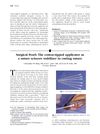
 This article discusses the various uses of the cotton-tipped applicator in dermatologic surgery, highlighting its innovative role as a suture scissors stabilizer, but reports no clinical results.
 5 citations
,
March 2017 in “International journal of GEOMATE : geotechnique, construction materials and environment”
5 citations
,
March 2017 in “International journal of GEOMATE : geotechnique, construction materials and environment” This study found that incorporating pig-hair fibers and green mussel shells in concrete increased compressive strength but decreased workability, suggesting potential use in structures not requiring strength above 28 MPa.
305 citations
,
March 2008 in “AJP Endocrinology and Metabolism” This article reviews the regulation and roles of spermidine/spermine-N(1)-acetyltransferase (SSAT) in polyamine metabolism and its potential as a target in cancer and other diseases, without reporting new experimental results.
April 2018 in “The journal of investigative dermatology/Journal of investigative dermatology” This commentary discusses the crucial role of the alternative splicing factor Esrp1 in maintaining skin barrier function and its association with skin diseases like atopic dermatitis and psoriasis, but reports no new clinical results.