 January 2024 in “bioRxiv (Cold Spring Harbor Laboratory)”
 In this mouse study, the absence of the Ascl4 gene did not affect the development of hair follicles, teeth, or mammary glands, suggesting it is non-essential for these processes.
 January 2024 in “International Journal of Advanced Biochemistry Research”
 In this case report, a one-year-old male husky with canine demodicosis exhibited significant improvement in skin condition after receiving treatment with Nexgard®, antibiotics, and supportive therapies, suggesting Nexgard® as an effective option for managing this condition.
 November 2022 in “Research Square (Research Square)”
 This study identified key genes and pathways involved in the growth and development of forest musk deer hair follicles, providing insights into molecular regulation and laying groundwork for future research on related diseases.
 March 2026 in “Journal of Hunan University Natural Sciences”
 This study evaluated the antimicrobial activity of Albizia saponaria stem bark against microorganisms causing dandruff and fungal alopecia. It found that the hexane fraction exhibited potent antifungal effects comparable to ketoconazole, highlighting its potential as a natural therapeutic for dandruff.
5 citations
,
January 2015 in “Case reports in medicine” In this case report, a novel missense mutation c.1360G>C (p.Ala454Pro) in the MBTPS2 gene was identified in a boy with typical IFAP syndrome and severe atopic features, although no phenotype/genotype correlation was established.
 April 2023 in “JIVA : journal of Indian Veterinary Association Kerala/JIVA :Journal of Indian Veterinary Association, Kerala”
 This case study reported the successful recovery of a Doberman Pinscher with skin lesions, demodicosis, pyoderma, and malasseziosis following treatment with fluralaner, enrofloxacin, shampoos, immune boosters, and fatty acids.
 September 2024 in “Frontiers in Veterinary Science”
 In this study, researchers observed that introducing an Environmental Enrichment Program improved the reproductive and zootechnical performance of Calomys callosus rodents by enhancing reproductive indices, parental care, and overall health, including reduced non-infectious lumbar alopecia.
 2 citations
,
August 2024 in “Animal Bioscience”
2 citations
,
August 2024 in “Animal Bioscience” This study suggests that m6A-circHECA may influence the physiology of cashmere goats' SHFs both through miRNA pathways and interactions with target proteins, with promoter methylation potentially inhibiting its gene expression.
September 2025 in “OPAL (Open@LaTrobe) (La Trobe University)” In this study, researchers developed a non-invasive, partially automated protocol for extracting DNA from marmoset hair follicles, resulting in high-quality whole genome sequencing with low chimerism levels, making it a reliable method compared to blood DNA sequencing in these primates.
 4 citations
,
October 1998 in “In Practice”
4 citations
,
October 1998 in “In Practice” This article outlines a practical method for diagnosing and managing feline symmetrical alopecia but presents no new empirical findings.
April 2021 in “Cermin Dunia Kedokteran” This study reports improvement in tinea capitis symptoms in two siblings after two months of treatment with ketoconazole lotion and shampoo, following initial findings of M. canis and Rhodotorulla infections.
 March 2026 in “Dermatology Online Journal”
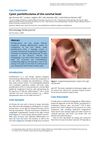
 In this case report, the authors describe a rare cystic panfolliculoma in an 84-year-old man's right conchal bowl, noting its potential to mimic other tumors like basal cell carcinoma, which complicates diagnosis.
March 2023 in “Editora e-Publicar eBooks” 10 citations
,
May 1991 in “Journal of the American Academy of Dermatology”  7 citations
,
June 2015 in “The anatomical record”
7 citations
,
June 2015 in “The anatomical record” This study in Hexi cashmere goats found that secondary follicle activity increases with time, and Hoxc13 expression varies significantly across different growth stages, suggesting a role in follicle activity.
18 citations
,
March 2004 in “The Journal of Urology” In this study, researchers used a hypospadiac rat model to demonstrate abnormal genital development, similar to human penoscrotal hypospadias, highlighting the model's value for studying penile growth and differentiation.
2 citations
,
May 2020 in “Journal of the American Academy of Dermatology” Hair shaft changes may be linked to CCCA, but their role is unclear.
December 2025 in “Agriculture” In this research, sequencing the chloroplast genomes of 10 Sansevieria trifasciata cultivars allowed the identification of a trnT-psbD deletion marker capable of distinguishing closely related species, and highlighted evolutionary links with Dracaena, contributing molecular tools for taxonomy and phylogenetic studies in Asparagaceae.
23 citations
,
June 1977 in “Clinical and experimental dermatology” This study described clinical findings in 71 patients with pityriasis amiantacea, noting that skin biopsies in 18 of these cases showed prominent eczematous changes.
 February 2006 in “Journal of The American Academy of Dermatology”
 This study found that Malassezia globosa, a scalp-associated fungus linked to dandruff, grows with saturated but not unsaturated fatty acids, potentially causing unsaturated fatty acid accumulation on the scalp and triggering dandruff-like flaking in susceptible individuals.
28 citations
,
May 2014 in “PubMed” This study found that increased hair cortisol levels, indicating stress, were associated with greater hair loss in captive rhesus macaques, although the causality of this relationship remains unclear.
 66 citations
,
August 2011 in “Parasitology Research”
66 citations
,
August 2011 in “Parasitology Research” This study found that Mentha pulegium essential oil had a stronger protoscolicidal effect against Echinococcus granulosus in vitro than Mentha piperita, showing dose- and time-dependent effects.
 1 citations
,
January 2017 in “Pharmaceutica Analytica Acta”
1 citations
,
January 2017 in “Pharmaceutica Analytica Acta” This study found petroleum ether to be more effective than methanol at extracting β-sitosterol from Eclipta alba, with higher concentrations detected using HPTLC and HPLC methods. The extracted materials contained metals within safety limits.
 15 citations
,
August 2008 in “Toxicology Letters”
15 citations
,
August 2008 in “Toxicology Letters” This study found that minoxidil induced cardiovascular toxicity in marmosets at higher doses than those affecting dogs, potentially due to the drug's exaggerated pharmacological effects.

This review discusses male androgenetic alopecia treatments, noting that topical minoxidil and oral finasteride are FDA-approved and require continuous use to maintain hair retention effects, but reports no new clinical results.
August 2004 in “Veterinary Dermatology” This case series described opportunistic skin conditions in three diabetic cats with additional immunosuppressive diseases, highlighting various treatments and outcomes, including a notable demodicosis recovery.
 4 citations
,
August 2022 in “The Scientific World Journal”
4 citations
,
August 2022 in “The Scientific World Journal” This study found that bufotalinin, derived from Merremia peltata leaves, may enhance hair growth by acting as a potential androgen receptor antagonist in rabbits.
In this case study, a 15-year-old obese boy was diagnosed with acanthosis nigricans and hair casts in the axillae, with Wood's lamp and dermoscopic examination revealing specific features, yet fungal infection was ruled out through a negative KOH test.
March 2024 in “Clinical Case Reports” In this study, the authors emphasize the importance of not ignoring the partial presence of comma or harpin hairs and black spots when identifying early lesions of tinea capitis, which may initially be overlooked due to their small size.
 August 2024 in “Indian Journal of Entomology”
 This study found that rabbits with mange showed significant declines in haemoglobin, PCV, and RBC count, alongside increased TLC and liver enzyme levels. Following treatment with ivermectin and proper management, recovery from the disease was observed.