 January 2024 in “Theranostics”
 This study found that HDAC6 plays a crucial role in regulating primordial follicle activation, with its overexpression delaying activation and preserving fertility by reducing NGF levels.
 December 2023 in “International journal of multidisciplinary research and analysis”
 This study suggests that administering SH-MSCs gel might decrease IL-6 expression and increase TGF-β expression in alopecia-like rats, indicating potential for alopecia therapy.
 December 2023 in “Scientific reports”
 This study assessed three lactic acid bacteria-fermented proteins and found that F-WPI and F-SPI could normalize osteoclastogenesis markers in vitro, while F-SPI enhanced osteoblastogenesis markers, suggesting potential as dietary supplements for osteoporosis prevention, though further research into mechanisms is needed.
 November 2023 in “International journal of biology, pharmacy and allied sciences”
 This review highlights scientific information about the medicinal uses and phytochemistry of Musa paradisiaca plant parts, which are traditionally used in human medicine to treat conditions such as diabetes, diarrhoea, hypertension, and ulcers, and exhibit various pharmacological activities including antidiabetic, antioxidant, and wound healing effects.
 November 2023 in “Open Repository of the University of Porto (University of Porto)”
 Pharmacists play a crucial role in patient care and education.
 March 2023 in “Seminars in reproductive medicine”
 This review discusses the link between polycystic ovary syndrome and sleep problems, primarily obstructive sleep apnea, and calls for more research on other sleep disturbances in affected women and adolescent girls.
 January 2023 in “Frontiers research topics”
 This article describes the Frontiers journal series, highlighting its open-access approach and tiered publishing system, but it presents no new empirical findings.
 January 2022 in “Journal of current research in food science”
 This review discusses diet and exercise benefits for PCOS, noting that healthier lifestyle choices may help reduce the condition's severity and related complications, but it reports no new clinical results.
 September 2021 in “Research Square (Research Square)”
 This study reports that despite rescuing neurulation and skin barrier defects, Grhl3 gene overexpression in mice leads to hearing impairment, hair loss, and other developmental abnormalities, highlighting low tolerance for Grhl3 dysregulation.
 June 2021 in “bioRxiv (Cold Spring Harbor Laboratory)”
 This study found that gene therapy using a mouse cytomegalovirus vector with telomerase reverse transcriptase or follistatin significantly extended lifespan and improved health markers in mice, without adverse effects.
 August 2020 in “Egyptian Veterinary Medical Society of Parasitology Journal (EVMSPJ)”
 In this study, 10.5% of sheep examined in Ismailia, Egypt, were infested with Sarcoptes scabiei, showing specific molecular and skin alterations.
 June 2020 in “bioRxiv (Cold Spring Harbor Laboratory)”
 This study found that overexpression of β-catenin in bipotent Schwann-cell precursors promotes melanocyte development in limb areas by inducing MITF and repressing FoxD3, especially during a specific developmental timeframe.

This book reviews evidence-based medicine practices in obstetrics and gynecology but reports no new clinical findings.
 December 2013 in “Biomedical and biopharmaceutical research”
 This review discusses technological advances in liposome systems for drug delivery and reports no new clinical results; it highlights the clinical acceptance and market presence of liposomal products.
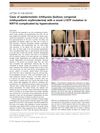 October 2011 in “Journal of dermatology”
 A man with a rare skin condition and a new gene mutation developed high calcium levels due to his treatment.
 August 1996 in “Australasian Journal of Dermatology”
 This article reviews four books on pediatric dermatopathology, photodamage, photoimmunology, and hair and scalp disorders, reporting no new research findings.
 July 2026 in “npj Regenerative Medicine”
 This study identified a crucial Gli2-Serpinh1 regulatory axis that regulates fibroblast state transitions during skin wound healing, shedding light on fibroblast heterogeneity and suggesting potential precision regenerative therapies.

This study found that patients with androgenetic alopecia showed distinct scalp bacterial imbalances compared to healthy individuals, which were associated with unhealthy lifestyles. These microbial changes might contribute to follicular inflammation, potentially accelerating hair loss in these patients.
 June 2026 in “Scientific Reports”
 This study found that nestin-expressing hair follicle-derived cells express higher levels of certain neurotrophic factors and neural markers, indicating potential for neuroregenerative therapy applications.
 May 2026 in “Journal of Health and Allied Sciences NU”
 This study concluded that human epidermal stem cells cultured in MEM-α and EpiLife media with growth factors show high proliferation potential and plasticity, suggesting potential use in skin regenerative medicine.
 May 2026 in “Research Square”
 This research reports that the polyG fragment within the Hoxc13 protein alters its gene regulatory functions, which could have influenced mammalian hair evolution by affecting pathways related to hair follicle development.
 May 2026 in “Iranian journal of pharmaceutical research”
 This study found that HAMA hydrogels promote faster healing of skin wounds in mice by enhancing the accumulation of anti-inflammatory macrophages and increasing type III collagen in the local wound environment.

This study demonstrates that a novel autologous hair follicle-derived epithelial sheet can effectively repigment skin in patients with stable vitiligo, offering a potential new treatment option.
 February 2026 in “Orphanet Journal of Rare Diseases”
 This study identified pathogenic or likely pathogenic gene variants in 70.1% of Russian families affected by hypohidrotic ectodermal dysplasia, expanding knowledge of causative mutations.
 January 2026 in “Frontiers in Bioscience-Landmark”
 This study reported that, in a laboratory setting, araliadiol derived from Centella asiatica activated antioxidant pathways, mitigating urban particulate matter-induced oxidative stress and skin damage.
 January 2026 in “Animal Advances”
 In this study of four Chinese goat breeds, black goats exhibited significantly higher melanin content, while Inner Mongolian cashmere goats had longer fiber lengths. These findings highlight genetic variations in coat color and fiber length, informing future breeding programs.
 December 2025 in “Frontiers in Veterinary Science”
 This study found that PT-LCG extends hair follicle activity and promotes continuous cashmere growth by enhancing lipid synthesis, remodeling the extracellular matrix, and modulating inflammatory signaling, offering insights into improving cashmere yield and quality through molecular breeding.
 December 2025 in “Al-Iraqia Medical College Journal”
 This study explored the relationships between virus susceptibility to infection and several factors, finding that higher heat tolerance and larger virus size correlated positively with infection susceptibility, while high humidity and higher mutation rates correlated inversely among eight RNA viruses, including SARS-CoV-2 and influenza.
 September 2025 in “Animal Bioscience”
 This study found that triglyceride and energy metabolic pathways are crucial factors influencing wool fiber diameter in fine-wool Alpine Merino sheep, providing insights for enhancing wool quality.
 July 2025 in “Scientific Reports”
 In this study, researchers identified six novel prognostic biomarkers for bladder cancer and developed a predictive model that effectively stratifies patients into high-risk and low-risk groups based on immune cell infiltration differences and gene expression.