August 2019 in “DOAJ (DOAJ: Directory of Open Access Journals)”
 This review discusses the pharmacology, mechanism of action, clinical efficacy, and adverse events of topical minoxidil for hair loss but reports no new clinical findings.
 117 citations
,
August 2019 in “Drug Design Development and Therapy”
117 citations
,
August 2019 in “Drug Design Development and Therapy” This review article provides an updated overview of the pharmacology, mechanism of action, clinical efficacy, and adverse events associated with topical minoxidil, a widely used treatment for androgenetic alopecia and other hair loss conditions, while noting that its exact mechanism is still not fully understood.
 8 citations
,
April 2019 in “Dermatologic Therapy”
8 citations
,
April 2019 in “Dermatologic Therapy” This study found that applying topical tretinoin can influence follicular sulfotransferase expression, enabling 43% of predicted nonresponders to minoxidil to respond positively in the context of androgenetic alopecia.
 9 citations
,
October 2018 in “Journal of Cosmetic Dermatology”
9 citations
,
October 2018 in “Journal of Cosmetic Dermatology” This study found that isotretinoin therapy at 0.5 mg/kg per day does not significantly alter hair growth parameters in patients with moderate-severe acne vulgaris over a three-month period.
 4 citations
,
November 2016 in “Dermatologic Therapy”
4 citations
,
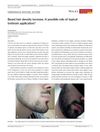
November 2016 in “Dermatologic Therapy” Topical tretinoin may increase beard hair density.
 9 citations
,
February 2016 in “The Journal of Dermatology”
9 citations
,
February 2016 in “The Journal of Dermatology” This letter provides no study results about minoxidil 3% lotion for beard enhancement but instead shares author and affiliation details for the published research.
 10 citations
,
February 2016 in “Anais Brasileiros de Dermatologia”
10 citations
,
February 2016 in “Anais Brasileiros de Dermatologia” This case report describes a 5-year-old child in Brazil who developed generalized hypertrichosis after using topical minoxidil, suggesting caution when using it in children.
 May 2015 in “Journal of The American Academy of Dermatology”
 Minoxidil response testing helps predict hair growth success.
 43 citations
,
August 2014 in “Dermatologic Therapy”
43 citations
,
August 2014 in “Dermatologic Therapy” This study confirmed that a sulfotransferase enzyme test can effectively rule out 95.9% of nonresponders to 5% topical minoxidil for treating androgenetic alopecia.
 13 citations
,
November 2013 in “The Journal of Dermatology”
13 citations
,
November 2013 in “The Journal of Dermatology” This study suggests that minoxidil 2% lotion is a safe and effective treatment for enhancing eyebrows, showing better results than placebo after 16 weeks.
 37 citations
,
January 2013 in “Postepy Dermatologii I Alergologii”
37 citations
,
January 2013 in “Postepy Dermatologii I Alergologii” This article discusses isotretinoin for severe acne vulgaris, noting its effectiveness but also highlighting significant side effects on skin, mucous membranes, and hair; it reports no new clinical results.
 17 citations
,
May 2012 in “Journal of dermatology”
17 citations
,
May 2012 in “Journal of dermatology” This letter to the editor compares the efficacy and safety of bimatoprost 0.03% with minoxidil 3% for eyebrow enhancement but does not report any study results.
9 citations
,
January 2007 in “Journal of dermatological treatment” This study found that applying 2.5% testosterone gel increased facial terminal hairs in young males with beta-thalassemia major and was well tolerated.
 41 citations
,
January 2007 in “Journal of Korean Medical Science”
41 citations
,
January 2007 in “Journal of Korean Medical Science” This study found that combining minoxidil with all-trans retinoic acid additively promoted hair growth in vitro by activating certain cell survival pathways and reducing apoptosis markers more effectively than minoxidil alone.
 32 citations
,
January 2007 in “Biological & Pharmaceutical Bulletin”
32 citations
,
January 2007 in “Biological & Pharmaceutical Bulletin” This study found that combining minoxidil and retinol additively promoted hair growth in vitro, enhancing Erk- and Akt-dependent pathways and preventing apoptosis in dermal papilla cells and keratinocytes.
 149 citations
,
March 2004 in “Journal of Dermatological Science”
149 citations
,
March 2004 in “Journal of Dermatological Science” This study found that minoxidil stimulates hair follicle growth by promoting dermal papilla cell survival and activating ERK and Akt pathways, which leads to increased proliferation and reduced cell death.
51 citations
,
November 1998 in “The journal of investigative dermatology/Journal of investigative dermatology” In this study, researchers found that while both beard and scalp dermal papilla cells release similar autocrine growth factors, only beard cells increased production and response with testosterone, suggesting these factors enhance androgen-induced hair growth.
 192 citations
,
March 1998 in “British Journal of Dermatology”
192 citations
,
March 1998 in “British Journal of Dermatology” This study found that minoxidil significantly increases VEGF mRNA and protein expression in dermal papilla cells, suggesting a role in enhancing hair follicle vascularization in androgenetic alopecia.
25 citations
,
July 1994 in “Journal of dermatological science” This study observed that testosterone metabolism and androgen receptor localization differ significantly across body sites, with beard hair follicles showing distinct characteristics compared to occipital scalp hair follicles.
15 citations
,
July 1993 in “The journal of investigative dermatology/Journal of investigative dermatology” In a C3H mouse model, this study found that topical retinoids can significantly alter hair-cycle dynamics by prolonging the anagen phase and shortening the telogen phase, a reaction connected to increased cellular retinoic acid-binding protein levels.
11 citations
,
July 1993 in “The journal of investigative dermatology/Journal of investigative dermatology”  166 citations
,
November 1990 in “Journal of Investigative Dermatology”
166 citations
,
November 1990 in “Journal of Investigative Dermatology” Minoxidil sulfate stimulates hair growth.
 30 citations
,
April 1990 in “Clinical Pharmacology & Therapeutics”
30 citations
,
April 1990 in “Clinical Pharmacology & Therapeutics” This study found that coadministering minoxidil with tretinoin cream increased minoxidil absorption nearly threefold in healthy males, attributed to increased stratum corneum permeability.
73 citations
,
October 1986 in “Journal of the American Academy of Dermatology” This study found that a combination of topical tretinoin and 0.5% minoxidil resulted in terminal hair regrowth in 66% of subjects with androgenetic alopecia over one year.