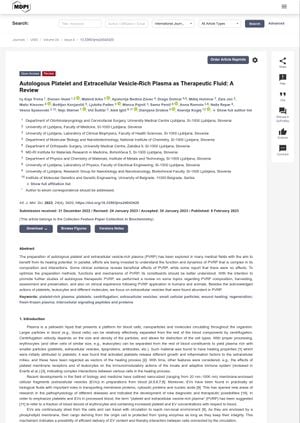
Autologous Platelet and Extracellular Vesicle-Rich Plasma as Therapeutic Fluid: A Review

    Kaja Troha, Domen Vozel, Matevž Arko, Apolonija Bedina Zavec, Drago Dolinar, Matej Hočevar, Zala Jan, Matic Kisovec, Boštjan Kocjančič, Ljubiša Pađen, Manca Pajnič, Samo Penič, Anna Romolo, Neža Repar, Vesna Spasovski, Nejc Steiner, Vid Šuštar, Aleš Iglič, Damjana Drobne, Ksenija Kogej, Saba Battelino, Veronika Kralj-Iglič
    Image of study
    TLDR Autologous Platelet and Extracellular Vesicle-Rich Plasma (PVRP) has potential in enhancing tissue regeneration and improving hair conditions, but its effectiveness varies due to individual differences.
    The review discusses the therapeutic potential of Autologous Platelet and Extracellular Vesicle-Rich Plasma (PVRP), a complex substance used in various medical fields. PVRP contains bioactive molecules like growth factors, amino acids, hormones, and more, which are involved in healing mechanisms. Extracellular vesicles (EVs), small particles shed from activated platelets, play a crucial role in cellular signaling and mediate communication between cells. The effectiveness of PVRP treatment varies due to differences in patients' plasma composition, influenced by factors such as age, sex, diet, and physical activity. PVRP has shown potential in enhancing tissue regeneration in various medical fields, including maxillofacial surgery, dermatology, ophthalmology, and more. In the treatment of alopecia, PVRP has been found to significantly improve hair density, hair count, hair shedding, and hair diameter in patients with mild conditions. However, more randomized comparative studies are needed to confirm these findings. The review emphasizes the need for individual consideration of PVRP products in clinical use due to the complexity of interactions influencing PVRP composition.

    Discuss this study in the Community →

    Research cited in this study

    13 / 13 results

    Related Community Posts Join

    6 / 602 results

      community New and Interesting HairLoss Studies/Papers/Reviews

      in Treatment  43 upvotes 6 years ago
      Hair loss treatments discussed include Dutasteride with Ketoconazole, tissue engineering strategies, and androgenetic alopecia therapies. Massage doubles follicular retention, improving treatment effectiveness.

      community Hey med experts explain this please??

      in Research/Science  8 upvotes 6 months ago
      Finasteride, dutasteride, saw palmetto, caffeine, spironolactone, acetyltetrapeptides, tea tree oil, hydrocortisone, zinc pyrithione, latanoprost, melatonin, marine protein supplements, PRP, microneedling, and valproate are discussed as treatments for hair loss. DHT reduction and inflammation control are key strategies.

      community For those who switched from finasteride to Dutasteride !

      in Chat  43 upvotes 2 years ago
      People discussed switching from finasteride to dutasteride for hair loss treatment. They reported satisfaction with dutasteride, noting it was more effective than finasteride, particularly after finasteride's effects diminished, and some experienced additional benefits like cost savings and stabilized hair loss, rating dutasteride highly as a treatment.

      community Experience with hair transplant or additional mechanisms for hairline

      in Transplants  1 upvotes 10 months ago
      A 27-year-old male is using a minoxidil and finasteride spray for hairline recession and is considering other treatments like oral minoxidil, exosomes, PRP, or a hair transplant. Suggestions include microneedling, possibly with tretinoin, while another user suggests the hairline is fine and mentions body dysmorphia.

    Similar Research

    5 / 1000+ results