 26 citations
,
December 2002 in “International Journal of Dermatology”
26 citations
,
December 2002 in “International Journal of Dermatology” This study found that in Korea, nonbald individuals perceive balding men as older and less attractive, with women more likely than nonbald men to view them as less attractive.
 174 citations
,
November 2002 in “Expert Reviews in Molecular Medicine”
174 citations
,
November 2002 in “Expert Reviews in Molecular Medicine” This review discusses the genetic factors contributing to androgenetic alopecia and highlights the potential for developing more effective therapies based on recent discoveries, but reports no new clinical results.
 233 citations
,
November 2002 in “The journal of investigative dermatology/Journal of investigative dermatology”
233 citations
,
November 2002 in “The journal of investigative dermatology/Journal of investigative dermatology” This review explores androgen metabolism in the skin, highlighting enzyme localization and potential implications for treating androgen-dependent skin conditions, but it reports no new clinical results.
12 citations
,
August 2002 in “Archives of Dermatology”  116 citations
,
September 2001 in “Journal of The American Academy of Dermatology”
116 citations
,
September 2001 in “Journal of The American Academy of Dermatology” This study suggests that miniaturization in pattern hair loss may occur abruptly and can be reversed with treatment, as supported by histologic evidence in finasteride-responsive patients.
299 citations
,
March 2001 in “Journal of Investigative Dermatology” This study found that specific genetic markers near the androgen receptor gene are significantly more common in men with male pattern baldness, suggesting a genetic component in its development.
 50 citations
,
March 2001 in “Clinics in Dermatology”
50 citations
,
March 2001 in “Clinics in Dermatology” Genes and hormones cause hair loss, with four genes contributing equally.
231 citations
,
December 1999 in “Journal of Investigative Dermatology” This study found that the volume of a hair follicle's dermal papilla is strongly correlated with its size, primarily due to the number of cells it contains and the volume of extracellular matrix.
 100 citations
,
September 1999 in “British Journal of Dermatology”
100 citations
,
September 1999 in “British Journal of Dermatology” This study suggests that finasteride's effect on promoting hair growth in men with androgenetic alopecia may be due to its inhibition of 5aR2 localized in hair follicles.
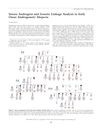 32 citations
,
August 1999 in “Journal of Investigative Dermatology”
32 citations
,
August 1999 in “Journal of Investigative Dermatology” This study found that individuals with early onset extensive androgenetic alopecia have an elevated ratio of DHT to testosterone, but no significant genetic linkage to markers on chromosomes 2 or 5 was detected.
51 citations
,
November 1998 in “The journal of investigative dermatology/Journal of investigative dermatology” In this study, researchers found that while both beard and scalp dermal papilla cells release similar autocrine growth factors, only beard cells increased production and response with testosterone, suggesting these factors enhance androgen-induced hair growth.
 179 citations
,
September 1998 in “BMJ”
179 citations
,
September 1998 in “BMJ” This article reviews the pathogenesis, genetic basis, and recent treatment breakthroughs for androgenetic alopecia but reports no new clinical findings.
169 citations
,
June 1998 in “Journal of Investigative Dermatology” This study found no significant genetic association between the 5α-reductase enzyme genes and male pattern baldness, suggesting a polygenic etiology rather than simple inheritance.
 25 citations
,
January 1998 in “Dermatology”
25 citations
,
January 1998 in “Dermatology” Male pattern hair loss negatively affects quality of life, but drug treatments can help.
 11 citations
,
September 1997 in “Archives of Dermatology”
11 citations
,
September 1997 in “Archives of Dermatology” Reduced androgens linked to kinky hair disorder and hair loss; 5a-reductase inhibitors may help.
 416 citations
,
September 1997 in “Journal of Investigative Dermatology”
416 citations
,
September 1997 in “Journal of Investigative Dermatology” People with hair loss have more androgen receptors and enzymes in certain follicles, with men and women showing different patterns.
 19 citations
,
October 1996 in “Dermatologic Clinics”
19 citations
,
October 1996 in “Dermatologic Clinics” This review discusses using cultured dermal papilla cells to investigate hair follicle biology, emphasizing their potential to inform treatments, but reports no new clinical results.
 143 citations
,
October 1996 in “Dermatologic Clinics”
143 citations
,
October 1996 in “Dermatologic Clinics” Too much androgen can cause hair loss; finasteride may help.
173 citations
,
July 1995 in “Biochemical and biophysical research communications” This study suggests that IGF-I may mediate androgen-induced hair growth in outer root sheath cells cocultured with beard dermal papilla cells.
 192 citations
,
June 1992 in “Journal of The American Academy of Dermatology”
192 citations
,
June 1992 in “Journal of The American Academy of Dermatology” Hair loss can cause low self-esteem, anxiety, and depression in men.
124 citations
,
April 1992 in “Journal of Endocrinology/Journal of endocrinology” This study observed that cells from androgen-sensitive areas like the beard and scrotum showed higher androgen receptor levels compared to those from non-balding scalp areas, supporting the role of dermal papilla in follicle growth responses to androgens.
143 citations
,
October 1988 in “Clinics in Dermatology” This review discusses the histopathology of male-pattern baldness and highlights ongoing disputes over several aspects, including sebaceous gland size and follicle loss, reporting no new clinical findings.
203 citations
,
November 1984 in “Journal of the American Academy of Dermatology” This study presents evidence suggesting that androgenetic alopecia is most likely inherited through a polygenic model, challenging the traditional view that it is caused by a simple Mendelian autosomal dominant gene.