418 citations
,
January 2018 in “Journal of Investigative Dermatology” This study identified at least four distinct fibroblast populations in adult human skin, each with unique functional properties, suggesting potential therapeutic applications for wound healing and fibrosis-related diseases.
 115 citations
,
December 2017 in “Wiley Interdisciplinary Reviews-Developmental Biology”
115 citations
,
December 2017 in “Wiley Interdisciplinary Reviews-Developmental Biology” This review discusses the origins, differentiation, and function of dermal fibroblasts in skin development and healing, reporting no new clinical results.
 21 citations
,
June 2016 in “Genesis”
21 citations
,
June 2016 in “Genesis” This study identified a gene expression signature in mouse embryonic dermal fibroblasts that depends on Wnt/β-catenin activity, potentially influencing dermal fibroblast identity and function.
 87 citations
,
January 2016 in “Development”
87 citations
,
January 2016 in “Development” This study suggests that the postnatal loss of hair follicle formation in wounds may be due to elevated Wnt/β-catenin activation in the dermis, affecting fibroblast function in mice.
 218 citations
,
May 2014 in “Experimental Dermatology”
218 citations
,
May 2014 in “Experimental Dermatology” This review explores the evolution and development of skin-associated adipose tissue and proposes new nomenclature for the cells and adipose tissue underlying the reticular dermis, without reporting clinical results.
1235 citations
,
December 2013 in “Nature” This study found that skin fibroblasts in mice arise from two distinct lineages which contribute differently to dermal structure and repair, impacting hair follicle formation during wound healing.
31 citations
,
September 2012 in “Journal of biological chemistry/The Journal of biological chemistry” This study found that proper levels of retinoic acid, controlled by the enzyme Cyp26b1, are essential for normal hair follicle development and morphogenesis in mice.
 207 citations
,
March 2012 in “Development”
207 citations
,
March 2012 in “Development” In this mouse study, researchers found that dermal Wnt signaling/β-catenin activity is essential for fibroblast proliferation and initiating hair follicle formation by interacting with epidermal Wnt ligands.
338 citations
,
July 2009 in “Development” This study demonstrates that Sox2-positive dermal papilla cells specify particular hair follicle types by showing heterogeneity in gene expression and pathway activation in these cells.
 759 citations
,
February 2009 in “Current Biology”
759 citations
,
February 2009 in “Current Biology” This review summarizes fundamental concepts and recent advancements in hair follicle biology, including insights from mouse models into broader molecular and cellular processes relevant to regeneration and development.
 829 citations
,
May 2007 in “Nature”
829 citations
,
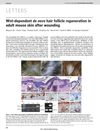
May 2007 in “Nature” Hair follicles can regrow in wounded adult mouse skin using a process like embryo development.
92 citations
,
November 2006 in “Proceedings of the National Academy of Sciences of the United States of America” This study found that transgenic mice overexpressing the BMP antagonist noggin showed increased hair follicle size and altered hair type, linked to changes in cell proliferation and gene expression.
 176 citations
,
January 2003 in “Journal of Investigative Dermatology”
176 citations
,
January 2003 in “Journal of Investigative Dermatology” This review summarizes the roles of bone morphogenetic proteins in the development and regulation of normal and diseased skin, but it does not provide new clinical results.
 211 citations
,
October 2001 in “The FASEB Journal”
211 citations
,
October 2001 in “The FASEB Journal” This study found that the BMP antagonist noggin induces hair growth in postnatal skin by neutralizing BMP4's inhibitory activity, potentially mediated by changes in Shh expression.
745 citations
,
February 1992 in “Trends in genetics” This article describes the potential role of various growth factors and molecules in regulating mammalian hair follicle development but does not present new experimental results.