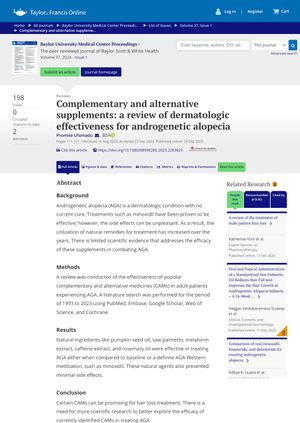
April 2023 in “International Journal of Dermatology” This article reviews existing studies on the use of oils, including castor, pumpkin, lavender, peppermint, rosemary, and tea tree oils, for treating androgenetic alopecia, highlighting the need for more research in humans, particularly within the Black community.
 1 citations
,
February 2023 in “International Journal of Molecular Sciences”
1 citations
,
February 2023 in “International Journal of Molecular Sciences” This review discusses various therapeutic roles of melatonin, particularly its antioxidant and sleep-regulating properties, for skin and scalp conditions, and reports no new clinical results.
 11 citations
,
November 2022 in “JAMA dermatology”
11 citations
,
November 2022 in “JAMA dermatology” This review suggests that certain nutritional supplements may have a potential role in improving hair loss, though evidence quality varies, and such treatments should be discussed collaboratively between physicians and patients.
 7 citations
,
July 2022 in “Pharmaceuticals”
7 citations
,
July 2022 in “Pharmaceuticals” This study reports that pumpkin seed oil-loaded niosomes significantly decreased hair loss and increased hair growth indicators in vivo, suggesting potential as a natural anti-hair loss therapy.
 2 citations
,
January 2022 in “Dermatologic Therapy”
2 citations
,
January 2022 in “Dermatologic Therapy” Natural products like saw palmetto, caffeine, melatonin, marine extracts, rosemary oil, procyanidin, pumpkin seed oil, and cannabidiol oil could potentially treat male hair loss.
 4 citations
,
February 2021 in “Journal of Cosmetic Dermatology”
4 citations
,
February 2021 in “Journal of Cosmetic Dermatology” This study found that pumpkin seed oil significantly improved hair parameters in females with pattern hair loss, demonstrating potential as a treatment comparable to minoxidil 5% foam.
 8 citations
,
January 2020 in “Skin appendage disorders”
8 citations
,
January 2020 in “Skin appendage disorders” This review found that supplements containing saw palmetto may improve hair quality and density in patients with androgenetic alopecia and telogen effluvium, but more large-scale RCTs are needed for conclusive evidence.
 8 citations
,
January 2020 in “Skin Pharmacology and Physiology”
8 citations
,
January 2020 in “Skin Pharmacology and Physiology” This article discusses the potential for topical caffeine as a natural alternative for treating androgenetic alopecia due to its ability to penetrate skin, but it reports no new clinical findings.
 40 citations
,
August 2018 in “Skin appendage disorders”
40 citations
,
August 2018 in “Skin appendage disorders” This review examines complementary and alternative medicine for alopecia and finds limited support from robust clinical trials, highlighting the need for standardized studies to evaluate efficacy and safety.
 21 citations
,
May 2016 in “The Cochrane library”
21 citations
,
May 2016 in “The Cochrane library” This review found that while topical minoxidil is effective for treating female pattern hair loss, finasteride showed no more effectiveness than placebo, and low-level laser therapy increased hair count but with inconsistent results.
 26 citations
,
September 2015 in “Journal of The American Academy of Dermatology”
26 citations
,
September 2015 in “Journal of The American Academy of Dermatology” In this study, spironolactone was reported to stabilize or improve female pattern hair loss in 74.3% of treated women, especially those with signs of hyperandrogenism.
 32 citations
,
August 2015 in “Anais Brasileiros de Dermatologia”
32 citations
,
August 2015 in “Anais Brasileiros de Dermatologia” This review discusses the side effects and diseases related to hairstyles and hair treatments among black women, highlighting the need for thorough examination by dermatologists, but reports no new clinical results.
 91 citations
,
August 2015 in “Anais Brasileiros De Dermatologia”
91 citations
,
August 2015 in “Anais Brasileiros De Dermatologia” This review discusses the clinical, epidemiological, and pathophysiological aspects of female pattern hair loss, reporting no new research findings.
 18 citations
,
May 2015 in “Australasian Journal of Dermatology”
18 citations
,
May 2015 in “Australasian Journal of Dermatology” This study found that topical application of Serenoa repens extract increased hair count in men with androgenetic alopecia, suggesting it could be an alternative for those unable to use standard medications.
160 citations
,
April 2014 in “Drug discovery today” This review discusses the mechanism of action of melatonin in various disorders and suggests its potential for designing new receptor ligands, but reports no new clinical findings.
 36 citations
,
January 2014 in “Evidence-based Complementary and Alternative Medicine”
36 citations
,
January 2014 in “Evidence-based Complementary and Alternative Medicine” This study found that men with androgenetic alopecia treated with pumpkin seed oil for 24 weeks experienced a notable 40% increase in hair count compared to a 10% increase with a placebo.
 22 citations
,
January 2013 in “International Journal of Trichology”
22 citations
,
January 2013 in “International Journal of Trichology” Hair loss is often linked to thyroid problems, especially in women and older people, and screening for thyroid issues is advised for those with hair loss.
 51 citations
,
October 2012 in “International Journal of Immunopathology and Pharmacology”
51 citations
,
October 2012 in “International Journal of Immunopathology and Pharmacology” In this study, 68% of patients treated with finasteride showed improved hair growth in male androgenetic alopecia, compared to 38% with Serenoa repens, indicating finasteride's superior efficacy.
 39 citations
,
January 2012 in “International Journal of Trichology”
39 citations
,
January 2012 in “International Journal of Trichology” This study found that topical melatonin solution was associated with positive effects on hair density and reduction in hair loss for androgenetic alopecia, with good tolerability reported in several clinical trials.
28 citations
,
January 2009 in “Journal of Cutaneous and Aesthetic Surgery” This article discusses Serenoa repens for androgenetic alopecia and reports no strong evidence of its effectiveness, emphasizing the need for larger clinical trials.
 78 citations
,
February 2004 in “British Journal of Dermatology”
78 citations
,
February 2004 in “British Journal of Dermatology” This article reviews the potential impact of melatonin on hair growth, noting its benefits observed in animals, but reports no clinical results in humans to date.
 68 citations
,
April 2002 in “Journal of Alternative and Complementary Medicine”
68 citations
,
April 2002 in “Journal of Alternative and Complementary Medicine” This study suggests that botanical 5AR inhibitors like Serenoa repens and β-sitosterol may improve symptoms of androgenetic alopecia, with 60% of treated subjects showing improvement compared to placebo.
 226 citations
,
September 2001 in “Journal of The American Academy of Dermatology”
226 citations
,
September 2001 in “Journal of The American Academy of Dermatology” Hair loss in women is genetic, diagnosed by examination and biopsy, and treated with minoxidil, finasteride, or transplantation.
 122 citations
,
November 1998 in “Archives of Dermatology”
122 citations
,
November 1998 in “Archives of Dermatology” This study found that aromatherapy involving essential oils significantly improved symptoms of alopecia areata compared to carrier oils alone in a randomized controlled trial.