 26 citations
,
October 2020 in “Pediatric Dermatology”
26 citations
,
October 2020 in “Pediatric Dermatology” This study found that oral tofacitinib led to clinically significant improvement in alopecia areata severity scores among pre-adolescents, though results varied and further evaluation in clinical trials is needed.
 26 citations
,
October 2016 in “Case Reports in Dermatology”
26 citations
,
October 2016 in “Case Reports in Dermatology” In this study, tofacitinib treatment in a male patient with alopecia areata led to significant hair regrowth and improvement in nail dystrophy symptoms, restoring finger function within 10 months.
 23 citations
,
September 2019 in “Journal of The American Academy of Dermatology”
23 citations
,
September 2019 in “Journal of The American Academy of Dermatology” In this retrospective analysis, combination therapy with tofacitinib and oral minoxidil led to significant scalp hair regrowth in patients with severe alopecia areata, with 67% achieving at least 75% regrowth, although the small sample size limits the findings.
 17 citations
,
January 2019 in “Dermatologic Therapy”
17 citations
,
January 2019 in “Dermatologic Therapy” The article in Dermatologic Therapy discusses clinical experiences with using tofacitinib to treat alopecia areata in 63 patients, but no specific results are reported in the abstract.
 16 citations
,
July 2017 in “Rheumatology and Therapy”
16 citations
,
July 2017 in “Rheumatology and Therapy” This review examines the outcomes of treating Brazilian patients with alopecia universalis using tofacitinib and highlights the need for randomized controlled trials to determine optimal dosing and duration.
 16 citations
,
January 2017 in “Acta dermatovenerologica Alpina, Pannonica et Adriatica (Tiskana izd.)”
16 citations
,
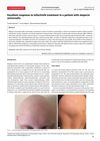
January 2017 in “Acta dermatovenerologica Alpina, Pannonica et Adriatica (Tiskana izd.)” This case study reports that a 23-year-old woman with alopecia universalis experienced complete hair regrowth after six months of treatment with tofacitinib, a JAK-3 inhibitor.
 15 citations
,
November 2020 in “Pharmaceutics”
15 citations
,
November 2020 in “Pharmaceutics” In this ex vivo and mouse model study, Tofacitinib-loaded nanoparticles demonstrated enhanced delivery of the drug into hair follicles and reduced inflammatory effects compared to conventional forms, indicating potential for safer, topical use in treating alopecia areata.
 11 citations
,
November 2019 in “Clinical Case Reports”
11 citations
,
November 2019 in “Clinical Case Reports” This study highlights that while there are no FDA- or ANVISA-approved treatments for children with alopecia areata, JAK inhibitors are emerging as a promising therapeutic option for this population.
 11 citations
,
November 2018 in “Journal of the American Academy of Dermatology”
11 citations
,
November 2018 in “Journal of the American Academy of Dermatology” This study found that among patients with alopecia areata treated with the JAK inhibitor tofacitinib, 34% achieved complete regrowth of eyebrows and 39% achieved complete regrowth of eyelashes, highlighting differences in treatment responses across hair-bearing sites.
 9 citations
,
May 2021 in “International Journal of Dermatology”
9 citations
,
May 2021 in “International Journal of Dermatology” In this study, sublingual tofacitinib achieved a longer estimated half-life than oral administration in treatment-resistant alopecia areata patients, potentially supporting daily dosing; overall treatment response was modest.
 9 citations
,
April 2018 in “Journal of Dermatological Treatment”
9 citations
,
April 2018 in “Journal of Dermatological Treatment” This study found that oral tofacitinib monotherapy improved nail changes in 73.3% of adults with moderate-to-severe alopecia areata over a median period of 5 months, but nail improvement was not linked to the severity of hair loss or hair regrowth.
 2 citations
,
April 2024 in “Dermatology Practical & Conceptual”
2 citations
,
April 2024 in “Dermatology Practical & Conceptual” This study found that Janus Kinase inhibitors, tofacitinib and baricitinib, showed effectiveness and safety in treating severe alopecia areata in a real-world setting, with optimal tolerability noted in younger individuals.
 2 citations
,
October 2018 in “Archives of Dermatological Research”
2 citations
,
October 2018 in “Archives of Dermatological Research” The researchers reported that topical tofacitinib in mice increased hair follicles in the growth phase and boosted noggin and BMP4 mRNA expressions, compared to a vehicle and minoxidil.
 1 citations
,
January 2023 in “Research Square (Research Square)”
1 citations
,
January 2023 in “Research Square (Research Square)” In this report, a 61-year-old woman with vitiligo showed significant improvement after tofacitinib treatment but developed lung adenocarcinoma, highlighting potential cancer risks associated with JAK inhibitors.
 1 citations
,
October 2020 in “Journal of Cosmetic Dermatology”
1 citations
,
October 2020 in “Journal of Cosmetic Dermatology” This study presents a case of treatment-resistant alopecia universalis that successfully responded to a combination of tofacitinib and oral minoxidil, highlighting a potential therapeutic approach for challenging cases of alopecia areata.
 March 2026 in “Journal of Pakistan Association of Dermatologists”
 In this quasi-experimental study, 24-week tofacitinib treatment significantly improved hair regrowth in South Asian patients with alopecia areata, but a high relapse rate post-withdrawal signals the need for continuous treatment strategies.
 January 2026 in “Frontiers in Public Health”
 This study observed distinct post-marketing safety signal patterns for baricitinib and tofacitinib in adult AA, influenced by their differing regulatory uses and real-world contexts, and emphasizes the need for future studies to validate these findings.

In this six-year study of a Saudi cohort, oral tofacitinib showed favorable long-term effectiveness for patients with AA, with manageable adverse events requiring regular monitoring.
 November 2025 in “Clinical Cosmetic and Investigational Dermatology”
 This study evaluated the efficacy and safety of tofacitinib for treating severe alopecia areata in five patients, finding that three responded favorably with mild side effects, supporting its potential use based on existing research.
 June 2025 in “International Journal of Science and Research (IJSR)”
 This study found that oral tofacitinib at a 5mg twice daily dosage was effective in treating recalcitrant alopecia areata, showing significant improvement in hair regrowth and a 27% reduction in SALT scores over six months, with minimal side effects among the 19 patients monitored.
 January 2025 in “International Journal of Dermatology Venereology and Leprosy Sciences”
 This study found that oral tofacitinib significantly reduced alopecia severity and improved quality of life over 12 months for children with moderate to severe alopecia areata, though the authors recommend more research due to the small sample size and absence of a control group.
 March 2024 in “Clinical, cosmetic and investigational dermatology”
 In this report, a patient with vitiligo and systemic lupus erythematosus achieved complete skin repigmentation after 30 days of treatment with the oral JAK inhibitor tofacitinib, with no adverse reactions, suggesting its efficacy and safety as a potential treatment for vitiligo with coexisting autoimmune conditions.
 June 2020 in “Journal of Investigative Dermatology”
 This study observed that insurance coverage for oral tofacitinib in alopecia areata patients was difficult to obtain, with 71% of patients ultimately not receiving approval despite the drug's efficacy as an off-label treatment.
 11 citations
,
January 2018 in “Acta dermato-venereologica”
11 citations
,
January 2018 in “Acta dermato-venereologica” In this study, oral tofacitinib showed higher efficacy and tolerability in treating refractory alopecia totalis and universalis compared to traditional treatments, achieving a 50% improvement in severity scores for 44.4% of patients over six months, with fewer adverse effects.
13 citations
,
February 2017 in “Clinical rheumatology” This report suggests that tofacitinib may be beneficial for patients with nail disease unresponsive to other treatments.
 11 citations
,
January 2020 in “Dermatologica Sinica”
11 citations
,
January 2020 in “Dermatologica Sinica” This study found that tofacitinib effectively promoted hair regrowth in Asian patients with severe alopecia areata, with 74.3% showing a clinical response.
8 citations
,
January 2017 in “Dermatology online journal” This case study reports that tofacitinib led to remission of psoriasis but did not improve alopecia universalis in one patient, suggesting varied responses in treating such conditions.
 October 2025 in “International Journal of Risk & Safety in Medicine”
 In this case study, a 5-year-old girl with alopecia areata and atopic dermatitis that were unresponsive to previous treatments achieved substantial improvement with long-term tofacitinib, highlighting its potential safety and efficacy in managing both conditions concurrently.
 June 2024 in “Indian Dermatology Online Journal”
 In this study, 40% of alopecia areata patients using topical 2% tofacitinib ointment achieved greater than 50% improvement in hair regrowth after six months, showing significant efficacy compared to controls, with no serious adverse effects reported.
 159 citations
,
October 2015 in “Science Advances”
159 citations
,
October 2015 in “Science Advances” This study observed that applying JAK-STAT pathway inhibitors to mouse and human skin led to rapid hair growth by inducing the anagen phase of hair follicles.