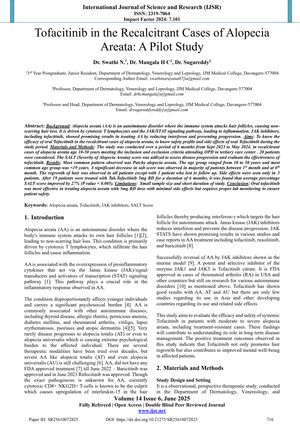
This case report presented the successful treatment of a patient with alopecia universalis using tofacitinib.
 January 2021 in “International journal of dermatology, venereology and leprosy sciences”
 This study found that, among 100 patients with alopecia areata, the most prevalent subtype was patchy alopecia areata, with characteristic trichoscopic features including black dots, yellow dots, and empty hair follicles.
 4 citations
,
July 2018 in “PubMed”
4 citations
,
July 2018 in “PubMed” This study reports significant hair regrowth in 11 patients with severe alopecia areata following longstanding treatment with oral tofacitinib and also highlights successful treatment using topical tofacitinib cream in one case.
 16 citations
,
January 2017 in “Acta dermatovenerologica Alpina, Pannonica et Adriatica (Tiskana izd.)”
16 citations
,
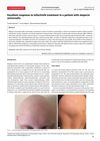
January 2017 in “Acta dermatovenerologica Alpina, Pannonica et Adriatica (Tiskana izd.)” This case study reports that a 23-year-old woman with alopecia universalis experienced complete hair regrowth after six months of treatment with tofacitinib, a JAK-3 inhibitor.
 November 2016 in “대한피부과학회지”
 This study found that trichoscopy is effective for diagnosing androgenetic alopecia and alopecia areata, and it can also be used to assess the severity of androgenetic alopecia.
 5 citations
,
June 2015 in “Veterinary dermatology”
5 citations
,
June 2015 in “Veterinary dermatology” This case report describes a canine with alopecia areata universalis treated with oral ciclosporin, which was associated with hair regrowth, but some areas remained hairless after 17 months.
 14 citations
,
January 2011 in “International Journal of Trichology”
14 citations
,
January 2011 in “International Journal of Trichology” This study reports that combination therapy with oral steroids, anthralin, and minoxidil yielded effective cosmetic responses in 80% of patients with treatment-resistant extensive alopecia areata.