 3 citations
,
March 2020 in “Dermatology Research and Practice”
3 citations
,
March 2020 in “Dermatology Research and Practice” In this study, 33 overweight women with normal hormone levels but showing PCOS symptoms experienced substantial reductions in acne lesions and improvements in hirsutism and menstrual irregularities after 8 weeks of Tracnil™ treatment, with minimal adverse reactions reported.
 21 citations
,
July 2014 in “Clinics in Dermatology”
21 citations
,
July 2014 in “Clinics in Dermatology” This review examines the role of hormones in acne pathogenesis, the use of hormonal therapies for treatment, and the importance of contraceptive counseling during isotretinoin therapy, but reports no new clinical results.
1 citations
,
January 2024 in “Arab Board Medical Journal” This study found that tofacitinib was an effective and well-tolerated treatment for alopecia areata, with significant to moderate hair regrowth in 78% of patients observed.
21 citations
,
October 2022 in “International Journal of Molecular Sciences” This study found that quercitrin, a natural compound, enhances Wnt/β-catenin signaling and may help mitigate synapse loss and memory impairment in Alzheimer's models.
 April 2018 in “Journal of Investigative Dermatology”
 In this study, topical tofacitinib significantly promoted hair regrowth in mice, outpacing both minoxidil and controls over 21 days, with findings suggesting increased VEGF levels and decreased inflammation as possible mechanisms.
June 2026 in “International Journal of Innovative Technologies in Social Science” This review highlights the broad range of adverse effects associated with isotretinoin in acne treatment and examines strategies such as dietary supplementation and adjusted dosing protocols to enhance patient tolerability while maintaining efficacy.
 January 2025 in “ARC Journal of Clinical Case Reports”
 This case report suggests that using encapsulated retinol in polylysine may effectively treat actinic keratosis with minimal irritation, potentially providing a safer alternative for frequent use.
In this study, introducing the rat OTC gene into spf-ash mice led to increased OTC activity and normalized hair growth and biochemical markers like urinary orotic acid and serum citrulline, partially correcting the symptoms of OTC deficiency.
 1 citations
,
January 2017 in “Organic chemistry”
1 citations
,
January 2017 in “Organic chemistry” This article reviews the traditional uses and documented properties of Tridax procumbens in medicine but reports no original research findings, emphasizing its potential therapeutic applications.
 15 citations
,
November 2020 in “Pharmaceutics”
15 citations
,
November 2020 in “Pharmaceutics” In this ex vivo and mouse model study, Tofacitinib-loaded nanoparticles demonstrated enhanced delivery of the drug into hair follicles and reduced inflammatory effects compared to conventional forms, indicating potential for safer, topical use in treating alopecia areata.
 June 2024 in “Indian Dermatology Online Journal”
 In this study, 40% of alopecia areata patients using topical 2% tofacitinib ointment achieved greater than 50% improvement in hair regrowth after six months, showing significant efficacy compared to controls, with no serious adverse effects reported.
 September 2021 in “Han'gug mi'saengmul saengmyeong gong haghoeji/Han-guk misaengmul saengmyeong gonghak hoeji”
 This study found that an ethanolic extract from the microalga Tetrathelmis tetrathele exhibited anti-inflammatory effects, promoted the proliferation of certain skin and hair cells, and inhibited 5α-reductase activity, suggesting its potential as a therapeutic agent for preventing alopecia and enhancing scalp health.
 1 citations
,
September 2022 in “TURKDERM”
1 citations
,
September 2022 in “TURKDERM” This study found that using isotretinoin and acitretin was not linked to a higher risk or severity of COVID-19 in patients undergoing systemic retinoid therapy.
15 citations
,
February 2014 in “Toxicology Letters” This study found that osthole, a coumarin derivative, demonstrated significantly higher skin accumulation and potential skin irritation compared to coumarin, which showed negligible alterations in protein biomarkers.
 3 citations
,
March 2019 in “Journal of Pigmentary Disorders”
3 citations
,
March 2019 in “Journal of Pigmentary Disorders” This presentation highlighted future directions in acne care, emphasizing the roles of topical and oral antibiotics, as well as skin microbiome studies. It also described how clascoterone targets androgen receptors in hair follicles and sebaceous glands to reduce sebum production.
9 citations
,
October 1957 in “A M A Archives of Dermatology” In this study, carotene injected into the skin was converted into vitamin A by sebaceous gland cells, where it was not normally detectable.
11 citations
,
April 1997 in “International Journal of Dermatology” This article discusses using topical tretinoin with intralesional triamcinolone acetonide for alopecia areata in northern Saudi Arabia, but it reports no new clinical findings.
 13 citations
,
July 2019 in “Journal of Biochemical and Molecular Toxicology”
13 citations
,
July 2019 in “Journal of Biochemical and Molecular Toxicology” In this study on rat dermal papilla cells, hydroxytyrosol, an antioxidant found in olive oil, was reported to protect against oxidative stress, reduce inflammation, and enhance hair growth factors, suggesting its potential to prevent hair loss.
 February 2024 in “Trends in Sciences”
 This study examined the stability of two 5α-reductase inhibitors in Tectona grandis extracts, finding that they are more stable in acidic environments and degrade rapidly under heat and light unless protected, suggesting the need for careful storage when developing anti-hair loss medications.
 October 2024 in “Asian Journal of Pharmaceutical and Clinical Research”
 This study at Gajra Raja Medical College found that topical methotrexate with tretinoin was more effective but not significantly better than betamethasone with tretinoin for treating alopecia areata over six months, with similar safety profiles between the treatments.
 January 2025 in “Advanced Materials Interfaces”
 This study observed that tannic acid significantly reduced hair shedding by 56.2% over seven days in human participants when used as a coating for controlled release of active compounds to hair follicles.
43 citations
,
January 2016 in “Oxidative medicine and cellular longevity” This review discusses the biological effects and mechanisms of THSG in antiaging and related disease treatments but reports no new experimental findings.
26 citations
,
July 2006 in “International Journal of Cosmetic Science” This study found that taurine uptake by isolated human hair follicles promoted hair survival and protected against TGF-β1-induced damage in an in vitro setting.
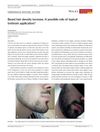 4 citations
,
November 2016 in “Dermatologic Therapy”
4 citations
,
November 2016 in “Dermatologic Therapy” Topical tretinoin may increase beard hair density.
 April 2024 in “Jurnal Agroindustri Halal/Jurnal agroindustri halal”
 This study investigated formulations of hair tonic using Hormophysa triquetra seaweed and candlenut extract, finding that the variant with the highest seaweed extract content demonstrated superior physical stability and rapid hair growth in test animals due to its antioxidant properties.
 30 citations
,
October 2015 in “Journal of Ethnopharmacology”
30 citations
,
October 2015 in “Journal of Ethnopharmacology” This study identified several compounds from traditional Chinese medicines that may inhibit prostaglandin D2 synthase, potentially providing promising candidates for treating androgenic alopecia with minimal adverse skin reactions.
69 citations
,
March 2016 in “American journal of clinical dermatology” Topical retinoids effectively improve photodamaged skin.
 May 2017 in “Journal of The American Academy of Dermatology”
 An intact skin barrier is crucial to prevent infection in cases of tether-induced tenosynovitis.
January 2015 in “Annual Research & Review in Biology” This review explores the potential of phytotherapeutic molecules and oxidative inhibitors as novel anticancer and chemopreventive agents, reporting no new clinical results while suggesting their promise in drug development.
 June 2017 in “Journal of The American Academy of Dermatology”
 Tapinarof cream at 1% concentration is effective and better tolerated for treating atopic dermatitis than the 2% concentration.