48 citations
,
March 2010 in “PloS one” This study found that the co-ablation of C/EBPalpha and C/EBPbeta in adult mouse skin disrupted sebocyte differentiation and epidermal homeostasis, highlighting their critical roles in these processes.
 48 citations
,
May 2008 in “Drug Discovery Today: Disease Mechanisms”
48 citations
,
May 2008 in “Drug Discovery Today: Disease Mechanisms” This review discusses recent advancements in understanding hair follicles, their disorders, and potential therapeutic opportunities, but it reports no new clinical findings.
48 citations
,
March 2007 in “The journal of investigative dermatology/Journal of investigative dermatology” This study observed that retinoic acid biosynthesis and signaling in hair follicles have a spatial and temporal regulation linked to distinct stages of the hair cycle in mice.
48 citations
,
July 1993 in “Archives of Dermatological Research” Merkel cells are abundant in facial vellus hair follicles, especially during the anagen phase.
47 citations
,
April 2021 in “BMC Medical Genomics” This systematic review and meta-analysis reported potential risk variants for acne in genes related to inflammation and sebaceous gland function, including TNF, CYP17A1, and FST, across diverse populations.
 47 citations
,
January 2015 in “Dermatology”
47 citations
,
January 2015 in “Dermatology” This review revisits mechanisms underlying acne lesion formation and suggests that preventing comedone development requires controlling critical factors in the pilosebaceous follicle before acne involvement.
 47 citations
,
April 2003 in “Journal of dermatological science”
47 citations
,
April 2003 in “Journal of dermatological science” This study showed that Thujae occidentalis semen extract inhibited 5alpha-reductase type 2 in laboratory tests and reduced androgen-related hair loss in animal models, suggesting potential use for male pattern baldness.
47 citations
,
January 1998 in “Molecular Carcinogenesis” This study observed that targeted expression of the neu oncogene in transgenic mice led to significant epidermal hyperplasia and a carcinoma-like appearance, suggesting a crucial role for erbB2 signaling in epidermal proliferation and carcinogenesis.
 46 citations
,
May 2018 in “The journal of investigative dermatology/Journal of investigative dermatology”
46 citations
,
May 2018 in “The journal of investigative dermatology/Journal of investigative dermatology” This study found that the vitamin D receptor is essential for the self-renewal, migration, and differentiation of epidermal stem cells during skin wound healing in mice.
 46 citations
,
June 2015 in “Journal of Investigative Dermatology”
46 citations
,
June 2015 in “Journal of Investigative Dermatology” This study found that androgen receptor activation in adult mouse skin reduces β-catenin-induced hair follicle growth and sebaceous gland conversion, highlighting its role in stem cell fate decisions.
46 citations
,
November 1998 in “Experimental Cell Research” This study found that K15 is variably expressed in sheep and mouse hair follicles, with specific patterns suggesting a role in the early stages of keratinocyte differentiation.
46 citations
,
April 1982 in “Journal of the American Academy of Dermatology” This study found that subcutaneous isotretinoin in male hamsters reduced sebaceous gland size without affecting other androgen-dependent skin structures, while etretinate had no effect.
45 citations
,
September 2000 in “Archives of dermatology” This study found that 5alpha-reductase type 1 localizes specifically to sebaceous glands in both normal and acne follicles, suggesting its role in sebum regulation.
45 citations
,
August 1954 in “Experimental Biology and Medicine” This study found that vitamin A dissolved in alcohol penetrates skin quickly and does not impair hair growth, even in large doses, but it does not retard keratinization unlike when dissolved in fatty acids.
 44 citations
,
December 1991 in “Annals of the New York Academy of Sciences”
44 citations
,
December 1991 in “Annals of the New York Academy of Sciences” This study observed that epidermal growth factor and fibroblast growth factor have distinct roles in sheep skin, with EGF involved in differentiation and FGF in bulb proliferation and fiber growth.
 43 citations
,
January 2012 in “Biological Research”
43 citations
,
January 2012 in “Biological Research” This review discusses the embryonic origins and characteristics of various stem cell populations in the skin, but it provides no new experimental results.
43 citations
,
April 2010 in “Developmental Biology” In this study, researchers observed that the sebaceous gland niche in mice allows for Wnt-induced hair follicle differentiation, unlike the non-permissive bulge.
 43 citations
,
December 2008 in “Molecular biology of the cell”
43 citations
,
December 2008 in “Molecular biology of the cell” This study found that disrupting Smad4 signaling in young mice led to overactivation of follicle stem cells, causing hyperplasia and depletion of the stem cell niche.
 43 citations
,
August 2008 in “Regenerative Medicine”
43 citations
,
August 2008 in “Regenerative Medicine” In this study, murine follicular cell aggregates developed into hair-like structures in culture, which upon implantation into mice skin matured into complete hair follicles, suggesting potential for treating hair loss.
 41 citations
,
July 2015 in “Clinical and Experimental Dermatology”
41 citations
,
July 2015 in “Clinical and Experimental Dermatology” This review explores the connection between psoriasis and hair loss, noting that both the disease and its treatments can contribute to alopecia, and reports no new clinical results.
 41 citations
,
June 2013 in “PLOS ONE”
41 citations
,
June 2013 in “PLOS ONE” This study demonstrated that engineered skin substitutes using human keratinocytes and murine dermal papilla cells can develop pigmented hairs without sebaceous glands, suggesting separate pathways for hair development and eruption.
 41 citations
,
October 2008 in “The American journal of pathology”
41 citations
,
October 2008 in “The American journal of pathology” This study found that reducing BMP signaling in mouse nipple epithelia, achieved through Noggin overexpression, can convert them into hairy skin with pilosebaceous units.
41 citations
,
September 2003 in “Journal of Investigative Dermatology” This study suggests that the COX-2 enzyme plays a role in hair follicle biology, as transgenic overexpression in mice induced hair follicle cycling disturbances and alopecia, which was mitigated by COX-2 inhibition.
 40 citations
,
January 2016 in “Elsevier eBooks”
40 citations
,
January 2016 in “Elsevier eBooks” This article explains the structure and multifunctional roles of the human skin, including its protective, regulatory, and sensory functions, but does not report new research findings.
 40 citations
,
May 2012 in “British Journal of Dermatology”
40 citations
,
May 2012 in “British Journal of Dermatology” This study reviewed scalp biopsies from African-American patients, identifying distinct features and diagnostic clues for scarring alopecia types such as traction alopecia and central centrifugal cicatricial alopecia.
40 citations
,
April 1995 in “Journal of Cutaneous Pathology” This study found that androgen receptor expression varied across different types of skin appendage tumors, with specific expression patterns noted in sebaceous and sweat gland tumors but absent in hair follicle tumors.
39 citations
,
March 2022 in “Nature Protocols” This study describes a protocol for generating hair-bearing skin organoids from human pluripotent stem cells, achieving full complexity resembling fetal skin tissue by day 130 in vitro.
39 citations
,
June 2018 in “Burns” This study found that the spiny mouse can regenerate tissues such as skeletal muscle, dermis, and hair without scarring after full thickness thermal burns, unlike the lab mouse.
 39 citations
,
January 2016 in “PubMed”
39 citations
,
January 2016 in “PubMed” This review discusses the role of epidermal differentiation complex genes and epigenetic mechanisms in skin development and certain diseases, emphasizing their potential for improving drug development and delivery systems but provides no new experimental results.
 39 citations
,
July 2015 in “British Journal of Dermatology”
39 citations
,
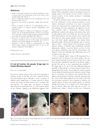
July 2015 in “British Journal of Dermatology” This article discusses the pseudo 'fringe sign' in frontal fibrosing alopecia, highlighting that it is not solely related to traction, and it reports no new clinical results.