 May 2025 in “International Journal Of Science Technology & Management”
 This study focused on developing a pomade called "Hyung Hair" made from rambutan leaf extract, which showed potential benefits such as reducing hair loss and slowing gray hair growth, with a feasibility analysis indicating the business's viability.
April 2026 in “Biomedical and Biotechnology Research Journal (BBRJ)” In this study, researchers observed that using microtube-based forced aggregation, human hair follicle dermal papilla cells formed stable, compact spheroids at higher cell densities, showing enhanced expression of specific markers compared to 2D culture.
 63 citations
,
November 2009 in “British journal of dermatology/British journal of dermatology, Supplement”
63 citations
,
November 2009 in “British journal of dermatology/British journal of dermatology, Supplement” This study found that the subtilisin protease Sub3 from Microsporum canis is essential for adherence to the feline epidermis but is not necessary for invading epidermal structures.
 125 citations
,
May 2007 in “Journal of The American Academy of Dermatology”
125 citations
,
May 2007 in “Journal of The American Academy of Dermatology” This study describes the development of the BASP classification system, providing a universal and systematic approach for classifying pattern hair loss in both men and women.
October 2024 in “Jurnal Pharmascience” This study concluded that formulations of celery and candlenut extracts meet the necessary criteria for use as a spray preparation aimed at promoting hair growth, based on evaluations of physical properties and consistency.
 30 citations
,
March 2019 in “Archives animal breeding/Archiv für Tierzucht”
30 citations
,
March 2019 in “Archives animal breeding/Archiv für Tierzucht” In this study, variation in the KRTAP15-1 gene in goats was linked to changes in cashmere fibre diameter, with specific variants showing dominant or recessive effects.
July 2026 in “Journal of the American Academy of Dermatology”  8 citations
,
January 2013 in “International Journal of Trichology”
8 citations
,
January 2013 in “International Journal of Trichology” This study found that the BASP classification is an effective and easily remembered method for diagnosing and treating male and female pattern hair loss in the Indian population.
 1 citations
,
July 2024 in “Indian Journal of Case Reports”
1 citations
,
July 2024 in “Indian Journal of Case Reports” This article presents a case study of a 16-year-old male with GAPO syndrome, characterized by growth retardation, alopecia, pseudoanodontia, and optic atrophy, who sought dental treatment for missing teeth.
 98 citations
,
June 2001 in “Journal of biological chemistry/The Journal of biological chemistry”
98 citations
,
June 2001 in “Journal of biological chemistry/The Journal of biological chemistry” This study identified a cluster of genes on chromosome 17 related to hair keratin-associated proteins, including 37 genes forming seven multigene families, localized in the hair shaft's upper cortex.
 1 citations
,
March 2023 in “Frontiers in Cardiovascular Medicine”
1 citations
,
March 2023 in “Frontiers in Cardiovascular Medicine” A specific gene variant is linked to heart disease, increased heart muscle, curly hair, and thick skin on palms and soles.
 13 citations
,
March 2013 in “International Journal of Cosmetic Science”
13 citations
,
March 2013 in “International Journal of Cosmetic Science” This study reports that the tetrapeptide AcSDKP significantly promotes skin and hair health in vitro and ex vivo, suggesting it could be used cosmetically to counteract skin aging and hair loss.
3 citations
,
July 2023 in “Acta Biomaterialia” This study demonstrates that a bioinspired peptide, PepACS, can efficiently and safely perm hair by interacting with keratin's sulfhydryl group without compromising tensile strength, and it shows potential for hair repair and dyeing applications in the hair care industry.

This study analyzed the genetic variations of the KAP20-1 gene in Chinese Tan sheep lambs and found that the G variant was linked to an increased mean fibre curvature in their fine wool fibres, potentially influencing breeding strategies for this wool trait.
 37 citations
,
May 2016 in “Scientific Reports”
37 citations
,
May 2016 in “Scientific Reports” In this study, the researchers found that using a core-shell assembly of adipose-derived stem cells and dermal papilla cells reconstructed hair follicle cellular arrangements more effectively than mixed assemblies, enhancing hair formation in vivo.
July 2026 in “Journal of the American Academy of Dermatology” In this study, Sox13 was identified as a novel marker for early hair follicle development and differentiation in mice, though it appears to be dispensable for overall epidermal and adnexal development.
 January 2022 in “Healthy Tadulako Journal”
 This study found no difference in the physical stability of hair tonic preparations made from sansevieria leaves extract, regardless of whether maceration or soxhletation methods were used.
 16 citations
,
February 2010 in “Journal of the European Academy of Dermatology and Venereology”
16 citations
,
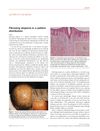
February 2010 in “Journal of the European Academy of Dermatology and Venereology” This article is a letter to the editor about fibrosing alopecia in a pattern distribution and reports no new research findings.
1 citations
,
August 2021 This study found that biomimetic dermal papilla spheres cultured in a specific microenvironment can partially restore hair-inducing ability in high-passage dermal papilla cells in nude mice, resembling the characteristics of primary cells.
 April 2012 in “Informa Healthcare eBooks”
 Fibrosing alopecia in a pattern distribution is a unique hair loss condition with inflammation and scarring, resembling but distinct from common balding.
5 citations
,
July 2024 in “Journal of Microbiology and Biotechnology” This study investigated autophagy activator ICP5249 and found it promotes hair growth by enhancing cell proliferation and autophagy-related markers in human dermal papilla cells and hair follicles, with AMPKα playing a regulatory role, suggesting its potential as a hair growth ingredient.
September 2016 in “Journal of dermatological science” This study found that hair-follicle-associated-pluripotent (HAP) stem cells can be cryopreserved for future use in nerve and spinal cord repair, with human trials being planned.
January 2014 in “China Animal Husbandry & Veterinary Medicine” In this study, researchers observed that the KAP8-1 gene influences skin and hair follicle development and wool quality with varying expression levels in different Ovis aries crossbred varieties.
August 2017 in “Seoul National University Open Repository (Seoul National University)” The study investigated the role of Aminoacyl-tRNA synthetase interacting multifunctional protein 1 (AIMP1) in hair follicle stem cell proliferation and its potential as a treatment for alopecia. AIMP1, when dissociated from the multi-tRNA synthetase complex, was found to be secreted by dermal papilla cells in a sonic hedgehog (Shh) signal-dependent manner. This secretion increased the proliferation of CD34+ hair follicle stem cells by promoting the wnt signaling pathway through inhibition of sFRP1, a known wnt antagonist. The research demonstrated that the N-terminal fragment of AIMP1 could be developed into a therapeutic peptide for hair loss. When applied topically to depilated mice, this peptide significantly accelerated hair growth, especially when formulated with carbomer. The findings highlighted a novel mechanism of AIMP1 action and its potential application in alopecia treatment.
 November 2021 in “bioRxiv (Cold Spring Harbor Laboratory)”
 This study found that 4-aminopyridine, a potassium channel blocker, greatly improves skin wound healing by accelerating wound closure, enhancing tissue regeneration, and promoting hair follicle neogenesis.

In this case-control study, researchers found that serum apelin-12 levels were significantly higher in acne patients and correlated with acne severity, BMI, insulin resistance, and inflammation, suggesting that managing insulin resistance could be important for acne treatment.
September 2012 in “The Thai journal of veterinary medicine” In this case study, apitoxin aquapuncture combined with herbal medicine was reported to have a favorable therapeutic effect in treating canine superficial pyoderma.
January 2015 in “프로그램북(구 초록집)” In this study, researchers found that nearly half of Korean women with female pattern hair loss showed temporal scalp involvement, with a decrease in temporal hair density compared to occipital areas.
52 citations
,
December 2014 in “Journal of Dermatological Science” Apremilast may help treat hair loss in alopecia areata.