19 citations
,
October 2017 in “Dermatologic Surgery” In this study, 755-nm alexandrite laser treatment significantly reduced acne keloidalis nuchae lesions in male patients, improving quality of life and showing low recurrence rates, with temporary hair loss as a reversible complication.
15 citations
,
August 2011 in “Lasers in medical science” This study reported that a single treatment with a short-pulsed 755-nm alexandrite laser effectively treated trichostasis spinulosa in patients with skin types II to V, providing rapid results with minimal pain and no recurrence during a 3-month follow-up.
1 citations
,
November 2023 in “Skin Appendage Disorders” This study found that 308 nm excimer lamp therapy provides a good clinical response with fewer adverse effects for limited alopecia areata but is less effective for widespread hair loss like alopecia totalis.
 April 2024 in “Military Medical Research/Military medical research”
 This review explores the current and experimental therapies for chronic wounds, emphasizing the potential of cellular and immunotherapies in addressing these persistent conditions, but notes a shortage of comprehensive studies on their effectiveness.
December 2016 in “Indonesian Journal of Tropical and Infectious Disease/Indonesian Journal of Tropical an Infectious Disease” In this case report, a two-year-old girl with kerion type of tinea capitis successfully achieved clinical and mycologic cure with double pulse dose terbinafine and 2% ketoconazole shampoo over two months, with excellent tolerability and no side effects.
 92 citations
,
September 2019 in “ACS nano”
92 citations
,
September 2019 in “ACS nano” This study observed that a wearable electric stimulation device significantly promoted hair regeneration in rats and mice, outperforming conventional pharmacological treatments and enhancing growth factor secretion.
 150 citations
,
April 1999 in “Dermatologic Clinics”
150 citations
,
April 1999 in “Dermatologic Clinics” This article reviews the biological and physical principles of laser hair removal and reports that current laser systems do not consistently achieve permanent hair follicle destruction across treated areas.
81 citations
,
January 2000 in “American journal of clinical dermatology” Various treatments can improve post-acne scars, but results vary.
 65 citations
,
March 2016 in “Lasers in Medical Science”
65 citations
,
March 2016 in “Lasers in Medical Science” This review found that many low-level light therapy studies report beneficial effects but often fail to provide adequate measurement details, affecting the reliability and repeatability of the research.
 31 citations
,
April 1999 in “Dermatologic Clinics”
31 citations
,
April 1999 in “Dermatologic Clinics” This article reviews the use of the Nd:YAG laser for hair removal and reports no new research findings.
 29 citations
,
January 1993 in “Dermatologic Clinics”
29 citations
,
January 1993 in “Dermatologic Clinics” This paper reviews diffuse androgen-dependent alopecia and chronic telogen effluvium in women, highlighting diagnostic challenges and management issues, but reports no new clinical findings; the authors suggest effective treatments are available.
27 citations
,
July 2013 in “The journal of investigative dermatology/Journal of investigative dermatology” This narrative review discusses the evolution and diverse medical applications of laser technologies, particularly in dermatology and skin biology, without reporting new research findings.
22 citations
,
January 2020 in “Veterinary dermatology” This review discusses the unique characteristics and taxonomy of Malassezia yeasts and examines current diagnostic and therapeutic approaches in veterinary medicine; it reports no new clinical findings.
21 citations
,
April 2019 in “Journal of cosmetic and laser therapy” This review examines the devices, mechanisms, risks, side effects, and regulatory differences in laser hair removal, particularly highlighting the lack of regulation in South Africa and its implications for patient safety.
 20 citations
,
February 2003 in “Facial Plastic Surgery”
20 citations
,
February 2003 in “Facial Plastic Surgery” This article reviews the classification and treatments of vascular anomalies, such as hemangiomas and vascular malformations, and reports no new clinical results; it emphasizes the importance of managing patient expectations due to treatment limitations.
 5 citations
,
February 2015 in “Dermatologic Surgery”
5 citations
,
February 2015 in “Dermatologic Surgery” Two cases of a rare skin condition were successfully treated with laser therapy, offering a non-surgical treatment option.
5 citations
,
June 2002 in “Clinical and Experimental Dermatology” This presentation reviews the management of alopecia areata, emphasizing treatment challenges and options, but reports no new clinical results.
 4 citations
,
July 1992 in “Clinics in Dermatology”
4 citations
,
July 1992 in “Clinics in Dermatology” Skin surgery has significantly advanced since 1950, with improvements in chemical peels, hair restoration, lasers, and Mohs surgery, and the development of less invasive techniques and specialized training.
 3 citations
,
January 2017 in “Stem Cells International”
3 citations
,
January 2017 in “Stem Cells International” This article highlights the significant challenge that tissue regeneration presents to modern medicine, emphasizing its importance in improving quality of life.
 3 citations
,
March 2008 in “Medical laser application”
3 citations
,
March 2008 in “Medical laser application” This review highlights recent advances in laser treatments for skin disorders, including the optimization of vascular lesion treatment and improved safety for hair removal, but reports no new results.
2 citations
,
December 2024 in “Journal of Photochemistry and Photobiology B Biology” This study suggests that pulsed wave photobiomodulation could be a promising treatment for androgenetic alopecia by enhancing dermal papilla cell function through specific light parameters, particularly frequency.
 2 citations
,
January 2015 in “Case reports in neurological medicine”
2 citations
,
January 2015 in “Case reports in neurological medicine” In this case report, pulsed radiofrequency neuromodulation provided over 80% pain relief for five months in a patient with chronic lesser occipital nerve pain after other treatments failed.
 2 citations
,
August 2020 in “Dermatologic Therapy”
2 citations
,
August 2020 in “Dermatologic Therapy” This study found that increasing energy fluence, session duration, and using pulsed irradiation significantly enhance hair regrowth in androgenetic alopecia when using low-level laser therapy, while the number of diodes does not affect outcomes.
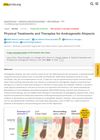
This review discusses various physical therapies for androgenetic alopecia, reporting that low-level laser therapy has the most evidence but highlighting other promising treatments, such as non-ablative lasers and multimodal approaches, that warrant further investigation.
 1 citations
,
January 2018 in “Journal of Cosmetic and Laser Therapy”
1 citations
,
January 2018 in “Journal of Cosmetic and Laser Therapy” The editorial introduces various topics on laser and cosmetic treatments in a medical journal.
1 citations
,
July 2014 in “The journal of investigative dermatology/Journal of investigative dermatology” This review discusses various topics from the 62nd Annual Montagna Symposium on the Biology of Skin, focusing on the diverse effects of light on skin biology, and reports no new clinical results.
1 citations
,
August 1984 in “Therapeutische Umschau. Revue thérapeutique” This article reviews treatments for facial hypertrichosis and hirsutism and reports no new clinical findings; the authors highlight the potential of laser and pulsed flash-light systems for permanent hair removal.
1 citations
,
May 2017 in “Journal of cosmetic and laser therapy” This study found that lasers and light devices may alleviate recalcitrant skin side effects in cancer patients treated with EGFR inhibitors, offering an alternative for those who do not respond to traditional therapies.
July 2025 in “Carolina Digital Repository (University of North Carolina at Chapel Hill)” This review evaluated various physical treatments for androgenetic alopecia and highlighted that low-level laser therapy is well-supported by evidence. However, nonablative laser and multimodal approaches like PEMF-LLLT appear promising and warrant further investigation.
August 2024 in “Journal of Clinical Medicine” This review concludes that low-level laser therapy is the most supported physical treatment for androgenetic alopecia, but other therapies like nonablative laser treatments and combinations including PEMF may also be promising.