 15 citations
,
November 2002 in “Cardiology in Review”
15 citations
,
November 2002 in “Cardiology in Review” This review discusses various adverse skin reactions linked to cardiovascular medications and reports no new clinical results, highlighting the need for vigilance when prescribing these drugs.
 64 citations
,
January 2002 in “American Journal of Clinical Dermatology”
64 citations
,
January 2002 in “American Journal of Clinical Dermatology” This review examines the adverse skin reactions associated with antipsychotic medications and reports no new clinical findings, but suggests discussing management strategies to improve patient compliance.
 44 citations
,
January 2002 in “American Journal of Clinical Dermatology”
44 citations
,
January 2002 in “American Journal of Clinical Dermatology” This review discusses adverse cutaneous drug reactions associated with antidepressants and provides guidance on managing these reactions, but it reports no new clinical findings; the authors recommend cautious use and alternative treatment if reactions occur.
 2 citations
,
May 2017 in “Springer eBooks”
2 citations
,
May 2017 in “Springer eBooks” Pregnancy can cause skin changes and affect existing skin conditions, with limited treatment options due to the need for fetal safety.
 February 2025 in “Physician s Journal of Medicine”
 In this review, researchers highlighted that COVID-19 can cause various skin manifestations like maculopapular rashes and "COVID toes," which often precede or appear without respiratory symptoms, suggesting their potential for early detection and prognostic evaluation, especially in severe cases.
 5 citations
,
April 2021 in “International Journal of Homoeopathic Sciences”
5 citations
,
April 2021 in “International Journal of Homoeopathic Sciences” This article reviews Acne Keloidalis Nuchae and presents a successful treatment case using Homoeopathy, emphasizing the need for individualized treatment approaches, but reports no new clinical results.
 80 citations
,
June 2020 in “Dermatopathology”
80 citations
,
June 2020 in “Dermatopathology” This review discusses the various skin lesions associated with COVID-19, which vary in type and severity, and reports that these lesions can appear before other symptoms and typically resolve spontaneously.
 2 citations
,
January 1998 in “Dermatology”
2 citations
,
January 1998 in “Dermatology” Stopping forehead irritation and using hydrocortisone helped a man's skin, Martinique has lower melanoma rates, a man had an allergy to a specific antifungal, another had unexplained cysts, certain drugs can cause skin reactions without always being interrelated, a link between Fanconi anemia and a skin condition was suggested, high levels of a certain protein may play a role in a type of psoriasis, and there's a need to study the connection between scalp pain and hair loss.
 16 citations
,
July 2013 in “Human & Experimental Toxicology”
16 citations
,
July 2013 in “Human & Experimental Toxicology” This study reports that complementary and alternative medicine is commonly used for dermatological diseases in Eastern Turkey, with 43.7% of patients using at least one method and various unconventional practices observed.
 15 citations
,
September 2018 in “Indian Research Journal of Pharmacy and Science”
15 citations
,
September 2018 in “Indian Research Journal of Pharmacy and Science” This article reviews the historical and therapeutic aspects of aromatherapy, discussing its effects on psychological and physical well-being but providing no new clinical findings.
 18 citations
,
December 1996 in “Seminars in Cutaneous Medicine and Surgery”
18 citations
,
December 1996 in “Seminars in Cutaneous Medicine and Surgery” This article reviews adverse skin reactions caused by chemotherapy and cytokine treatments, describing specific and nonspecific reactions, but reports no new clinical findings.
48 citations
,
November 2022 in “Journal of Cosmetic Dermatology” This review discusses various skin manifestations associated with COVID-19, emphasizing their potential role in early diagnosis and management of the infection, but reports no new clinical findings.
 11 citations
,
September 2021 in “Anais Brasileiros de Dermatologia”
11 citations
,
September 2021 in “Anais Brasileiros de Dermatologia” This article reviews how skin manifestations can aid in diagnosing various systemic diseases, focusing primarily on their association with rheumatologic conditions while also addressing vascular, granulomatous, and other disease impacts, aiming to provide dermatologists with practical diagnostic insights.
 1 citations
,
October 2022 in “Current Dermatology Reports”
1 citations
,
October 2022 in “Current Dermatology Reports” This review discusses various skin reactions after SARS-CoV-2 infection and COVID-19 vaccination, noting a higher incidence with mRNA vaccines than adenovirus vector vaccines, and reports no new clinical results.
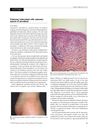 9 citations
,
July 2002 in “Journal of the European Academy of Dermatology and Venereology”
9 citations
,
July 2002 in “Journal of the European Academy of Dermatology and Venereology” This article discusses multiple minute digitate hyperkeratosis in a dermatological context and reports no new clinical findings; the authors focus on a descriptive review.
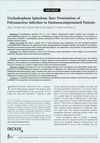 12 citations
,
November 2014 in “Journal of Cutaneous Medicine and Surgery”
12 citations
,
November 2014 in “Journal of Cutaneous Medicine and Surgery” This report describes a case where oral valganciclovir treatment led to improved skin texture and hair regrowth in a patient with trichodysplasia spinulosa.
 9 citations
,
April 1976 in “Archives of Dermatology”
9 citations
,
April 1976 in “Archives of Dermatology” This report observed that two teenagers developed skin issues, including abscess-like pustules, after taking kelp supplements, which cleared when the supplements were discontinued.
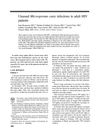 35 citations
,
November 1996 in “Journal of the American Academy of Dermatology”
35 citations
,
November 1996 in “Journal of the American Academy of Dermatology” This study reports two HIV-infected men with a rare M. canis infection unresponsive to ketoconazole and terbinafine, where itraconazole was effective but prolonged treatment led to only one cure.
 191 citations
,
February 2002 in “Archives of Dermatology”
191 citations
,
February 2002 in “Archives of Dermatology” This review discusses herbal therapies for dermatologic disorders, focusing on those with scientific evidence of efficacy and common interactions, but reports no new clinical results.
 2 citations
,
January 2022 in “Boletín médico del Hospital infantil de México/Boletín médico del Hospital Infantil de México”
2 citations
,
January 2022 in “Boletín médico del Hospital infantil de México/Boletín médico del Hospital Infantil de México” This report describes two cases of atypical Malassezia folliculitis in immunosuppressed patients, highlighting diagnostic challenges due to non-classical presentation in non-seborrheic areas.
 2 citations
,
September 2014 in “Journal of evolution of medical and dental sciences”
2 citations
,
September 2014 in “Journal of evolution of medical and dental sciences” In this study, 92% of HIV-infected patients had mucocutaneous manifestations, with oral candidiasis being the most common condition observed.
 November 2023 in “Berkala Ilmu Kesehatan Kulit dan Kelamin/Berkala ilmu kesehatan kulit dan kelamin (Periodical of dermatology and venerology)”
 This study suggests that using a dermoscope, a handheld microscope, can effectively help distinguish between Pityrosporum folliculitis and Acne vulgaris by revealing unique lesion characteristics that are not visible to the naked eye, offering a practical diagnostic alternative when KOH examinations are unavailable.
 47 citations
,
January 2003 in “American Journal of Clinical Dermatology”
47 citations
,
January 2003 in “American Journal of Clinical Dermatology” This article discusses the potential for severe adverse cutaneous drug reactions with mood-stabilizing agents, emphasizing the importance of monitoring and patient communication, but reports no new clinical findings.
 38 citations
,
January 2009 in “Journal of Cutaneous Medicine and Surgery”
38 citations
,
January 2009 in “Journal of Cutaneous Medicine and Surgery” This case report highlights a woman who developed new-onset alopecia areata after starting adalimumab for psoriatic arthritis, challenging the assumed role of TNF-alpha in the condition's pathogenesis.
 15 citations
,
October 1981 in “Archives of internal medicine”
15 citations
,
October 1981 in “Archives of internal medicine” Minoxidil can cause severe skin reactions like Stevens-Johnson syndrome in rare cases.
 1 citations
,
February 2004 in “Journal of The European Academy of Dermatology and Venereology”
1 citations
,
February 2004 in “Journal of The European Academy of Dermatology and Venereology” This paper reports a case of alopecia triangularis congenita in a 22-year-old woman, combined with androgenetic alopecia, and highlights successful treatment with internal and topical antiandrogens.
 April 1963 in “Archives of Dermatology”
 This case study details the progression of a woman's skin conditions, initially diagnosed as acanthosis nigricans and later as mycosis fungoides, with changes in lesion characteristics and distribution over time.
 172 citations
,
November 1983 in “Journal of The American Academy of Dermatology”
172 citations
,
November 1983 in “Journal of The American Academy of Dermatology” This article discusses the cutaneous side effects of various chemotherapeutic agents but reports no new clinical results; the authors emphasize the importance of dermatologists recognizing drug-induced skin reactions to better patient care.
 19 citations
,
June 2007 in “Veterinary Dermatology”
19 citations
,
June 2007 in “Veterinary Dermatology” In this study, amitraz was found to be an effective and well-tolerated treatment for resolving sarcoptic mange in alpacas, demonstrating no relapse over a 10-month follow-up.
 1 citations
,
February 2009 in “Clinical and Experimental Dermatology”
1 citations
,
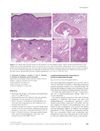
February 2009 in “Clinical and Experimental Dermatology” This study reports an improvement in lymphomatoid papulosis type A in a 52-year-old patient who concurrently used hormone-replacement therapy.