63 citations
,
April 2017 in “Acta psychiatrica Scandinavica” This study observed that higher prenatal androgen loads were associated with more severe alcohol dependence in male patients and linked to behaviors of pregnant women that may influence their children’s androgen exposure.
45 citations
,
January 2010 in “Forensic science international” This review discusses fetal hair follicle development and its importance for determining in utero drug exposure through neonatal hair, but it reports no new clinical results.
 39 citations
,
June 1982 in “The BMJ”
39 citations
,
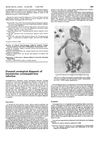
June 1982 in “The BMJ” Blood tests confirmed a baby in the womb had a CMV infection.
 28 citations
,
May 2015 in “Addiction Biology”
28 citations
,
May 2015 in “Addiction Biology” This study found that early life stress significantly affects hedonic sensitivity to high-palatable food by altering gonadal hormones in prenatally-stressed male and female rats, with sex-dependent changes in reward-related behaviors and neurochemistry.
 25 citations
,
June 2012 in “Endocrine”
25 citations
,
June 2012 in “Endocrine” This review discusses emerging concepts in PCOS from the AEPCOS 2010 meeting and reports no clinical findings; it suggests that the transition of care in congenital adrenal hyperplasia could inform PCOS adolescent care.
25 citations
,
May 2004 in “Prenatal Diagnosis” This study suggests that prenatal genetic diagnosis of MELAS syndrome using amniotic cells may not reliably predict fetal outcomes due to phenotypic diversity observed in siblings with similar levels of mutant mtDNA.
 17 citations
,
June 2017 in “Gene”
17 citations
,
June 2017 in “Gene” This is the first report of the FOXN1 p.R255X mutation from India, demonstrating the global spread of this genetic mutation previously found only in an Italian community.
9 citations
,
July 2022 in “International Journal of Molecular Sciences” This study suggests that prenatal exposure to THC may negatively impact ovarian health in rats by altering miRNA expression, potentially leading to reproductive issues such as subfertility or premature reproductive senescence.
5 citations
,
December 2016 in “Microscopy Research and Technique” This study suggests that prenatal infusion of epidermal neural crest stem cells may improve certain neural markers and reduce cortical injury in a mouse model of methylazoxymethanol-induced malformations.
 1 citations
,
December 2025 in “Selçuk tıp dergisi/Selçuk Üniversitesi Tıp Fakültesi dergisi”
1 citations
,
December 2025 in “Selçuk tıp dergisi/Selçuk Üniversitesi Tıp Fakültesi dergisi” In this cross-sectional study, researchers observed that patients with hidradenitis suppurativa, particularly women, had lower 2D:4D finger length ratios compared to healthy controls, suggesting a potential link to prenatal androgen exposure and disease severity, though further prospective research is needed to confirm this hormonal impact.
1 citations
,
October 2015 in “Actas Dermo-Sifiliográficas” October 2025 in “Environment International” This study reports that prenatal and prepubertal exposure to organochlorine compounds and perfluoroalkyl substances may affect pubertal development at age 12, with observed changes in development patterns in both girls and boys, highlighting the need for further research.
 February 2024 in “Psychoneuroendocrinology”
 This study observed that higher anxiety levels in pregnant individuals are negatively correlated with neonatal hair cortisol, suggesting that increased anxiety during pregnancy may affect fetal cortisol accumulation, which is important for fetal development and associated with birth outcomes and cognitive function.
 February 2024 in “Psychoneuroendocrinology”
 In this study, researchers found that higher levels of general and pregnancy-related anxiety during gestation were negatively correlated with neonatal hair cortisol levels, suggesting that increased maternal anxiety may alter fetal cortisol exposure, which is important for fetal development.
January 2019 in “Cell & developmental biology” This study found that using 3D cultures and fetal tissue extracts significantly improved the outcomes of stem cell treatments for regenerative medicine, including hair follicle formation and chronic wound healing.
August 2017 in “Journal of biotechnology” This review found that topical corticosteroids hold the highest level of evidence as a first-line treatment for pediatric alopecia areata, but further trials are needed to explore additional therapies.
 October 2022 in “Amplla Editora eBooks”
 Pre-natal, internal, and external factors may contribute to the development of Autism Spectrum Disorder (ASD).
54 citations
,
March 2012 in “International Journal of Andrology” This study found that prenatal exposure to certain pesticides may lead to earlier breast development in girls, potentially associated with higher androgen levels.
37 citations
,
November 2002 in “Biology of Reproduction” This study found that prenatal antiandrogen treatment in female spotted hyenas significantly altered the LH response to GnRH, indicating partial masculinization of their anterior pituitary gland without affecting ovulatory function.
 5 citations
,
May 2023 in “Science of the total environment”
5 citations
,
May 2023 in “Science of the total environment” This study observed that higher PFAS concentrations during adolescence were linked to later pubertal development and lower estradiol levels in females, but not in males, potentially due to PFAS excretion with menstrual fluid.
 October 2023 in “bioRxiv (Cold Spring Harbor Laboratory)”
 This study constructed a comprehensive atlas of prenatal human skin, revealing that innate immune cells, such as macrophages, play a crucial role in skin morphogenesis by interacting with non-immune cells, influencing hair follicle formation and angiogenesis beyond their traditional immune functions.
 May 2022 in “Frontiers in Cell and Developmental Biology”
 This study identified that in pig embryos, the miR-29a-5p/EDAR/lncRNA627.1 ceRNA complex plays a critical role in inhibiting hair placode precursor cells proliferation and regulating hair placode formation through the suppression of EDAR expression, which may provide insights into similar mechanisms affecting human hair conditions.
 11 citations
,
March 2020 in “Immunology”
11 citations
,
March 2020 in “Immunology” This study reports that immunologically inert and skewed immune cell populations in developing human skin may contribute to wound healing and structural changes during skin development.
11 citations
,
November 2019 in “The FASEB Journal” In this study, a missense mutation in the MAP2 gene was found to be associated with reduced hair follicle density, leading to the hairless phenotype in pigs.
8 citations
,
November 2019 in “Tissue Engineering Part A” In this study, collagen scaffolds functionalized with heparin and growth factors significantly enhanced long-term skin regeneration and growth in a sheep model of fetal skin defect, suggesting potential for prenatal spina bifida treatment.
 3 citations
,
June 2017 in “Environmental health perspectives”
3 citations
,
June 2017 in “Environmental health perspectives” Exposure to certain glycol ethers during pregnancy may be linked to lower verbal comprehension in children.
 1 citations
,
May 2023 in “Frontiers in Endocrinology”
1 citations
,
May 2023 in “Frontiers in Endocrinology” This research suggests that autism's genetic links are partially related to factors influencing physiological sex differences, with rare variants interacting with placental sex differences and common variants affecting steroid-related traits.
January 2020 in “Proyecto de investigación:” This study found a significant association between AGDAC measurements and the presence of PCOS, suggesting it could be an effective clinical tool in diagnosing the condition and its phenotypes, especially when combined with AMH.
August 2015 in “Han'gug dongmul jawon gwahag hoeji/Han-guk dongmul jawon gwahak hoeji/Journal of animal science and technology” This study reported variable expression levels of TRα and CRABPII genes during the prenatal development of cashmere goats, contributing to an understanding of hair follicle formation in these animals.
22 citations
,
April 1967 in “Australian Journal of Zoology” This study describes the stages of hair follicle development and foetal pelage growth in southern elephant seals, highlighting the formation and shedding processes of the first and subsequent hair generations.